Most mobile apps fail not because of the idea, but because of the technology choice behind them.
According to a report by Statista, global mobile app revenue is expected to surpass $700 billion by 2029, driven by increasing demand for high-performance, scalable applications. Yet, a significant number of businesses still struggle at the very first step, choosing the right development approach.
This is where the decision between Native vs Cross-Platform App Development becomes critical.
The approach you choose directly impacts your app’s performance, development cost, scalability, and time-to-market. A wrong decision can lead to slow performance, higher maintenance costs, and limited user experience as your product grows.
While Hybrid app development still exists for simpler use cases, most modern businesses now rely on either Native technologies or Cross-Platform frameworks like Flutter and React Native to build scalable mobile solutions.
As a mobile app development company, we’ve seen how this single decision can define the long-term success or failure of a digital product.
In this guide, we’ll break down Native vs Cross-Platform app development in terms of performance, cost, scalability, and real-world use cases so you can confidently choose the right approach for your business.
What Is Native App Development and How Does It Work?
Building an application specifically for an operating system is called as Native app development approach. It could be either for Android or iOS, using the platform-specific tools, languages, and frameworks.
In Android app development, Kotlin or Java is used with the help of Android Studio (Android Development Environment). For iOS app development, Swift or Objective-C is used with Xcode (Apple’s Official development Environment). The advantages of Native apps are that they are faster, more responsive, more secure, and offer the best device features like GPS, camera, and sensors.
What Are the Pros and Cons of Native App Development?
Native app development is known for delivering the highest level of performance, security, and user experience. However, these advantages also come with higher development costs and longer timelines because separate applications must be built for iOS and Android.
Pros and Cons of Native App Development
| Pros | Cons |
| Superior speed and performance with platform-specific optimization | Higher development cost due to separate codebases |
| Full access to device features like GPS, camera, sensors, and Bluetooth | Longer development timeline for multi-platform apps |
| Smoother UI/UX aligned with iOS and Android guidelines | Requires separate maintenance and updates |
| Better security and app stability | A larger development team may be needed |
| Ideal for high-performance apps like gaming, fintech, and AR/VR | Higher long-term resource investment |
What Is Cross-Platform App Development?
In contrast to the Hybrid approach, the cross-platform app development method leverages a single code base to deliver better usability and native-like performance on both iOS and Android. A cross-platform app development company uses frameworks like Flutter, React Native, and Xamarin because they allow us to write one code base that later on gets converted into Native components.
The frameworks above have distinct code architectures yet provide similar performance to native applications. As an instance, Flutter app development uses the Dart language and a special rendering engine.
What Are the Pros and Cons of Cross-Platform App Development?
Cross-platform app development helps businesses build applications for multiple platforms using a shared codebase. It has become one of the most popular approaches for startups and growing businesses because it reduces development time and costs while still offering near-native performance.
Pros and Cons of Cross-Platform App Development
| Pros | Cons |
| A single codebase reduces development cost and effort | Slightly lower performance in highly complex apps |
| Faster launch across iOS and Android platforms | Some advanced hardware features may require native modules |
| Easier maintenance and simultaneous updates | Large apps can become harder to optimize over time |
| Consistent UI and user experience across devices | Performance may vary depending on the framework used |
| Ideal for MVPs, startups, and scalable business apps | Less platform-specific customization compared to native apps |
Native vs Cross-Platform App Development: Key Differences
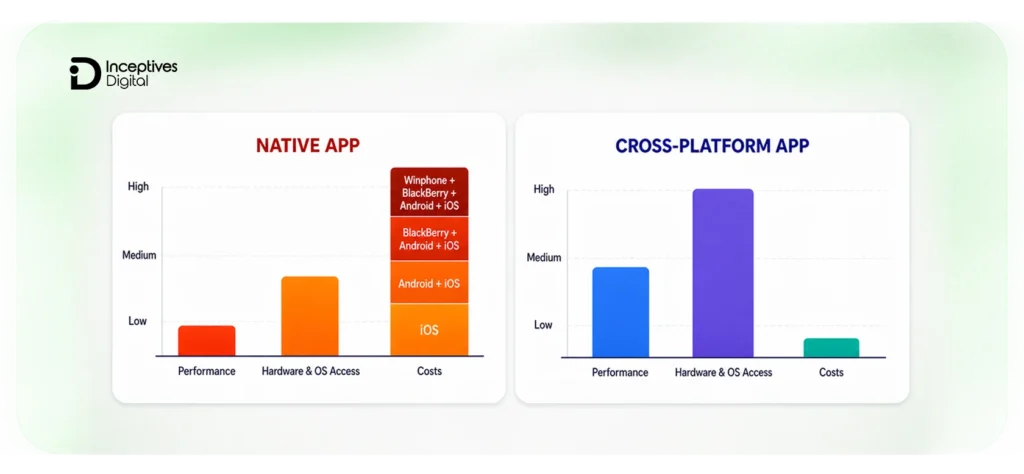
Choosing between Native vs Cross-Platform App Development comes down to how you balance performance, cost, scalability, and speed. Both approaches are widely used in modern mobile app development, but they serve different business needs and technical goals.
Below is a clear comparison to help you understand how they differ in real-world scenarios.
Native vs Cross-Platform App Development Comparison
| Feature | Native App Development | Cross-Platform App Development |
| Performance | Delivers the highest performance because apps are built specifically for a single platform | Offers near-native performance but may have slight overhead in complex applications |
| Development Cost | Higher cost since separate apps are built for iOS and Android | Lower cost due to a single shared codebase |
| Time to Market | Longer development cycle due to separate builds | Faster launch across multiple platforms |
| UI/UX Experience | Provides the best possible user experience aligned with platform guidelines | Consistent UI across platforms, but may not fully match the native feel |
| Maintenance | Requires separate updates for each platform | Easier maintenance with one unified codebase |
| Scalability | Highly scalable for complex, enterprise-level apps | Scales well for most business applications |
| Device Integration | Full access to all device features like GPS, camera, sensors | Limited or indirect access depending on framework capabilities |
What This Means for Your Business
Native app development is best suited for applications that demand maximum performance, security, and deep device integration, such as mobile game development, fintech platforms, or AR/VR solutions.
On the other hand, cross-platform app development is ideal for businesses that want to launch faster, reduce app development costs, and maintain a single codebase across platforms without compromising too much on quality.
This comparison forms the foundation of your decision-making process and will help you understand which approach aligns better with your product goals and budget.
Native vs Cross-Platform App Performance Comparison
Performance plays a major role when choosing between native and cross-platform app development. It affects your app’s speed, responsiveness, animations, and overall user experience.
Native apps generally provide improved performance because they are built specifically for a single platform using technologies like Swift, Kotlin, or Java. Cross-platform apps, on the other hand, use frameworks like Flutter and React Native to deliver near-native performance with a shared codebase.
Performance Comparison Table
| Performance Factor | Native App Development | Cross-Platform App Development |
| Speed & Responsiveness | Excellent | Very Good |
| UI Animations | Smooth and fully optimized | Smooth for most business apps |
| Hardware Access | Full device access | Limited in some advanced cases |
| Memory & Battery Efficiency | Better optimized | Slightly less efficient |
| Complex App Handling | Best for high-performance apps | Suitable for moderate complexity |
| Development Efficiency | Slower due to separate builds | Faster with a shared codebase |
Which Performs Better?
Native app development is the better choice for apps that require high performance, advanced graphics, real-time processing, or deep hardware integration.
Cross-platform development works well for most business apps that prioritize faster development, lower costs, and consistent UI/UX design across iOS and Android.
Native vs Cross-Platform App Development Cost Comparison
Mobile app development cost is one of the biggest deciding factors when choosing between native and cross-platform app development. The total cost depends on factors like app complexity, features, timeline, maintenance, and the number of platforms you want to target.
Native app development is usually more expensive because separate applications are built for iOS and Android. Cross-platform development reduces costs by using a single shared codebase across multiple platforms.
Cost Comparison Table
| Cost Factor | Native App Development | Cross-Platform App Development |
| Initial Development Cost | Higher | Lower |
| Development Team Size | Separate iOS & Android teams | Single development team |
| Maintenance Cost | Higher due to separate updates | Easier and more cost-effective |
| Time to Market | Longer | Faster |
| Scalability Cost | Higher for multi-platform scaling | More budget-friendly |
| Best For | Complex, high-performance apps | Startups, MVPs, and business apps |
Which Is More Cost-Effective?
If your priority is maximum performance and long-term platform optimization, native development is worth the higher investment.
However, if you want to launch quickly while keeping development and maintenance costs under control, cross-platform app development offers a more budget-friendly solution for most modern business applications.
Native vs Cross-Platform App Development Time Comparison
Mobile app development time directly impacts how quickly your app can launch and start generating results. The faster you reach the market, the quicker you can test mobile app ideas, attract users, and scale your product.
Native app development usually takes longer because separate apps are built for iOS and Android. Cross-platform development speeds up the process by using a single shared codebase for multiple platforms.
Development Time Comparison Table
| Factor | Native App Development | Cross-Platform App Development |
| Codebase | Separate for each platform | Single shared codebase |
| Development Speed | Slower | Faster |
| Testing Process | Separate testing for iOS & Android | Unified testing process |
| Feature Updates | Managed separately | Easier simultaneous updates |
| Time to Market | Longer launch cycle | Faster launch across platforms |
Which Approach Launches Faster?
For quick app publishing on the app stores, cross-platform development is usually the better option. It allows businesses to release apps on both iOS and Android in less time while reducing development effort.
Native development is more time-intensive but provides better optimization and flexibility for complex applications that require platform-specific functionality.
Popular Frameworks and Technologies Used in Native and Cross-Platform App Development
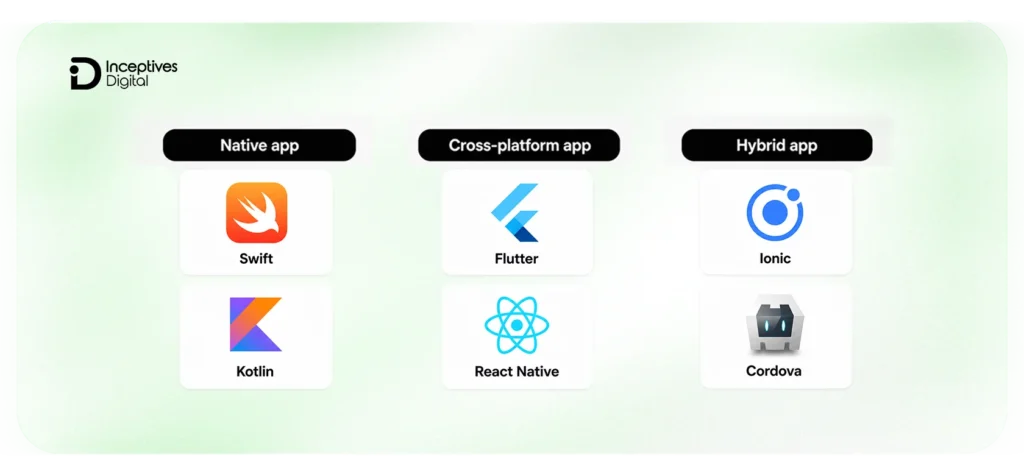
The tools and frameworks used in app development directly impact performance, scalability, development speed, and user experience. Both native and cross-platform development rely on different mobile app tech stacks based on project requirements.
Native app development uses platform-specific languages and tools, while cross-platform development focuses on shared codebases that work across multiple operating systems.
Frameworks and Technologies Comparison
| Development Approach | Popular Technologies | Best Known For |
| Native iOS Development | Swift, Objective-C, Xcode | High performance and smooth iOS experience |
| Native Android Development | Kotlin, Java, Android Studio | Deep Android integration and scalability |
| Cross-Platform Development | Flutter | Fast development with consistent UI |
| Cross-Platform Development | React Native | Shared codebase with near-native performance |
| Cross-Platform Development | Xamarin | Enterprise-grade app development using C# |
Which Technology Should You Choose?
Native technologies like Swift and Kotlin are ideal for applications that require maximum performance, security, and platform-specific functionality.
Cross-platform frameworks like Flutter and React Native are better suited for businesses looking to reduce development time and costs while maintaining a consistent experience across iOS and Android devices.
When Should You Choose Native App Development?
Native app development is the best choice when your application requires high performance, advanced functionality, and the best possible user experience. Since native apps are built specifically for a single platform, they offer better optimization, smoother performance, and deeper access to device features.
Choose Native App Development If:
- Your app requires maximum speed and performance
- You are building a gaming, fintech, or AR/VR application
- Advanced animations and real-time processing are important
- Your app depends heavily on device hardware and APIs
- Security and scalability are top priorities
- You want a fully platform-optimized user experience
Native Development Is Best For
| Use Case | Why Native Works Better |
| Gaming Apps | Handles graphics and processing efficiently |
| Fintech Apps | Offers stronger security and performance |
| AR/VR Applications | Provides deep hardware integration |
| Enterprise Apps | Better long-term scalability and stability |
| Streaming & Real-Time Apps | Faster processing and responsiveness |
If your business prioritizes quality, performance, and long-term scalability over development speed and budget, native app development is usually the better investment.
When Should You Choose Cross-Platform App Development?
Cross-platform app development process is a great option for businesses that want to launch applications faster while keeping development costs under control. By using a single codebase for both iOS and Android, businesses can reduce development effort and simplify maintenance.
Modern frameworks like Flutter and React Native also provide near-native performance for most business applications, making cross-platform development a practical choice for startups and growing companies.
Choose Cross-Platform App Development If:
- You want to launch on iOS and Android quickly
- Your budget is limited
- Faster development and updates are important
- You want a consistent UI across platforms
- You are building an MVP or startup application
- Your app does not require complex hardware-level integrations
Cross-Platform Development Is Best For
| Use Case | Why Cross-Platform Works Better |
| Startup Apps | Faster launch with lower development cost |
| MVP Development | Ideal for testing mobile app ideas quickly |
| E-Commerce Apps | Works well for standard business functionality |
| Booking & Service Apps | Easier maintenance across platforms |
| Content-Based Apps | Consistent user experience with a shared codebase |
If your goal is to balance development speed, cost-efficiency, and scalability, cross-platform app development is often the most practical solution for modern business applications.
Where Hybrid App Development Fits Today
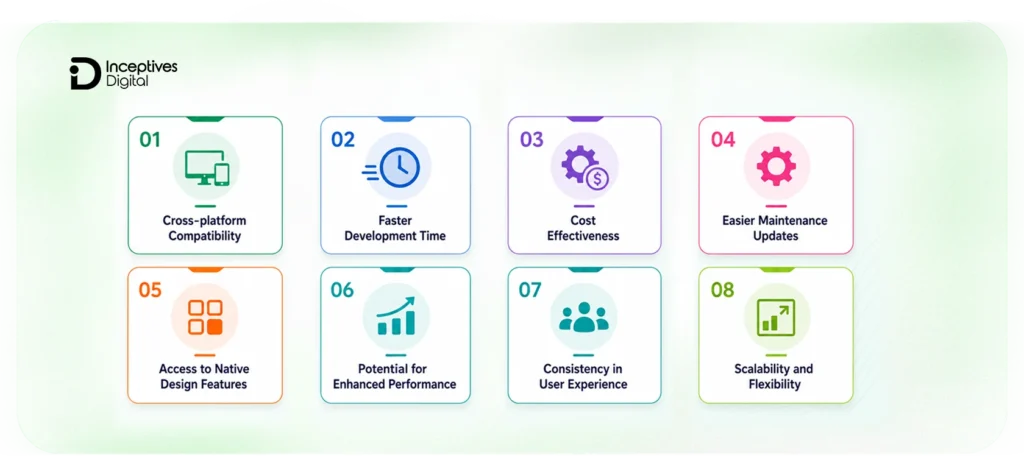
Hybrid app development was once a popular choice for businesses looking to build apps for multiple platforms using web technologies like HTML, CSS, and JavaScript. Frameworks such as Ionic and Apache Cordova made it possible to launch apps faster with a single codebase.
Today, however, cross-platform frameworks like Flutter and React Native have largely replaced hybrid development for many modern applications, offering better performance and a more native-like user experience.
Hybrid App Development Still Makes Sense For:
- Simple content-based applications
- Internal business tools
- Low-budget MVPs
- Apps with minimal hardware interaction
Hybrid vs Cross-Platform Apps
| Factor | Hybrid Apps | Cross-Platform Apps |
| Performance | Moderate | Near-native |
| UI/UX Experience | Web-like feel | More native-like experience |
| Hardware Access | Limited | Better device integration |
| Development Speed | Fast | Fast |
| Best For | Simple apps | Scalable business apps |
While hybrid app development can still work for lightweight applications, most businesses today prefer cross-platform development for better scalability, performance, and long-term flexibility.
How to Choose the Right App Development Approach for Your Business?
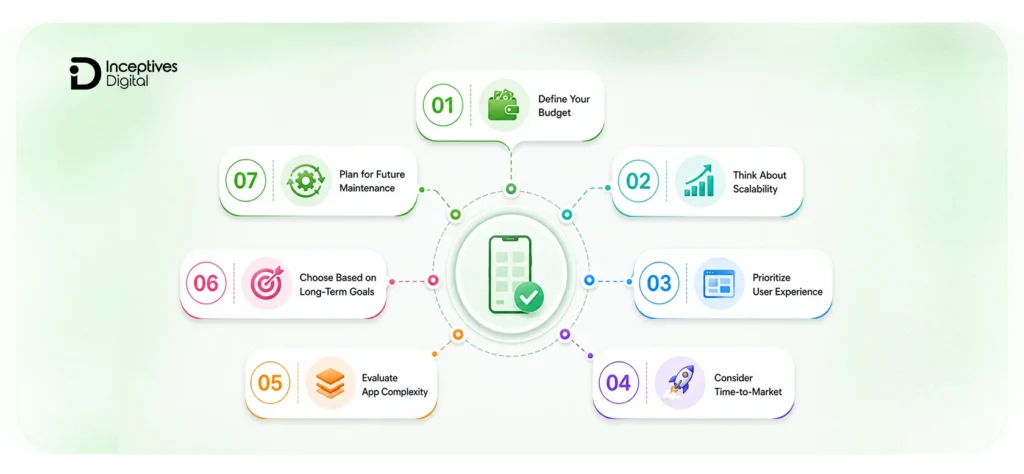
Choosing between native and cross-platform app development depends on your business goals, budget, timeline, and app complexity. There is no one-size-fits-all solution, as each approach is designed for different requirements.
The key is to choose the option that aligns best with your long-term product strategy.
Decision-Making Comparison
| Business Requirement | Recommended Approach |
| High performance and advanced features | Native App Development |
| Faster launch across multiple platforms | Cross-Platform App Development |
| Lower development and maintenance cost | Cross-Platform App Development |
| AR/VR, gaming, or real-time apps | Native App Development |
| MVP or startup application | Cross-Platform App Development |
| Deep hardware and API integration | Native App Development |
| Long-term scalability for complex apps | Native App Development |
Which Option Is Better?
Choose native app development if your priority is performance, security, and a fully optimized user experience.
Choose cross-platform app development if you want faster development, lower costs, and a consistent experience across iOS and Android using a single codebase.
For most modern startups and businesses, cross-platform development offers the best balance between speed, scalability, and cost-efficiency.
Real-World Examples: Who Uses Which App Type and Why?
Understanding how leading firms in each app development approach are using them and achieving highly successful results can help you choose between native, hybrid, and cross-platform app development approaches. Below, we have listed the top companies for every app development method.
Native App Development Examples
1. Instagram(Originally Native)
Instagram was originally a native app that was built to leverage the camera and system features on the device. The native structure creates a better experience and a more consistent experience when working with media, which is important for sharing photos and videos.
2. Spotify
Spotify makes use of native development to deliver better performance for its app and support offline playback. Additionally, its native structure also allows for more complex integrations such as background streaming and advanced caching.
Why Businesses Choose Native:
- Highest speed and performance
- Access to all device hardware and APIs
- Best suited for complex, feature-rich, or graphics-heavy apps
Hybrid App Development Examples
1. Evernote
Evernote employed a mixed strategy at first to create a uniform experience across different platforms. It was greatly beneficial for the team to quickly introduce new features while also controlling the expense of development at an affordable level.
2. Basecamp
Basecamp uses hybrid technology to support its internal project management tools. The approach allows them to maintain web functionality and native accessibility at once.
Why Businesses Choose Hybrid:
- Faster development cycles
- Lower cost for MVPs or internal tools
- Easier updates across iOS and Android
Cross-Platform App Development Examples
1. Alibaba
Alibaba’s team adopted Flutter app development to achieve a consistent UI and high performance across devices. The framework’s single codebase helped them accelerate release cycles while keeping the design uniform.
2. Reflectly
Reflectly is a React Native based app, which means it is built to work on both Android and iOS by using one codebase. This makes updates and maintenance simpler while still providing an intuitive design for the user.
Why Businesses Choose Cross-Platform:
- Faster launch across multiple platforms
- Balanced performance and cost
- Easier maintenance and scaling
The Future of Native, Cross-Platform, and Hybrid Development
As mobile technology evolves, the boundaries between native, hybrid, and cross-platform app development are becoming less distinct. New frameworks and tools are improving performance, security, and scalability across all three approaches — changing how businesses choose their tech stacks.
1. Native Development: Powering Performance-Driven Apps
Native app development will continue to lead in areas demanding high performance and deep hardware integration. With ongoing advancements in Swift, Kotlin, and platform-specific SDKs, mobile app developers can build apps that fully utilize device capabilities like AR, sensors, and advanced camera APIs. Expect native apps to remain dominant in fintech app development, and AR/VR experiences where speed and responsiveness are critical.
2. Cross-Platform Development: The Growing Middle Ground
Cross-platform frameworks are shaping the future of scalable app delivery. Flutter app development and React Native are bridging the performance gap between native and hybrid, providing near-native speed with a single codebase. As these frameworks mature, they’re becoming the go-to option for businesses looking to reduce mobile app development costs without compromising user experience and performance.
3. Hybrid Development: Faster MVPs and Internal Solutions
Hybrid development is finding its niche among businesses seeking rapid prototyping and budget-friendly solutions. With web technologies becoming more powerful and browser APIs improving, hybrid apps are expected to offer smoother performance than before. For startups or enterprises focusing on content delivery, internal tools, or MVP development, hybrid frameworks like Ionic and Cordova will remain practical choices.
4. Integration of Emerging Technologies
Emerging tech will further influence how these approaches evolve. For example:
- Blockchain app development will demand secure, high-performance architectures — favoring native or optimized cross-platform builds.
- AI and machine learning will enhance automation and personalization across all app types.
- 5G and IoT will push developers to build lighter, faster apps that process data in real-time.
5. Convergence Ahead
Over the next few years, the distinction between native, hybrid, and cross-platform apps will continue to blur. Frameworks like Flutter and Kotlin Multiplatform are already blending the best of both worlds — offering native performance with cross-platform flexibility.
Key Takeaway:
The future isn’t about choosing just one approach but understanding how native, hybrid, and cross-platform development can complement different business needs. Companies that stay flexible and leverage the right technology for each project will have a lasting edge in performance, scalability, and innovation.
Final Thoughts on Native vs Cross-Platform App Development
Choosing between Native vs Cross-Platform App Development depends entirely on your project goals, budget, and long-term vision. Native development stands out for its unmatched performance, security, and deep device integration, making it ideal for complex and high-performance applications. On the other hand, cross-platform development offers a faster, more cost-effective way to build and launch apps across multiple platforms while maintaining a consistent user experience. Understanding these differences helps businesses make smarter technical decisions that directly impact scalability and user satisfaction.
If you are planning to build a mobile application and want expert guidance on the right development approach, working with a reliable team can make a significant difference. Whether it’s enterprise solutions, startup MVPs, or even mobile app development services, choosing the right technology stack early ensures better performance, smoother scalability, and long-term success for your product.
CTA SECTION START
cta title: Still Confused About What to Build? Let’s Make It Simple
cta des: Not sure whether to choose native or cross-platform? Get expert guidance and build a scalable, high-performance app tailored to your business goals
cta button: Talk to Our App Experts
CTA SECTION END
FAQs: Native vs Cross-Platform App Development
It depends on your goal. Native apps are better for performance, security, and complex features, while cross-platform apps are better for faster development, lower cost, and multi-platform deployment.
Yes, cross-platform development is often ideal for startups because it reduces development time and cost while allowing you to launch on both iOS and Android using a single codebase.
Modern frameworks like Flutter and React Native offer near-native performance for most applications. However, native apps still perform better in highly complex or graphics-intensive use cases.
You should avoid cross-platform development if your app requires heavy hardware integration, advanced animations, or real-time processing like gaming or AR/VR applications.
Yes, native development is generally more expensive because separate apps are built for iOS and Android, requiring more time, resources, and maintenance effort.
Cross-platform app development is faster because it uses a single codebase for multiple platforms, reducing development and mobile app testing time significantly.
SIDEBAR LIST START
- Native vs Cross-Platform App Development: Which One Should You Choose?
- What Is Native App Development and How Does It Work?
- What Is Cross-Platform App Development?
- Native vs Cross-Platform App Development: Key Differences
- Native vs Cross-Platform App Performance Comparison
- Native vs Cross-Platform App Development Cost Comparison
- Native vs Cross-Platform App Development Time Comparison
- Popular Frameworks and Technologies Used in Native and Cross-Platform App Development
- When Should You Choose Native App Development?
- When Should You Choose Cross-Platform App Development?
- Where Hybrid App Development Fits Today
- How to Choose the Right App Development Approach for Your Business?
- Real-World Examples: Who Uses Which App Type and Why?
- The Future of Native, Cross-Platform, and Hybrid Development
- Final Thoughts on Native vs Cross-Platform App Development
- FAQs: Native vs Cross-Platform App Development
SIDEBAR LIST END