Revenue is what separates a successful app from one that is struggling to survive. An app with 1000 downloads is far better than an app with 10,000 downloads but less revenue. The sole reason is poorly executed monetization strategies.
For most businesses, the traditional pay-to-install monetization strategy is almost irrelevant now. The reason is very clear, as more than 90% of apps are free to download on both the Apple App Store and the Google Play Store collectively.
But it doesn’t mean there is nothing for businesses. In fact, there is still huge revenue potential, achievable through strategic monetization strategies. The global consumer spending on mobile apps is expected to touch $233 billion by 2026.
There are multiple ways to turn your app into a stable revenue-generating engine, like subscription models, in-app purchases, rewarded ads, and hybrid monetization strategies that are currently dominating the market.
But managing both the mobile app development process and post-launch planning is not an easy task. This is why businesses often consider partnering with an experienced mobile app development company to ensure an app with built-in monetization logic in the app’s architecture. Planning for monetization from the very start of the development process maximizes long-term value and retention.
If you want to master the execution of effective mobile app monetization strategies, this guide has all the insights, from real-world examples to avoiding common mistakes, and practical ways to boost your revenue as well as maintain an intuitive user experience.
What Is App Monetization?
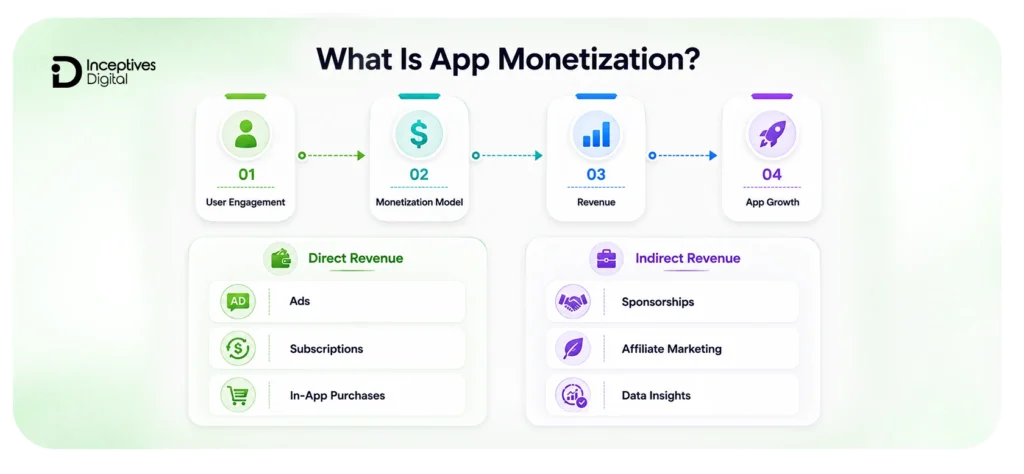
App monetization is the method by which a mobile application is able to generate income. It is the process that converts user participation, the amount of time spent, users’ actions, and the app’s features accessed into measurable mobile app revenue generation.
Straightforwardly, it is the method mobile app development companies make money from their applications without necessarily imposing charges on the users right away. A good monetization strategy is the link between the growth of your mobile app and its revenue, whether it has only a couple of hundred users or millions.
There are multiple ways to do that. Displaying advertisements, providing premium subscriptions, selling in-app products, or partnering with other companies for shared interests are the most frequent methods used.
The fundamental aspect of successful mobile app monetization is to maintain a balance, to provide value to users, and at the same time make your app profitable and scalable.
Here’s how does app monetization works:
- Direct revenue: Ads, subscriptions, and in-app purchases
- Indirect revenue: Sponsorships, affiliate marketing, and data insights
- Goal: Create sustainable income while improving user experience
To sum up, mobile app monetization is not only about making money. It is a matter of creating a business model that will keep your app thriving for a long time.
Why Well-Planned App Monetization Strategies Matter?
The mobile app market has reached an unprecedented level of both competition and profitability. It is forecasted that the total consumer spending on mobile apps worldwide will go over $190 billion, and this will mainly be the result of gaming, entertainment, and subscription services. The dramatic increase in mobile app spending underlines one very straightforward fact: apps that fail to monetize their users effectively are going to lose their market positions, irrespective of the number of downloads they have.
More than 90% of apps are free, so install-based revenue is no longer the method of earning for app development companies. They now depend on innovative and sustainable app monetization ways to bring in continuous revenue. Models of this kind are not only about revenue. But they are the factors behind the operation of apps, their scalability and competitiveness in the fast-moving ecosystem of today. Below are the three major reasons that make effective app monetization a necessity for applications.
1. Evolving User Spending Behavior
There has been a radical change in user habits. Consumers are willing to pay for apps that offer convenience and value, such as streaming, fitness, and productivity platforms. This change in users’ behavior has turned app monetization into a necessity. Nowadays, companies are less concerned with paywalls and more with engagement-based revenue like microtransactions or value-added subscriptions.
2. The Decline of Paid Apps and the Rise of Freemium Models
Paid applications are becoming rare. The users’ primary wish is to have free access first and then to pay for better features or for an ad-free experience. The freemium habit is a major factor in the mobile app industry, and it allows developers to bring in users without the upfront barrier and still get long-term app revenue.
3. How Smart Monetization Boosts User Retention and ROI?
Retention is also a factor that plays a vital role in effective monetization. Users stay longer and spend more when they believe that they are receiving value through exclusive content, personalized offers, or fair pricing. Smart app monetization methods do not disturb the experience; on the contrary, they improve it, thus fostering loyalty among customers and increasing the ROI.
To sum it up, mobile app monetization has become a survival strategy rather than a mere revenue tactic. The apps that excel at this will not only be visible and grow to a larger size faster, but also provide such experiences that both users and businesses will continue to grow.
Proven Mobile App Monetization Strategies
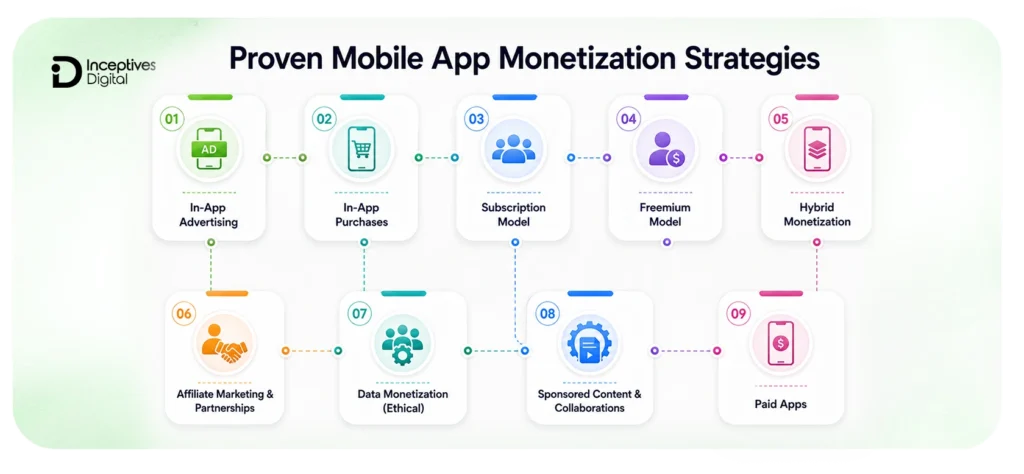
The success of an app is not just the thousands of downloads it has, but also finding a smart way to generate a handsome amount of revenue from it. Below, we have listed the 9 best mobile app monetization strategies that are very common in the mobile app development industry:
1. In-App Advertising
Understanding how to monetize mobile apps with in-app advertising starts with choosing the right ad formats and balance. It still is the most popular method for monetizing free apps. Ads can take several forms:
- Banner ads: Small and non-intrusive.
- Interstitial ads: Full-screen during natural breaks.
- Native ads: Blend with app content.
- Rewarded video ads: Offer in-app rewards for views.
It is advisable to use ad mediation tools and limit the frequency of ads to ensure a good user experience. The gaming applications often use rewarded ads as a technique to keep users engaged and, at the same time, earn extra money from ads.
2. In-App Purchases (IAP)
To understand how to monetize mobile apps with in-app purchases, simply give users the option of purchasing digital products, advanced features, or even subscriptions in the app. This means the app is generating revenue continuously.
Types include:
- Consumables: Coins, lives, or tokens.
- Non-consumables: Permanent unlocks.
- Subscriptions: Recurring payments for premium features.
Mobile games mainly get a boost in conversions through personalized offers and virtual currency.
3. Subscription Model
Many people often ask, “What is the subscription model for apps?” In simple terms, it is a monetization method that generates consistent and recurring income from the app, either monthly or annually. Apps that continuously provide value, like fitness, education, or streaming, are the ones that this model is best suited for.
Applications such as Calm and Duolingo Plus are very successful in using the strategies of giving free trials and having different plans. If you want to retain the users, you have to do regular updates to features and content.
4. Freemium Model
The freemium model first attracts a large user base by giving free access, and then it slowly converts active users to paid plans by offering premium features. That is the simple answer to the common question: What is the freemium model in apps?
Giving examples like Spotify and Canva, free tools can create a bond of trust while exclusive upgrades spur conversions. Keeping a healthy balance between free and paid features will help you engage the users.
5. Hybrid Monetization
A hybrid monetization model incorporates several methods, such as advertisements and in-app purchases, to secure a more diversified income.
This model has the advantage of being adaptable and suits the mobile game development industry perfectly. However, if there are too many monetization layers, it might lead to user fatigue, so the right amount is very important.
6. Affiliate Marketing & Partnerships
Apps can receive a commission via affiliate programs whenever they advertise third-party products or services. This is mainly applicable for travel, finance, or lifestyle apps.
Partnerships should always be disclosed and their relevance checked. For example, a travel app that connects to hotel or flight booking sites earns through referral links while providing users with added value.
7. Data Monetization (Ethical Approach)
Data monetization involves the conversion of anonymized analytics reports and the like into market insights or reports via GDPR and CCPA compliance.
The app can sell the market insights or trend data, but the user privacy compliance and the consent issue are very important in building and maintaining trust.
8. Sponsored Content & Brand Collaborations
The brands that have sponsored partnerships pay for visibility and co-branded campaigns. It is very effective for media, news, or fitness apps.
Think of native sponsorships that really match the brand, like a fitness app development firm working with a sportswear brand for challenges or tutorials.
9. Paid Apps
One question that often arises among app owners is, paid apps vs free-to-download apps, which is better? The answer will vary according to your audience and the business objectives.
Pros and Cons of Popular App Monetization Strategies
| Strategy | Advantages | Challenges |
| In-App Advertising | Easy to implement, scalable revenue | Can negatively affect UX if overused |
| Subscription Model | Predictable recurring revenue | Requires continuous value delivery |
| In-App Purchases | Strong engagement monetization | Works best with active users |
| Freemium Model | Attracts a large user base | Conversion rates can be low |
| Affiliate Marketing | Additional passive revenue | Depends heavily on niche relevance |
| Sponsored Content | High earning potential | Requires strong audience trust |
| Paid Apps | Immediate revenue | Lower download potential |
Paid apps require users to pay an amount rather than a subscription, and can still be applied to niche or B2B tools that users prefer due to their premium quality.
They generate upfront revenue with a premium image but normally have fewer installations. Productivity or design apps frequently adopt this paid app model successfully.
Advanced App Monetization Strategies
Traditional monetization models alone are no longer enough to maximize app revenue. Now, businesses are using advanced monetization strategies powered by AI, personalization, retention systems, and privacy-first experiences to improve customer lifetime value and long-term profitability.
1. AI-Powered Personalized Monetization
Artificial intelligence is transforming how mobile apps generate revenue. Instead of showing the same offers or ads to every user, AI-powered monetization systems analyze user behavior, engagement patterns, and in-app activity to deliver personalized experiences.
For example, a fitness app may recommend different subscription plans based on workout frequency, while a gaming app may offer personalized in-app purchases depending on player progress.
AI-driven monetization helps apps improve:
- conversion rates
- customer lifetime value
- retention
- user satisfaction
It also allows businesses to optimize ad placements, pricing strategies, and subscription offers more effectively.
2. Dynamic Paywalls and Smart Pricing
Traditional fixed pricing models are gradually being replaced by dynamic paywalls that adapt based on user behavior and engagement.
Apps now use factors like:
- session duration
- feature usage
- retention levels
- geographic location
- spending patterns
to display personalized pricing plans and offers.
This strategy is widely used by streaming, productivity, and wellness apps to improve subscription conversions while reducing subscription fatigue through flexible and user-focused pricing.
3. Gamification and Reward-Based Monetization
Gamification is now widely used beyond gaming apps. Many businesses use reward systems, streaks, badges, and engagement challenges to increase user retention and monetization opportunities.
Popular examples include:
- rewarded video ads
- loyalty rewards
- daily streak bonuses
- milestone unlocks
- referral incentives
Apps like Duolingo and TikTok successfully use gamified engagement systems to keep users active longer, which naturally increases ad impressions, subscriptions, and in-app purchases.
4. Privacy-First Monetization Strategies
Privacy-focused updates from Apple and Google have significantly changed mobile advertising. As third-party tracking becomes more restricted, businesses are shifting toward privacy-first monetization models that rely on first-party data and contextual targeting.
Modern apps now focus on:
- transparent data collection
- ethical user consent
- contextual advertising
- first-party behavioral insights
This approach not only helps businesses comply with regulations like GDPR and CCPA but also builds long-term user trust, which plays a major role in app retention and sustainable revenue growth.
How to Choose the Best Mobile App Monetization Model?
One of the most important decisions after the launch of your app is choosing the right app monetization model. There is no universal app monetization strategy that works for every app. What works for one app may not work for others. For example, a strategy that works for a fitness app may not work for a fintech application. You have to determine who your target audience is, their behaviour, and design a custom app monetization strategy that seems natural and profitable.
Key Factors That Influence Monetization Decisions
Here are the factors that can affect your app monetization strategies:
- App Type: There is a possibility that the model applied to a gaming app (such as in-app purchases) may not be appropriate for a finance app, which may get more advantage from the subscription or freemium access method.
- Audience Demographics and Location: Different regions have different spending habits. Like North American users might go for a subscription model, while users in emerging markets could be more inclined towards ad-supported models.
- User Engagement Levels: Highly active users open more opportunities for in-app purchases and ads, while occasional users might respond better to simple, freemium access.
- Platform (Android vs. iOS): iOS applications are more likely to generate bigger payments when it comes to purchases and subscriptions. On the other hand, Android applications usually generate higher revenues through ads.
- Monetization Goals: Choose between fast user growth and steady revenue as your main goal. A freemium or ad-supported income stream can lead to quicker scaling, while subscriptions ensure a stable and long-lasting source of income.
Best App Monetization Models Compared
| Monetization Model | Revenue Potential | Best For | User Experience Impact | Long-Term Scalability |
| In-App Advertising | Medium to High | Free apps with large user bases | Medium | High |
| Subscription Model | High | Fitness, streaming, productivity apps | High if value-driven | Very High |
| In-App Purchases | High | Gaming and social apps | Low to Medium | High |
| Freemium Model | Medium to High | SaaS and productivity apps | High | High |
| Affiliate Marketing | Medium | Travel, finance, and eCommerce apps | Low | Medium |
| Paid Apps | Low to Medium | Niche or premium apps | High | Limited |
| Hybrid Monetization | Very High | High-engagement apps | Medium | Very High |
Why Test, Measure, and Optimize Your App Monetization Model?
There is no single “best app revenue strategy” that applies to all. What is effective for one application may not be the same for another app, even if they are in the same category. It is crucial to implement various models, carry out real-time data analysis, and adapt according to customer feedback and performance metrics.
Constant A/B testing, audience segmentation, and user retention monitoring will assist you in perfecting your app monetization model to get the right mix of profit and user experience.
The 4-Layer Mobile App Monetization Framework
Successful app monetization is not just about displaying ads or adding subscriptions. The most profitable apps build monetization into every stage of the user journey. A structured monetization framework helps businesses balance user experience, engagement, retention, and long-term revenue growth.
Acquisition Monetization
The first stage focuses on attracting users without creating friction. Most apps use free access, freemium models, free trials, or referral incentives to maximize downloads and user acquisition.
At this stage, the main goal is not immediate profit. It is building a large and engaged user base that can later be monetized more effectively.
Common Strategies:
- Freemium access
- Free trials
- Referral rewards
- Onboarding incentives
Engagement Monetization
Once users become active, apps focus on increasing engagement through interactive experiences and retention systems.
This stage often includes:
- Rewarded ads
- Gamification
- Personalized recommendations
- Loyalty rewards
- Limited-time offers
The longer users stay engaged inside the app, the more monetization opportunities the business creates.
Retention Monetization
Retention-focused monetization aims to convert active users into long-term revenue sources. Subscription models, premium content, loyalty systems, and personalized experiences are commonly used to increase customer lifetime value.
Apps that consistently deliver value usually achieve:
- Higher retention
- Stronger recurring revenue
- Lower churn rates
Common Strategies:
- Subscription plans
- Premium memberships
- Loyalty programs
- Personalized content
Expansion Monetization
The final stage focuses on diversifying revenue streams beyond the core monetization model. Businesses expand revenue opportunities through affiliate partnerships, sponsored content, upselling, creator monetization, and cross-platform monetization strategies.
This layer helps mature apps reduce dependency on a single revenue source while increasing long-term profitability.
Common Strategies:
- Affiliate partnerships
- Brand sponsorships
- Premium upgrades
- Cross-selling
- Creator monetization
The most successful mobile apps rarely rely on a single monetization strategy. Instead, they combine multiple monetization layers to support different stages of the user journey while balancing profitability with user experience.
Common App Monetization Mistakes to Avoid
Even well-designed mobile apps can struggle to generate revenue when monetization is poorly implemented. Many businesses focus heavily on downloads and user acquisition but fail to build a monetization strategy that supports long-term profitability and retention.
Below are some of the most common app monetization mistakes businesses should avoid.
1. Overloading the App With Ads
One of the biggest mistakes businesses make is displaying too many ads too early. Excessive advertising disrupts the user experience, increases churn rates, and often reduces long-term engagement.
While ads can generate strong revenue, poorly placed interstitials or repetitive ad experiences can frustrate users and damage retention.
Better Approach:
Use non-intrusive formats like:
- rewarded ads
- native ads
- contextual advertising
These formats monetize engagement without heavily interrupting the user experience.
2. Choosing the Wrong Monetization Model
Not every monetization strategy works for every app category. A subscription model may perform well for a fitness or streaming app, while gaming apps often generate stronger revenue through in-app purchases and rewarded advertising.
Choosing a monetization model without considering user behavior, engagement patterns, or audience expectations can significantly reduce profitability.
Better Approach:
Select monetization models based on:
- app category
- audience demographics
- engagement frequency
- retention potential
- long-term revenue goals
3. Ignoring User Retention
Many apps focus heavily on short-term monetization while neglecting user retention. However, retention plays a direct role in app profitability because engaged users generate more recurring revenue over time.
Aggressive monetization strategies often increase uninstall rates and reduce customer lifetime value.
Better Approach:
Focus on:
- long-term engagement
- personalized experiences
- loyalty systems
- value-driven monetization
Instead of prioritizing immediate revenue only.
4. Failing to Use Analytics and A/B Testing
Without analytics, businesses cannot accurately measure monetization performance or understand user behavior.
Many apps fail to optimize:
- pricing strategies
- ad placements
- subscription offers
- onboarding flows
because they rely on assumptions instead of real user data.
Better Approach:
Use tools like:
- Firebase
- Mixpanel
- Adjust
- AppsFlyer
to monitor monetization metrics and continuously improve conversion performance through A/B testing.
5. Treating Monetization as a Post-Launch Decision
One of the most expensive mistakes businesses make is waiting until after launch to plan monetization. Apps that treat monetization as an afterthought often struggle to integrate revenue systems naturally into the user experience.
Successful apps build monetization directly into the product strategy and app architecture from the beginning.
Better Approach:
Plan monetization during the mobile app development process to create a more balanced experience between engagement, retention, and profitability.
How to Track and Optimize Mobile App Monetization Performance
Choosing the right monetization model is only the beginning. Long-term app profitability depends on continuously tracking performance, understanding user behavior, and optimizing revenue strategies based on real data.
Successful apps constantly monitor monetization performance to improve retention, increase customer lifetime value, and maximize revenue without negatively affecting user experience.
Important App Monetization Metrics to Track
| Metric | What It Measures | Why It Matters |
| ARPU | Average revenue generated per user | Measures monetization efficiency |
| Retention Rate | Percentage of returning users | Indicates long-term engagement |
| Conversion Rate | Free-to-paid user conversions | Shows monetization effectiveness |
| eCPM | Revenue per 1,000 ad impressions | Evaluates ad performance |
| Customer Lifetime Value (LTV) | Total revenue from a user over time | Helps predict long-term profitability |
| Churn Rate | Users leaving the app | Identifies retention problems |
Monitoring these metrics regularly helps businesses make smarter monetization decisions while balancing profitability and user satisfaction.
1. Use Analytics Tools for Smarter Revenue Decisions
Analytics tools help businesses understand how users interact with monetization systems inside the app. These insights can reveal:
- where users abandon subscriptions
- Which ads perform best
- What features increase engagement
- Which user segments generate the highest revenue
Popular app monetization analytics tools include:
- Firebase
- Mixpanel
- AppsFlyer
- Adjust
- RevenueCat
These platforms help businesses optimize monetization strategies using real-time behavioral insights instead of assumptions.
2. Improve Revenue Through A/B Testing
A/B testing is one of the most effective ways to improve app monetization performance. Even small changes in pricing, ad placements, onboarding flows, or subscription offers can significantly impact conversions and retention.
Businesses should regularly test:
- subscription pricing
- free trial durations
- ad frequency
- CTA placement
- paywall designs
- onboarding experiences
Continuous testing helps apps identify the most effective monetization strategies while improving overall user experience.
3. Focus on Long-Term User Value
Many apps fail because they prioritize short-term monetization over long-term retention. Aggressive monetization strategies may increase temporary revenue but often reduce engagement and increase churn rates.
The most profitable apps focus on maximizing customer lifetime value by creating experiences that encourage users to stay active over time.
This includes:
- personalized recommendations
- loyalty systems
- value-driven subscriptions
- gamified engagement
- consistent feature updates
Long-term retention usually leads to stronger recurring revenue and more sustainable app growth.
Future Trends in App Monetization
The mobile app economy keeps on changing, and alongside that, the methods developers use to monetize their applications are also changing. New technologies and customer requirements are influencing the future of app revenue in 2025.
1. AI-Powered Personalization
The use of artificial intelligence in ad targeting has been nothing short of radical. Through AI personalization and predictive modeling, an app is able to show relevant and beneficial ads instead of being annoying to the user. This results in higher user engagement and conversion rates while the user experience remains pleasant.
2. Contextual Ads Over Cookies
With the coming of stricter privacy laws, contextual advertising has taken over cookie-based targeting. Now, ads are displayed according to in-app audience behavior and content instead of personal information, making it possible for the brands to comply with laws and, at the same time, retain the effectiveness of the ad.
3. Microtransactions and Gamification
It seems that non-gaming applications are getting inspired by gaming’s strategies. Be ready to see a lot of microtransactions, tiny, very easy to make purchases, and gamified systems that offer rewards for involvement and loyalty.
4. Web3 and Tokenized Economies
New revenue streams are being unlocked by the implementation of Web3 and blockchain development. Apps are discovering new and creative ways to make money through tokens that provide users with ownership and visibility, such as token-based loyalty programs and decentralized marketplaces.
5. Privacy-First Monetization
People have become very conscious about their privacy, and many of them now understand what the different app monetization models are. Privacy-first app monetization models, in which users’ data is either anonymized or controlled by the user, will get noticed and create a long-term trust bond.
To sum up, the app monetization trends will be mainly concerned with personalization, compliance, and user empowerment, which are the three powerful forces that will determine the next generation of mobile revenue strategies.
Case Studies: Apps That Nailed Monetization
Often, real-world scenarios reveal what data cannot show. These applications are proof that mobile app monetization strategies based on engagement can turn revenue into consistency.
1. Candy Crush Saga – Hybrid Model Mastery
Candy Crush Saga is utilizing a hybrid model where users have the option to either pay for in-game perks and extra lives or watch ads to get rewards. This mixed strategy not only allowed the app to cross the mark of $1 billion annual revenue but also made it the top mobile game by revenue in the world.
Lesson: Increase customer retention and profit by introducing different varieties of ads, optional ads, and fair purchases.
2. Calm – Subscription-Driven Success
Calm constructed its model on freemium subscriptions, allowing users access to free basic features and then offering premium upgrades. The company’s commitment to providing uninterrupted value transformed it into a brand with a recurring revenue of one hundred million dollars.
Lesson: Always keep users hooked with personalized and changing content.
3. The New York Times App – Native Ads That Work
The NYT app integrates both sponsored and native ads seamlessly into its editorial experience and thus generates more than $300 million in digitized ad revenues annually.
Lesson: Understated but relevant advertising gets and gives trust and thus generates income that can last for a long time.
Key Insights from Successful App Monetization Examples
| App | Monetization Model | Key Strategy | Outcome | Core Insight |
| Candy Crush Saga | Hybrid (Ads + IAP) | Rewarded ads and optional purchases | $1B+ annual revenue | Balance user choice with revenue options |
| Calm | Freemium Subscription | Free basic access with paid premium features | High recurring revenue | Continuous value keeps users subscribed |
| The New York Times | Native Advertising | Sponsored articles matching editorial tone | $300M+ in ad revenue | Relevance and authenticity drive trust |
How to Start Monetizing Your App (Step-by-Step Guide)
If you are prepared to convert your application into a revenue source, the method will begin with an app monetization plan and finish with its refinement. Here is an easy app monetization guide to help you proceed correctly.
Step 1: Understand Your Users
Before the monetization process begins, it is important to know the users and their values. Investigate the user behavior, demographics, and in-app activity to find out the common traits. This knowledge will allow you to select the monetization models that won’t be felt as forced, but rather as a natural fit.
Step 2: Choose the Right Monetization Model
Different apps have different features. It is up to you to see which way is best for your audience and category. Ads, subscriptions, in-app purchases, or a hybrid model. Don’t simply imitate what others do; concentrate on what suits your user experience the best. We will suggest collaborating with an app development company for better results. Click to see how to choose the right app development company.
Step 3: Integrate SDKs or APIs
After picking a model, you should link it with trustworthy SDKs or APIs. One possible scenario is using Google AdMob or Facebook Audience Network for ads and Stripe for subscriptions. A smooth integration guarantees a steady performance and correct tracking.
Step 4: Test and Refine Your Approach
Test various positions, pricing, or ad rates through A/B experiments. Get data, pay attention to what people say, and improve the parts that are not effective. App monetization is not just one setup. It is a continuous process of trying out different methods.
Step 5: Track and Optimize for Growth
Keep an eye on important indicators like ARPU (Average Revenue Per User), conversion rates, and retention. Analyze the performance and make improvements based on data using tools like Firebase, Adjust, or App Annie.
Final Thoughts on Mobile App Monetization Strategies
App monetization is more than just putting up ads or implementing subscriptions. It means developing a model that is suitable for your customers and also expands with your business. When executed properly, it transforms the engagement into a steady revenue stream.
To start, you should have a thorough understanding of your audience, experiment with various methods, and monitor the results. Continue to make small refinements, as minor adjustments frequently result in significant advances.
If you are in need of professional mobile app development services, we will be happy to assist you in the areas of strategy, design, and growth. Our main objective is to develop custom software that not only draws the users in but also provides a steady income source.
CTA SECTION START
cta title: 2x Your App Revenue With Smarter Monetization Strategies
cta des: Build smarter monetization strategies that boost revenue, improve retention, and maximize lifetime value with expert app development support.
cta button: Start Monetizing Your App Today
CTA SECTION END
FAQs About App Monetization
Free apps make money through various ways, such as in-app ads, affiliate marketing, or selling upgraded features. They also provide subscriptions to, or sell digital items to, users who are highly engaged.
There is no such thing as a universal solution. Startups usually start with a freemium or ad-supported model to pull in the customers, then later on, they launch subscriptions or in-app purchases along with heightened engagement.
The first step is to prioritize user experience. Implement personalized and soft ad placements, consider rewarded ads, and conduct Ongoing A/B testing on ad formats for regular ads.
Subscriptions provide a consistent stream of income, whereas in-app purchases are more flexible and lead to quicker sales. The right one for you will depend on your app’s nature and the frequency of the user’s interaction.
Free apps generate revenue through in-app advertising, subscriptions, affiliate marketing, sponsored content, and in-app purchases. Most successful apps combine multiple monetization methods instead of relying on just one.
SIDEBAR LIST START
- Mobile App Monetization Strategies That Work
- What Is App Monetization?
- Why Well-Planned App Monetization Strategies Matter?
- Proven Mobile App Monetization Strategies
- Advanced App Monetization Strategies
- How to Choose the Right Mobile App Monetization Model?
- The 4-Layer Mobile App Monetization Framework
- Common App Monetization Mistakes to Avoid
- How to Track and Optimize Your Monetization Performance?
- Future Trends in App Monetization
- Case Studies: Apps That Nailed Monetization
- How to Start Monetizing Your App (Step-by-Step Guide)
- Final Thoughts on Mobile App Monetization Strategies
- FAQs About App Monetization
SIDEBAR LIST END