Mobile App Development Timeline
Throughout the mobile app development journey, the next question clients usually ask after the mobile app development cost is, “How long does it take to create an app?”
The average development time of an app is highly dependent on factors such as the complexity of the app, how many features are required, the application size, the domain of the application, and the development team’s composition. Below is the average development time that is expected for each category of app.
- Simple App Development: 2-4 months
- Mid-Level App Development: 4-7 months
- Complex App Development: 7-12+ months
As a prominent mobile app development company, we have put our years of experience into this guide for the app development timeline breakdown. In this guide, we have covered the full app development process, every aspect that affects the time to build an app, and tips to reduce your app development time.
We recommend reading to the end to have a clear idea of how long your app will take to develop until market launch.
How Mobile App Development Timelines Are Estimated?
There is no universal figure for a mobile app development timeline. It is influenced by several factors, including the scope of work, feature complexity, and how the whole development process goes. A clear understanding of how the budget is estimated helps in developing realistic timeline expectations for your project.
1. Feature Breakdown
In setting a realistic app development estimate, the very first step is having a feature-wise look at your idea. Review and categorize every feature based on complexity:
- Simple features (login, basic forms, static screens)
- Medium features (payments, user profiles, search, notifications)
- Complex features (real-time chat, geolocation tracking, AI integrations)
Once features are listed, they are grouped to understand the overall workload.
2. Mapping Features to Development Phases
Each feature goes through multiple stages before it becomes part of the final app:
- UI/UX design
- Frontend development
- Backend development
- Testing and quality assurance
- Deployment and release
A feature is not “done” after coding alone. It must pass through all these phases, which directly impact the total timeline.
3. Effort Estimation Per Phase
Each development phase requires different levels of effort depending on the app type.
- UI-heavy apps take more time in design and frontend work
- Data-driven apps require more backend development
- Feature-rich apps require longer QA cycles due to more edge cases
For example, a simple calculator app may take minimal backend effort, while blockchain app development requires extensive backend logic, security layers, and compliance checks, increasing overall time significantly.
4. Team Size and Structure Assumptions
Timeline estimates usually assume a standard development team, which may include:
- 1 UI/UX designer
- 2–4 developers (frontend and backend)
- 1 QA engineer
- 1 project manager
If a smaller team is working on the project, the timeline increases because tasks are completed sequentially. With a larger team, work can be split and handled in parallel, reducing total app development time.
5. Parallel Development Work
One of the biggest factors affecting timeline accuracy is parallel execution of tasks.
For example:
- Designers can work on UI while developers set up backend architecture
- Frontend and backend development can happen simultaneously
- Testing can begin while final modules are still being completed
The more effectively tasks are run in parallel, the faster the overall delivery becomes.
6. Buffer Time for Changes and Risks
No app is built exactly as planned from day one. That’s why a buffer is always included in timeline estimates.
Typical buffer factors include:
- Design revisions after feedback
- Unexpected technical issues or bugs
- Third-party API delays or limitations
- Scope adjustments during development
- App store review delays before launch
Most professional estimates include an additional 10% to 25% buffer to account for these real-world variables.
In Short
App timelines are calculated by combining feature complexity, development phases, team structure, and execution style. The final estimate is not just about coding time, but the full lifecycle of designing, building, testing, and launching a complete product.
Average Mobile App Development Timeline
The exact app development timeline is determined by various factors. For example, an app that has more features and tech integrations will take more time to develop than a simple app with minimal features. If we talk specifically about the timeline of your app idea, the minimum time it can take is two months or more than a year.
Here we have constructed a comparison table for you to understand the average app development timeline according to app complexity.
| App Complexity | Average Development Time | Example Apps |
| Simple App | 2–4 months | To-do list, calculator |
| Medium App | 4–7 months | Fitness tracker, food delivery |
| Complex App | 7–12+ months | E-commerce, fintech, social media |
Mobile App Development Timelines by Industry and App Type
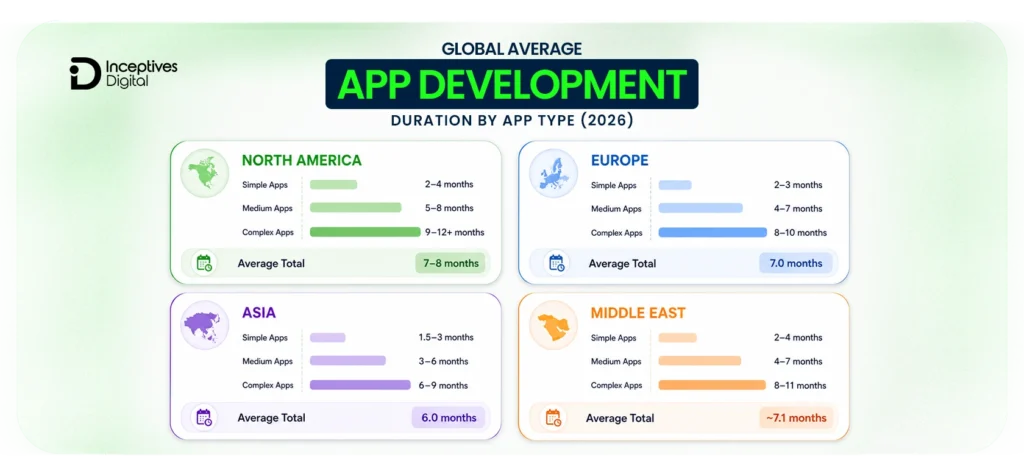
Different industries require different levels of functionality, security, scalability, and third-party integrations. Because of this, app development timelines can vary significantly depending on the type of application you want to build.
Below are some common app categories and their average development timelines.
1. E-Commerce App Development Timeline
Estimated Timeline: 6–10 Months
E-commerce apps require features like:
- product catalogs
- shopping carts
- payment gateways
- order tracking
- customer accounts
- inventory management
Advanced eCommerce platforms may also include AI-based recommendations, multi-vendor systems, loyalty programs, and real-time analytics, which increase development time further.
Examples include online retail stores and marketplace shopping apps.
2. On-Demand Service App Timeline
Estimated Timeline: 5–9 Months
On-demand applications usually involve multiple user panels, such as:
- customer apps
- service provider apps
- admin dashboards
These apps often require:
- real-time location tracking
- booking systems
- notifications
- payment integrations
- live order status updates
Examples include ride-sharing, food delivery, and home service platforms.
3. Marketplace App Development Timeline
Estimated Timeline: 8–12+ Months
Marketplace applications are more complex because they support interactions between multiple parties.
Typical features include:
- buyer and seller accounts
- messaging systems
- payment escrow
- reviews and ratings
- dispute handling
- advanced search and filtering
The backend infrastructure for marketplace apps is usually larger and requires more testing and scalability planning.
4. Healthcare and Fitness App Timeline
Estimated Timeline: 4–9 Months
Healthcare and fitness app development often include:
- wearable integrations
- health tracking
- appointment scheduling
- video consultations
- activity monitoring
Healthcare app development may also require compliance with regulations and stronger security standards, which can extend the development timeline.
5. Fintech App Development Timeline
Estimated Timeline: 8–14+ Months
Fintech app development usually takes longer due to:
- high security requirements
- financial compliance
- fraud prevention systems
- secure payment processing
- data encryption
Apps involving banking, digital wallets, stock trading, or cryptocurrency often require extensive backend development and multiple testing cycles before launch.
Gaming App Development Timeline
Estimated Timeline: 8–18+ Months
Mobile game development timelines usually require significantly more development time due to advanced graphics, animations, physics engines, and real-time interactions.
Common game development features include:
- multiplayer functionality
- in-game purchases
- leaderboards
- character animations
- audio integration
- cloud saves
- real-time synchronization
2D vs 3D game development is generally faster because 3D games require custom environments, multiplayer systems, and heavy graphics, which can take well over a year.
7. Internal Business App Timeline
Estimated Timeline: 3–6 Months
Internal business applications are typically developed for operational efficiency within companies.
These apps may include:
- employee management
- reporting dashboards
- workflow automation
- attendance systems
- communication tools
Although they may not require highly polished public-facing designs, they still need strong backend functionality and secure access controls.
8. MVP App Development Timeline
Estimated Timeline: 2–4 Months
A Minimum Viable Product (MVP) focuses only on core features required to validate your mobile app idea quickly.
MVPs are commonly used by:
- startups
- solo founders
- businesses testing new concepts
By limiting advanced features and focusing on essential functionality, businesses can launch faster, gather user feedback early, and reduce initial development costs.
Why App Type Impacts Development Time
Different app categories require different levels of:
- backend infrastructure
- integrations
- security
- scalability
- testing
- compliance
For example, a basic scheduling app may take only a few months, while a fintech or marketplace platform may require close to a year because of security layers, advanced workflows, and extensive testing requirements.
Understanding your app category early helps create more accurate project timelines and development expectations.
Native vs Cross-Platform App Development Time Comparison
The development approach plays a vital role in determining the timeline of the app. It can either be native or cross-platform.
Native application development entails having individual applications developed for iOS and Android using the respective platform-specific languages and tools (Swift for iOS, Kotlin or Java for Android). Though this technique yields excellent performance and unparalleled user experience, it will be longer as the developers will have to not only write but also manage two separate code bases.
Cross-platform app development, however, will utilize one code base that will work on both platforms. Frameworks like Flutter, React Native, and Xamarin will decrease the time to build the app and also decrease redundant coding. Depending on app complexity, cross-platform app development can decrease the overall time to build an app by as much as 30-40% and will decrease costs.
Here’s a quick comparison:
| Development Approach | Average Timeline | Best For |
| MVP Development | 2–4 Months | Startups validating an idea quickly |
| Full-Scale Custom App | 6–12+ Months | Businesses building feature-rich products |
| Native App Development | 6–12+ Months | High-performance and platform-specific apps |
| Cross-Platform Development | 4–8 Months | Faster launch across iOS and Android |
| No-Code / Low-Code Apps | 2–6 Weeks | Basic apps with limited customization |
| Enterprise Application | 9–18+ Months | Large-scale business systems and workflows |
If you want to develop an app that requires native like performance, like a gaming app. You should go for a native development approach. In case you want to launch quickly, but want to target the audience of both iOS and Android without overspending, cross-platform development will be the best option for you.
Stage-by-Stage Breakdown of Mobile App Development Timeline
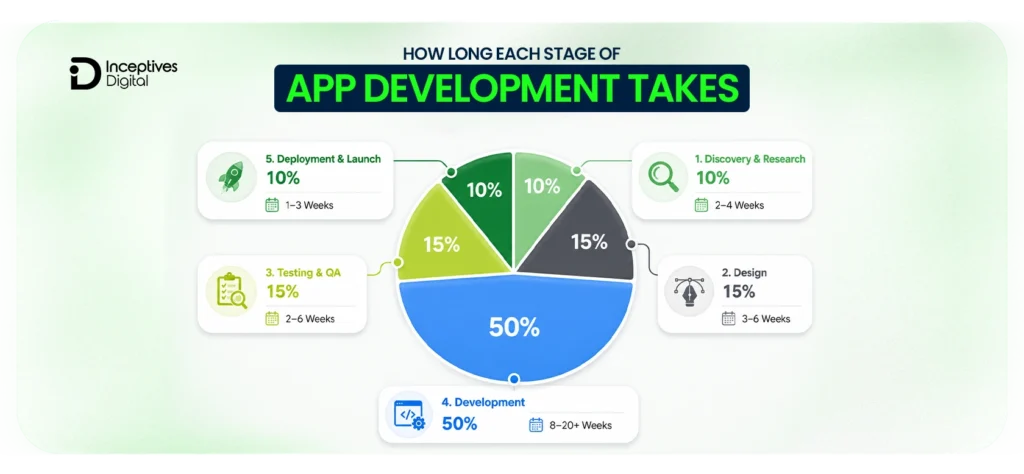
According to Clutch, if you consider all phases of a mobile app development project, from the initial planning to finally deploying the application, it will take at least 20 to 40 weeks to arrive at the final product. Below is a detailed timeline for each of the steps involved in the mobile app development process.
1. Discovery & Research Phase
This is the most critical phase that lasts for 2 to 4 weeks in the development of an application. In this phase, turn your app idea into reality through validation, research of your potential users, competitive analysis, requirements gathering, and a clear roadmap that will lead to the development of your project. The importance of this stage is that you will be sure of your goals after that. It would be best if you hire mobile app developers for a clear and hassle-free roadmap for your project.
2. Design Phase
After making sure that your application’s fundamental plan is flawless, the very next step is the creation of the application prototype. The design stage places a lot of importance on UI/UX design to make sure that the application is user-friendly and attractive. It offers a developer’s blueprint enabling them to execute a well-organized approach throughout the overall development process.
Key Aspects of the Design Phase
1. Design High-Fidelity Wireframes
The design phase is initiated with low-fidelity wireframes that define the app’s core features, structure, and user experience. It usually takes 1 to 2 weeks, depending on the customizations.
After validating the features and logics, it is upgraded to high-fidelity wireframes. These wireframes assist in testing the app’s responsiveness, functionality, and aesthetics to make sure it aligns with your goals.
2. Build a Comprehensive UI Kit
The UI kit is a basic deliverable of the design phase, and its creation needs about a week to two weeks. It consists of reusable components such as buttons, sliders, navigation, widgets, and progress indicators. These pre-defined design elements help maintain visual parity across the application and consequently save developers a huge amount of time doing repetitive work.
The UI kit makes sure that the entire application is in tune with your brand identity and design guidelines by bringing together all these different elements in one place. Moreover, it helps keep the mobile application development timeline accurate, preventing unnecessary delays.
3. Development Phase
The development is considered the backbone and most time-consuming phase of the overall development process. This is where the developers add functionality to all the approved designs and features. The development phase consumes most of the time because it involves complex coding, third-party integrations, and careful testing. This phase generally is 8 to 20+ weeks long. Below is a breakdown of the different stages of the development phase:
1. Frontend Development
This is where the front-end developers bring the design approved at the start to life using modern frameworks. For a native app, the frontend is developed separately for both iOS and Android versions, which increases the development timeline. However, cross-platform app development can save both time and cost. The average frontend development timeline lies between 2 and 10 weeks.
2. Backend Development
Writing code that will power your application is what backend development is. It handles databases, APIs, user authorization, and server logic. It usually takes 2 to 3 weeks, depending on the type of application and complexity level. For example, the iOS app development timeline and the Android app are longer than that of a cross-platform app.
4. Third-party API integrations
Numerous contemporary applications rely on outside services for functionalities like monetary transactions, geographic information, statistical analysis, and social sign-ins. Combining these third-party APIs, however, requires not only meticulous arrangement but also thorough testing in order to guarantee both stability and compatibility. The timeline normally is 2 to 4 weeks.
5. Testing & Quality Assurance
Once your app is fully developed, it has to undergo a comprehensive mobile app testing and quality assurance process. This includes testing the app in different scenarios. The purpose is to make sure the app is bug-free, crash-resistant, and provides a stable performance across devices. Depending on the level of complexity, testing and QA can take 2 weeks to a maximum of 6 weeks.
Post-Launch and App Maintenance Timeline
Launching an app is not the end of the development process. After release, most applications require ongoing updates, monitoring, and optimization to maintain performance and user satisfaction.
1. Initial Post-Launch Support
The first few weeks after launch are usually focused on stabilization. During this phase, developers monitor:
- crashes and bugs
- device compatibility issues
- app performance
- real user feedback
Even well-tested applications often require quick fixes after users start interacting with the app at scale.
2. Ongoing Updates and Maintenance
Most apps need continuous maintenance to stay functional and competitive. Common post-launch activities include:
- bug fixes
- security updates
- OS compatibility updates
- UI/UX improvements
- feature enhancements
Apps that receive regular updates generally perform better in retention and app store rankings.
3. Scaling and Future Improvements
As the user base grows, businesses often expand the application with:
- new features
- third-party integrations
- infrastructure upgrades
- analytics-driven improvements
For MVPs and startup apps, post-launch feedback usually shapes future development priorities and product growth.
Key Factors Influencing the App Development Timeline
We have listed key factors that can affect your app development timeline.
1. App Complexity & Features
The complexity level of your app has a huge impact on your app development timeline. The more feature-heavy your application is, the more time it will take for completion. For instance, the timeline to develop a simple app with basic features takes 2 to 4 months, and an app with advanced features like chats, maps, and payments takes 7 to 12 months or more to complete.
2. Platform Choice
Choose your development platform wisely for a smart and efficient app development timeline. If you choose to develop a native app, you will need to develop separate applications for both iOS and Android devices, which increases the app development time. However, a cross-platform app runs on both devices from a single codebase that can save you a lot of time and money as well.
3. Design Complexity
As we discussed earlier, every new functionality or feature adds extra time to the overall app development time. The complexity level of your app design is also one of the many factors affecting the timeline. A design that includes heavy graphics like animations, transitions, and custom layouts can make a hike in the development time.
4. Team Size & Expertise
United and proficient personnel, to a great extent, can reduce development time. Just to illustrate, a project overseen by a group of experienced mobile app developers, designers, and QA engineers can move up to 30% faster as compared to a project managed by a small or less experienced team.
Working in a parallel manner is a great advantage of larger teams (one such scenario is that while visuals are being refined by designers, developers can already start on backend building). However, a small team or a single developer may take longer to finish an entire project when working through each stage one after the other.
5. Technology Stack
The mobile app tech stack you select, the programming languages, frameworks, and libraries, also have an impact on the app development timeline. The use of modern and well-supported technologies like Node.js, Firebase, or Flutter app development can quicken the pace.
On the other hand, the dependency on old-fashioned or technically very complex technologies may delay the entire process as a result of poor support, difficulties in integration, and debugging.
6. API and Feature Integration
Third-party APIs are used by a lot of applications for a variety of functionalities like payment systems, maps, chat tools, or analytics. The process of integrating these APIs may last from 1 week to 4 weeks, depending mainly on the complexity of the API and the quality of the documentation.
Unstable or poorly documented APIs may cause delays in testing, and troubleshooting will require additional time.
7. Testing & Quality Assurance
Skipping or rushing the testing and QA can result in costly fixes and user dissatisfaction after the launch. We recommend performing the QA and testing patiently and carefully. The more comprehensive your testing process is, the longer the app development timeline will be. We recommend working with expert app developers for a faster, efficient, and reliable QA and testing process.
8. Project Management & Communication
Efficient communication and organized project management are the deciding factors that determine the timeline. That is why teams employing Agile methods, having continuous sprint reviews and documentation, are the ones that complete their projects quicker and with fewer changes.
To summarize, every factor has its own way of impacting the app development timeline. Proper planning of the strategy that includes balancing the factors of complexity, design quality, and efficiency guarantees that the app is ready for launch on time without degrading performance or user experience.
How to Reduce App Development Time Without Losing Quality
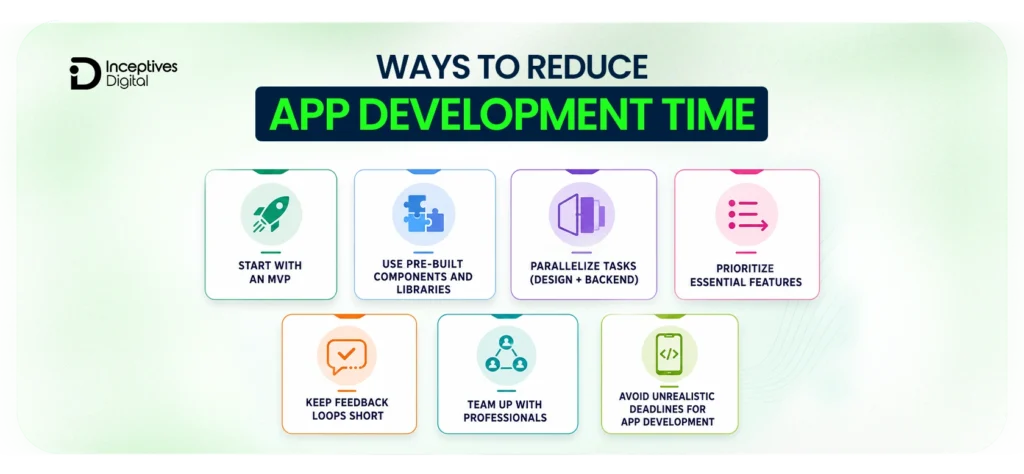
There is no need to resort to shortcuts to build an app quickly. By taking an intelligent route and making a few smart decisions at the beginning, you can increase the pace of the development while still providing a good and polished product. Here is the way to do it.
1. Start With a Minimum Viable Product (MVP)
Do not even think about fitting all the features into your app from day one. Develop an MVP comprising only the essential features that eliminate your users’ most significant problem. This not only keeps your app in the loop sooner, but also enables you to gather actual feedback and make adjustments before the big launch. And most importantly, it is affordable.
2. Lean on Pre-Built Tools
Why begin from scratch? Collect trustworthy third-party libraries, frameworks, or templates to cut down on the time you spend by tons. The tools are widely used, so you can focus on producing the special features that make your app different from others.
3. Choose the Right Mobile App Development Company
Choosing the right mobile app development company that is very familiar with your tech stack can perform miracles. They’ve seen it all, so they will catch possible challenges quickly, make the process easier, and keep it going. Hiring good employees not only means faster development but also a stable and durable application.
4. Keep Feedback Tight
Long feedback waiting periods can be a major factor in the loss of momentum. Quick check-ins, usage of project management tools, and regular short updates can keep all the people involved informed. This way, problems are caught early on before they change into expensive headaches.
5. Work in Parallel
Don’t make teams wait on each other. Let backend devs build databases and APIs while designers craft the UI/UX and frontend. This overlap keeps the project humming and shaves time off the schedule.
Do not let teams wait on one another. Allow backend developers to create databases and APIs while designers are working on the UI/UX and frontend. The overlapping of these activities keeps the project going and cuts the time off the schedule.
6. Focus on What Matters
Initially, focus on the core features that are crucial and define your app’s purpose and user experience. The extras can be rolled out later once the application starts gaining traction.
7. Skip Unrealistic Deadlines
Hastening the design of a complicated application in an incredibly short time always results in poor coding and accumulation of “technical debt”. Those immediate solutions that eventually cause problems. Make a timeline that is realistic and allows you the time to test, improve, and create something that can expand.
You can get your application out quicker by gradually opening it up, being efficient, and maintaining flexibility without sacrificing quality. The time that you save each week should be due to clever planning and not to cutting corners or going back to redo work.
Common Reasons Behind Delays In App Development
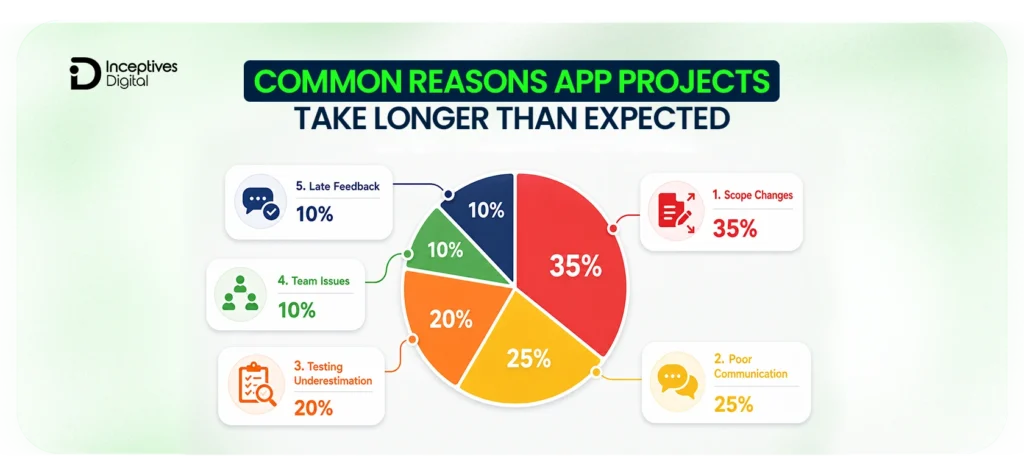
There are multiple reasons that cause delays in the app development process. Here are some common problems listed that you may face during the development of your application.
Even well-planned app projects can experience delays during development. In most cases, delays happen because of changing requirements, technical dependencies, communication gaps, or extended testing cycles. Understanding these risks early can help businesses plan more realistic timelines and avoid unnecessary setbacks.
1. Scope Creep and Feature Changes
One of the most common causes of delays in app development is scope creep. This happens when new features, design requests, or functionality changes are added after development has already started.
Even small changes can create a chain reaction across:
- design
- frontend development
- backend logic
- testing workflows
Frequent revisions often require developers to rewrite existing code, increasing both the timeline and the mobile app development cost. This is why defining an MVP and finalizing core features early is extremely important.
2. Delayed Feedback and Approval Cycles
Many projects slow down because approvals from stakeholders take longer than expected.
For example:
- delayed UI approvals
- late feature feedback
- postponed review meetings
- unclear revision requests
When teams wait days or weeks for feedback, development momentum slows significantly. Fast communication and scheduled review checkpoints help keep projects moving efficiently.
3. Third-Party API and Integration Issues
Modern apps often depend on third-party services such as:
- payment gateways
- maps and geolocation APIs
- social logins
- analytics tools
- cloud services
These integrations can become major bottlenecks if:
- Documentation is incomplete
- APIs are unstable
- rate limits exist
- compatibility issues appear
In some cases, developers may need to redesign portions of the application to resolve integration conflicts, extending the timeline further.
4. Backend Architecture Changes
Backend systems are the foundation of many modern applications. If the backend architecture is not planned properly in the beginning, developers may later need to restructure databases, APIs, or server logic.
This is especially common in:
- marketplace apps
- fintech platforms
- social networking apps
- enterprise systems
Backend restructuring is time-consuming because it affects multiple connected parts of the application.
5. App Store Review and Rejection Delays
Many businesses underestimate the time required for publishing on the App Store and Google Play.
Even after development is completed:
- Apps may be rejected for policy violations
- metadata may need revisions
- Permissions may require clarification
- bugs discovered during review may need fixes
Apple App Store reviews can sometimes take several days, and rejected submissions may delay launch timelines further.
6. Testing and Bug-Fix Cycles
Testing is not a one-time process. As new features are added, additional bugs and compatibility issues often appear.
Quality assurance usually includes:
- performance testing
- device compatibility testing
- usability testing
- security testing
- regression testing
Complex apps typically require multiple testing cycles before release. Rushing QA often creates even larger delays later due to post-launch fixes and poor user experience.
7. Poor Communication and Project Management
Communication gaps between designers, developers, testers, and stakeholders can create confusion and duplicate work.
Without organized project management:
- priorities become unclear
- tasks are delayed
- revisions increase
- The development flow slows down
Agile workflows, sprint planning, and regular progress updates help reduce delays and improve coordination across teams.
8. Understaffed or Inexperienced Teams
Hiring fewer developers to reduce costs may increase the overall timeline significantly.
Smaller or inexperienced teams often struggle with:
- parallel task execution
- debugging complex issues
- managing large feature sets
- maintaining development speed
Experienced development teams can identify technical risks early and complete tasks more efficiently, reducing unnecessary delays.
Real-World Mobile App Development Timeline Examples
It’s easier to understand the mobile app development timelines when you look at real-world applications. The time required depends on complexity, features, scalability, and the level of engineering behind the product. Below are examples of popular apps and how their development timelines typically compare based on their scale.
1. Instagram– Social Media App
Instagram-like apps generally take around 5 to 7 months for an initial version. Early development focuses on core features like photo sharing, user profiles, feeds, and notifications. Over time, advanced features such as reels, stories, and algorithm-based content ranking significantly increase complexity and development cycles.
2. Uber– On-Demand Service App
Apps like Uber usually require 10 to 14+ months of development. This is due to real-time GPS tracking, dynamic pricing systems, driver-rider matching, and secure payment integrations. The backend architecture must also support large-scale traffic and real-time updates, which adds to the timeline.
3. TikTok– Video Streaming Platform
TikTok-style apps can take 12 to 18+ months or more to develop. The biggest time-consuming components include video processing, AI-driven recommendation systems, content moderation, and high-performance streaming infrastructure. These systems require continuous optimization even after launch.
4. Airbnb– Marketplace App
Marketplace platforms like Airbnb typically take 8 to 12+ months to build. They require complex booking systems, host-guest management, payment flows, reviews, messaging, and trust & safety layers. Scalability and multi-user interactions also extend development time.
Wrapping Up
Building a mobile app is not a fixed-timeline process. It depends on multiple moving parts such as feature complexity, design requirements, technology choices, integrations, and the overall development approach. Simple apps can be completed in a few months, while more advanced platforms like fintech, marketplaces, or gaming apps can take close to a year or more. Each stage, from planning and design to development, testing, and post-launch updates, plays a direct role in shaping the final delivery timeline. Understanding these stages helps set realistic expectations and reduces delays caused by unclear planning or shifting requirements.
If you are planning to build an app, the best approach is to clearly define your core idea, prioritize essential features, and choose the right development strategy from the start. A well-structured roadmap can make the entire process more efficient and predictable. Many businesses also explore professional mobile app development services to better align timelines, features, and technical execution with their long-term goals.
CTA SECTION START
cta title: See How Long Your App Will Really Take
cta des: Understand exactly how long it takes to build an app based on complexity, features, and development approach. Plan smarter, avoid delays, and set realistic expectations before starting your mobile app project.
cta button: Get a Free App Timeline Estimate
CTA SECTION END
FAQs About Mobile App Development Timeline
The time to develop an app varies based on the complexity level, features, and team expertise, etc. A simple app can be developed in 2 to 3 weeks, but a highly complex application with advanced integrations can take several months.
The fastest way to develop a mobile app is by using low-code or no-code platforms. You can also take help from AI tools that can fast-track your development process. But we suggest consulting with an expert app development company for a reliable product.
A Minimum Viable Product (MVP) development cost typically ranges from a few thousand dollars to $50,000+, depending on factors like features, complexity, team size, and development approach.
The complexity affects the development timeline because a simple app needs fewer features and testing, whereas a complex app has more features and integrations, which need rigorous testing as well. This results in increasing the development time for complex applications compared to simple applications.
Yes, a simple app can be developed in 1 month, but a medium complexity app can take 3 to 4 months to be released as a fully functional and polished application.
SIDEBAR LIST START
- How Long Does It Take to Build An App?
- How Mobile App Development Timelines Are Estimated?
- Average Mobile App Development Timeline
- Mobile App Development Timelines by Industry and App Type
- Native vs Cross-Platform App Development Time Comparison
- Stage-by-Stage Breakdown of Mobile App Development Timeline
- Post-Launch and App Maintenance Timeline
- Key Factors Influencing the App Development Timeline
- How to Reduce App Development Time Without Losing Quality
- Common Reasons Behind Delays In App Development
- Real-World Mobile App Development Timeline Examples
- Wrapping Up
- FAQs About Mobile App Development Timeline
SIDEBAR LIST END