Creating a successful financial application is not just about having a brilliant idea—it’s equally important to validate it before making a full-scale investment. In today’s digital finance market, businesses need a more intelligent, calculated approach to minimize risks and accelerate their launches. This is where a FinTech MVP works well.
A FinTech MVP, or minimum viable product, is a simple version of a financial application designed to validate a business idea, typically with a minimal set of features. In FinTech MVP development, the main objective is to deliver a quick launch while prioritizing key features such as security and user experience. To ensure a secure and scalable MVP, startups often collaborate with an experienced FinTech app development company.
Considering the FinTech industry’s strict demands for trust and security, as well as compliance with regulations, launching a product without prior validation can be risky. FinTech startups can now test their ideas without incurring extra costs by focusing solely on the product’s most important aspects.
FinTech MVPs are increasingly important amid the rapid growth of the digital payments market, as noted in the Global Payments Market Report, which predicts significant growth in 2026 driven by the adoption of mobile wallets and digital financial services.
The idea behind an MVP in FinTech is to create a product that includes only the features necessary to solve a particular problem. However, a full scale FinTech application has been developed to incorporate features and integrations that can be scaled to meet the high demand for the application.
By following the MVP app development approach, businesses can avoid FinTech development risks and focus on core value before investing in a full product.
Why Startups Should Build a FinTech MVP First?
There are various strategic advantages to developing an MVP for FinTech startups. It helps businesses to test their ideas on time and reduce costs. It also reduces risks for FinTech businesses, given their high regulatory requirements. By launching their products early, FinTech businesses can build confidence before scaling.
- Firstly, MVP app development for FinTech enables startups to achieve faster market entry, launch their products, and gain traction before rivals.
- Secondly, these MVPs are cost effective because building them is less expensive than building the actual product, since only the necessary features are incorporated.
- Thirdly, MVP for FinTech minimizes risk by managing uncertainties and variables, including regulatory changes, security risks, and market conditions.
- Fourthly, MVPs help FinTech businesses collect user data, enabling them to improve their products based on user experience.
- Fifthly, MVPs help FinTech startups gain traction and attract investors because they are operational, and investors are confident in the product’s scalability.
Key Challenges in FinTech MVP Development
There are challenges in building a FinTech app as an MVP that make financial data sensitive and the finance industry complex. Startups need to overcome these challenges to create a viable product.
Regulatory Compliance (KYC/AML/GDPR): Fintech applications must comply with stringent rules on data privacy, money laundering, and customer identification from day one. This may delay the launch of the Fintech product, and the company may face legal issues.
Security and Data Protection: Fintech applications require security and data protection, especially when handling financial and personal information. The Fintech applications need to ensure secure financial transactions and prevent fraud.
Integration with Legacy Banking Systems: New MVPs may need to work with legacy banking APIs, which can be sluggish and expensive. Smart integration is an essential feature for FinTech applications to offer strong financial services from the beginning.
Cost and Resource Constraints: A secure, compliant FinTech MVP development project requires developers with expertise in AI and blockchain app development.
Feature Minimalism: A startup should ensure it focuses on core features, removing any additional features that might hinder. This will ensure a perfect balance of a “Minimum Viable Product” and usability.
Gaining User Trust: It is paramount in a highly competitive market. A user needs a secure experience from the MVP.
To overcome these challenges effectively, it’s important to follow a structured development process.
Step-by-Step Process to Build a FinTech MVP
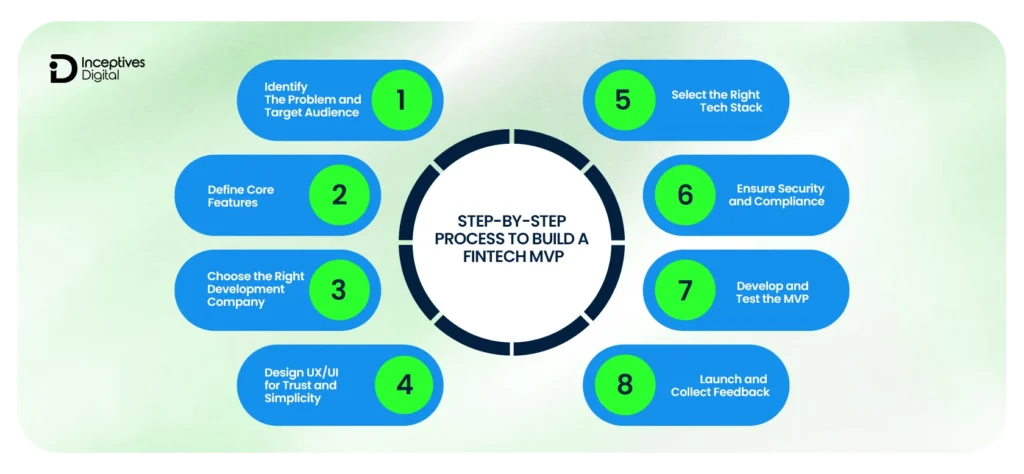
It is important to note that developing the FinTech MVP should follow a systematic process to ensure a secure, valuable product and minimize costs and risks. This includes the problem, the audience, and the key features of the FinTech MVP.
A well-designed dashboard gives users clear financial insights
Step 1: Identify the Problem and Target Audience
First, identify the problem your FinTech product solves and your audience. This is essential to ensuring you are not solving a hypothetical problem with your MVP or adding unnecessary features, which will help you deliver a product with instant value and connect with your audience.
Step 2: Define Core Features
Focus on the key functionality required to solve the problem. Select features that provide immediate value. By limiting functionality, you can speed up development, reduce costs, and achieve a lean, testable product. This helps a startup gather valuable user feedback.
Step 3: Choose the Right Development Company
A company with experience in FinTech app development can provide access to expertise, including security, compliance, and other FinTech-related technologies. This is an important aspect of development and can be a valuable asset for architecture, risk management, and MVP optimization.
Step 4: Design UX/UI for Trust and Simplicity
An intuitive, secure interface is important in the world of FinTech. The key areas to consider are ease of advancing the interface, transparency in the onboarding process, and ease of completing transactions. A simple UX/UI design plays an important role in gaining traction for an MVP.
Step 5: Select the Right Tech Stack
Some of the technologies to be selected for fast development, scalability, and security include React Native and Flutter for frontend development, Node.js and Python for backend development, and PostgreSQL and MongoDB for database development. Using cloud platforms like AWS and Firebase would be an added advantage for flexibility, reliability, and future expandability while keeping costs to a minimum.
Step 6: Ensure Security and Compliance
Security and compliance are essential and entail encryption, authentication, and data protection. Ensure your MVP is KYC, AML, and GDPR-compliant to avoid future legal issues. This will also help you avoid compromising sensitive financial data.
Step 7: Develop and Test the MVP
The development process should start with implementing all key features, followed by testing across functionality, security, and usability. This ensures a reliable system is produced. Testing during the creation of the MVP ensures a product is not only deployable but also usable in the real world.
Step 8: Launch and Collect Feedback
This MVP can be launched to a smaller user base, and user feedback collected. User engagement metrics can be analyzed, and performance can be monitored for improvement. This will not only validate the product’s market fit but also build trust with users and develop a roadmap for scaling the MVP into a fully functional FinTech product.
Must-Have Features for a FinTech MVP
As you build the FinTech MVP, consider incorporating the necessary core features to deliver value, trust, and security to users. Therefore, your MVP should deliver the necessary functions to the user so you can solve the user’s problems simply and easily.
The following are the key features that every MVP for a FinTech app needs to have:
User Authentication (2FA, Biometrics)
User authentication is a non-negotiable feature for an MVP FinTech. The inclusion of two-factor authentication and biometric authentication guarantees maximum security for the application. This feature is a priority because it builds trust and prevents unauthorized user access.
Secure Payments and Transactions
A secure payment feature is an essential component of an MVP FinTech. The app should allow for safe, efficient, and reliable financial transactions. It should also ensure users are protected from fraud. The use of encryption and API tools facilitates smooth financial transactions, helping users feel confident using the app for financial activities.
Dashboard and Analytics
It is important to note that a well-designed dashboard can provide users with a clear view of all their financial activities. The dashboard should provide the user with key insights into their financial activities, including where they spend their money, account balances, and investment performance.
Notifications
Another important aspect concerns notifications. Sending real-time notifications for transactions and activities helps users stay up to date on their financial activities. Notifications are important for improving the user experience and keeping users updated about their activities.
KYC Verification
It is important to note that KYC verification is essential for compliance with the law in FinTech applications. It also helps verify user information and prevent fraud and illegal activities. A successful KYC verification process ensures compliance and ease of use.
API Integrations
API integrations will help your FinTech connect MVP to external banking systems, payment systems, and financial services. Instead of building everything from the ground up, API integrations will speed up development and improve the functionality of your FinTech MVP.
FinTech MVP Tech Stack (Best Technologies to Use)
Therefore, the right technology stack is important for developing a FinTech MVP that is not only secure and scalable but also efficient. By using the best fintech MVP development platforms, FinTech startups can develop their applications in the quickest, most scalable, and most reliable way possible.
Here are the commonly used technologies for each layer:
Frontend: React Native or Flutter – for building responsive cross-platform mobile applications quickly.
Backend: Node.js or Python – for server side programming and secure data processing.
Database: PostgreSQL or MongoDB – for secure storage and querying of financial data.
Cloud: AWS or Firebase – for building highly available, scalable, and secure cloud applications.
APIs: Payment gateways and banking APIs – for efficient and secure transaction processing and access to external services.
With the technology stack finalized, it’s important to understand the estimated cost of building a FinTech MVP.
FinTech MVP Development Cost Breakdown
The cost of developing a FinTech app, including an MVP for personal finance, depends on various factors. Understanding these costs is essential for effective planning by the startup.
1. Basic: A basic MVP with features such as user authentication, transactions, and analytics may cost $15,000-$30,000.
2. Mid-level: This may include additional features such as complex analytics, notifications, KYC verification, and API integrations. The cost may range from $30,000 to $60,000 due to enhanced security measures and user experiences.
3. Advanced: Feature-rich MVPs with multiple compliance requirements, AI-driven insights, complex API integrations, high scalability, etc., may cost anywhere from $60,000-$100,000+.
4. Cost Factors: The cost to build a FinTech personal finance app may vary based on factors such as the number of features, security and compliance requirements, API integrations, UI/UX complexity, and FinTech app development expertise.
How Long Does It Take to Build a FinTech MVP?
Developing a FinTech MVP is not a long process. It is also not an activity that can be done instantly. It depends on how complex you want your features to be. It also depends on how many integrations and how much compliance you need to do. This includes things like KYC and AML. A well-thought-out plan for an MVP will allow you to focus on features. This will allow you to do it even faster.
Basic (8-12 Weeks)
An MVP with basic functionality, such as user authentication, transactions, and a dashboard, may take 8 to 12 weeks.
Mid-Level (3-4 Months)
An MVP with functionalities such as KYC, API integrations, and notifications may take around 3 to 4 months.
Advanced (4-6+ Months)
An advanced-level MVP with functionalities such as multi-region compliance, analytics, scalability, and integrations may take around 4 to 6 months or more.
FinTech MVP Examples (Real World Use Cases)
MVP app development for startups to test their fintech app ideas in the financial industry without building a full scale product. This allows FinTech startups to focus on the product’s essential functions and test the idea.
Here are some real world use cases for FinTech MVP:
Payment Apps
MVPs for digital payments are designed to ensure fast and secure money transfer services, bill payments, and peer-to-peer transactions. This is a validation of speed and convenience.
Real World Example: PayPal was originally developed as an MVP for digital payments before it became a financial platform. Venmo was originally designed for peer-to-peer transactions before it became a platform for other use cases.
Lending Apps
MVPs for FinTech lending enable users to apply for loans, get approved, and receive funds with a few clicks. This also tests demand for loans, the credit process, and related factors.
Real World Example: Lending Club started with a basic lending platform that connected borrowers with investors before expanding to a full fledged lending platform.
Investment Platforms
Investment MVPs offer basic features such as portfolio tracking, trading, and financial data, helping startups test usability and gauge market interest.
Real World Example: Robinhood was developed as a simple, commission-free trading app that eventually evolved into a feature-rich investment platform with advanced tools and services.
Digital Wallets
MVPs for digital wallets usually focus on money storage and transfer, as well as payment security. This is to ensure the convenience of digital wallets.
Real World Example: Apple Pay started as a basic payment system and gradually evolved into a digital wallet with additional financial services.
Common Mistakes to Avoid in MVP Development for FinTech
The art of creating an MVP development service for FinTech companies lies in achieving a good balance among speed, quality, security, and compliance. However, the challenge is that most FinTech businesses are making a series of critical mistakes that can cost them time, money, or even their product.
Knowing these common mistakes can help you create a more efficient MVP.
Overbuilding the MVP
Too many features at the onset would defeat the purpose of creating an MVP. Startups are more likely to build the whole product rather than focusing on solving a single problem. This could increase development costs. A lean approach with fewer essential features will make the idea more credible.
Ignoring Compliance
Failure to comply with KYC, AML, and data protection regulations can result in legal and operational risks. FinTech products must comply with regulations from the outset. This not only updates the process but also reduces legal risks and upgrades the credibility of FinTech products.
Poor User Experience
Complicated or confusing interfaces can easily cause users to stray off. In the FinTech space, users want simplicity, clarity, and trust. Complicated navigation, unclear processes, and even slower speeds can cause users to stray off. A simple interface can make users feel comfortable using the app.
Weak Security
In addition, security is a critical factor to consider in any financial application. Failure to implement proper security mechanisms may lead to data breaches, resulting in financial losses for the organization. It may also lead to a loss of user trust. The proper implementation of security mechanisms will ensure maximum security for the data, and users will feel comfortable using the application.
Choosing the Wrong Tech Stack
If the technology stack does not support growth, the application may need to change in the future, which could be costly. Thus, it is imperative to adopt the right technology stack from the outset to ensure smooth development, performance, and growth.
How to Validate Your FinTech MVP After Launch?
While the launch of the FinTech MVP is a significant step for a startup, the real value comes in validating this after launch. The validation process helps a startup get a better sense of what works and what doesn’t in the product, as well as whether it actually meets the market’s needs.
User Feedback Loops
One of the most effective ways to validate your FinTech MVP is to collect direct user feedback. Surveys, reviews, and in-app prompts are the most effective tools for collecting user feedback, which can be extremely useful for validating your FinTech idea.
Analytics Tracking
Analytics tools are vital for understanding how users interact with the MVP. You should track user engagement, session length, and transactional activities. These analytics will help you understand the drop-off points and make the necessary improvements to improve the user experience and product efficiency.
A/B Testing
A/B testing can help you compare different variations of features, designs, or workflows and evaluate which one performs better. This way, you can test different variations with real users and optimize the user experience, thereby improving the effectiveness of your MVP Fintech.
Iterative Improvements
However, improvement of your MVP should be a continuous process. You should make continuous updates and improvements based on feedback and analytics insights. This will ensure that your product continues to evolve and improve, moving towards a fully featured, market-ready FinTech product.
When to Scale Your FinTech MVP into a Full Product?
Scaling your FinTech MVP should be based on a solid product market fit. This means that if you find your users are consistently engaging with your product, finding value in your core features, and using it regularly, you’re ready to scale. This indicates that your product is meeting a market need.
Another key aspect to consider is the steady growth in user numbers. This includes increases in sign-ups and active users. This gives startups the confidence to grow the platform as more users engage with the product.
Revenue validation is another key signal for scaling. When your MVP starts generating consistent revenue or indicates clear monetization opportunities, it validates the business’s viability. This includes revenues generated from subscriptions, transactional fees, and many more. This indicates that the product is ready to move into a full scale product.
How to Choose the Right FinTech App Development Company?
However, selecting the top FinTech MVP development companies in USA is essential to creating a reliable and secure MVP. To begin with, the company’s experience in developing FinTech applications is important, as it would be familiar with financial systems, user behavior, and current market conditions.
Moreover, the company should be proficient in compliance, with the developer of the financial app well-versed in KYC, AML, and other related regulations to ensure the FinTech app adheres to them from the outset.
Furthermore, the company’s portfolio is important, as it enables selecting the right company to develop the FinTech app by gauging the quality of its projects and the performance of its solutions in real-world scenarios.
Finally, the company should also be well-versed in the app’s security, including encryption, API security, and various authentication methods, as this is an important aspect of information management in the finance sector.
Future Trends in MVP Development for FinTech
The FinTech industry is constantly evolving, and being aware of the new trends will help FinTech startups build an MVP for the future. New technologies will help businesses improve the user experience and increase competitiveness in the market.
Artificial Intelligence in FinTech
Artificial Intelligence is transforming the FinTech sector by offering the prospect of intelligent automation and decision-making. Artificial Intelligence can help FinTech organizations detect fraudulent behavior, analyze individuals’ financial data, and provide efficient customer support. FinTech businesses can use machine learning and predictive analysis to improve accuracy, mitigate risk, and offer a personalized financial experience for their customers.
Blockchain for Security and Transparency
Blockchain technology promotes transparency, security, and trust in financial transactions. With a decentralized ledger system, the risk of fraud and unauthorized use can be minimized. FinTech organizations can use blockchain for secure financial transactions, smart contracts, and transparent record-keeping, thereby creating a secure environment for users and organizations alike.
Fixed Finance Integration
Fixed Finance enables non-financial platforms to provide financial services, which include payment, lending, and insurance, directly to customers. This gives startups a chance to expand their service offerings, thereby improving customer engagement and generating revenue. This type of integration increases customer convenience, which, in turn, boosts customer loyalty in a digital world.
Open Banking Solutions
Open banking is a system that enables financial institutions to share financial information via APIs. This allows FinTech startups to develop connected applications. This gives users the benefits of using various accounts, better payment services, and personalized financial information. Open banking is a new approach to financial services that encourages innovation, competition, and transparency.
Final Thoughts
Building a FinTech MVP is a great idea for businesses, as it is a smart and practical approach for startups to test ideas, mitigate potential risks, and enter the market faster. By focusing on core features, compliance, and improvement, businesses can set a solid path to success. Instead of investing a lot in a FinTech business, you can efficiently test your idea with the help of an MVP FinTech. Working with the best mobile app development services can help you build a secure, scalable, and future-ready FinTech business with confidence.
CTA SECTION START
cta title: Got a FinTech idea but unsure how to bring it to life?
cta des: Partner with Inceptives Digital to develop a secure and scalable FinTech MVP app customized to your vision.
cta button: Let’s Connect
CTA SECTION END
FAQs
A FinTech MVP should include core features like user authentication, secure transactions, a dashboard, KYC verification, and basic analytics to solve a specific problem while ensuring usability, security, and compliance.
Yes, a FinTech MVP is built with scalability in mind, enabling startups to add new features, improve performance, and expand infrastructure as user growth, feedback, and evolving market demands develop.
The best tech stack includes React Native or Flutter for the frontend, Node.js or Python for the backend, PostgreSQL or MongoDB for the database, and AWS or Firebase for scalable cloud infrastructure.
FinTech MVPs ensure security through data encryption, secure APIs, two-factor authentication, regular security testing, and compliance with regulations like KYC and AML to protect sensitive financial and personal user information.
Startups can build independently, but hiring a FinTech development company provides expertise in security, compliance, and scalable architecture, helping reduce risks, speed up development, and ensure a reliable MVP launch.
SIDEBAR LIST START
- How to Build a FinTech MVP Step-by-Step Guide for Startups
- Why Startups Should Build a FinTech MVP First
- Key Challenges in FinTech MVP Development
- Step-by-Step Process to Build a FinTech MVP
- Must-Have Features for a FinTech MVP
- FinTech MVP Tech Stack (Best Technologies to Use)
- FinTech MVP Development Cost Breakdown
- How Long Does It Take to Build a FinTech MVP?
- FinTech MVP Examples (Real-World Use Cases)
- Common Mistakes to Avoid in FinTech MVP Development
- How to Validate Your FinTech MVP After Launch
- When to Scale Your FinTech MVP into a Full Product
- How to Choose the Right FinTech App Development Company
- Future Trends in FinTech MVP Development
- Final Thoughts on Building a FinTech MVP
- FAQs on FinTech MVP Development
SIDEBAR LIST END