How Much Does It Really Cost to Develop a Mobile Game?
The mobile game development cost usually lies between the range of $15000 to $500,000+, influenced by factors such as features, genre, complexity, and scale. For example, a game with basic graphics requires a leaner budget compared to a multiplayer or 3D RPG that can surpass six figures. The question that pops up here is not just “how much does mobile game development cost?” but “what will your game cost based on what you are building?”
Currently, the stakes are at the highest point ever. Due to the huge user base, mobile games are dominating the gaming industry with more than 3 billion mobile gamers worldwide. And if we talk about the revenue numbers, mobile games are cultivating an annual revenue of $80 billion.
Startups, businesses, and entrepreneurs eager to invest in the gaming sector shouldn’t be a surprise after looking at these numbers. But there’s a catch: the decision you make early on impacts the cost to develop a mobile game. Decisions like the features, technologies, and even the mobile game development company you choose will have a direct impact on your mobile game development budget and ROI.
But you don’t have to worry, this extensive guide will explain where exactly your investment goes, factors that matter, and how to estimate your mobile game development cost realistically before advancing towards actual development.
Mobile Game Development Cost Overview (Quick Snapshot)
If you are looking for a quick mobile game development cost estimate, this section will give a quick overview. The complexity of your game mainly impacts the timeline and resources. Here is the average cost of mobile game development based on different categories.
Estimated Mobile Game Development Cost by Game Type
| Game Type | Complexity | Estimated Cost | Timeline |
| Hyper-casual | Low | $10K – $30K | 1–3 months |
| Casual | Medium | $30K – $100K | 3–6 months |
| Mid-core | High | $100K – $300K | 6–12 months |
| AAA Mobile | Very High | $300K – $1M+ | 12+ months |
What These Numbers Actually Mean
- Hyper-casual games are quick to build with simple mechanics and minimal design. Think tap-based or endless runner games.
- Casual games present improved UI/UX and slightly deeper gameplay loops.
- Mid-core games include advanced systems like progression, in-game economies, and sometimes multiplayer features.
- AAA mobile games involve high-end 3D graphics, complex gameplay, and large-scale backend infrastructure.
These are just basic estimates, not exact figures. The actual game development cost varies by features, UI/UX quality, and technical requirements. To make you understand where the mobile game development budget goes and what you are actually paying for, we have broken that down in the next section.
Mobile Game Development Cost Breakdown by Stages
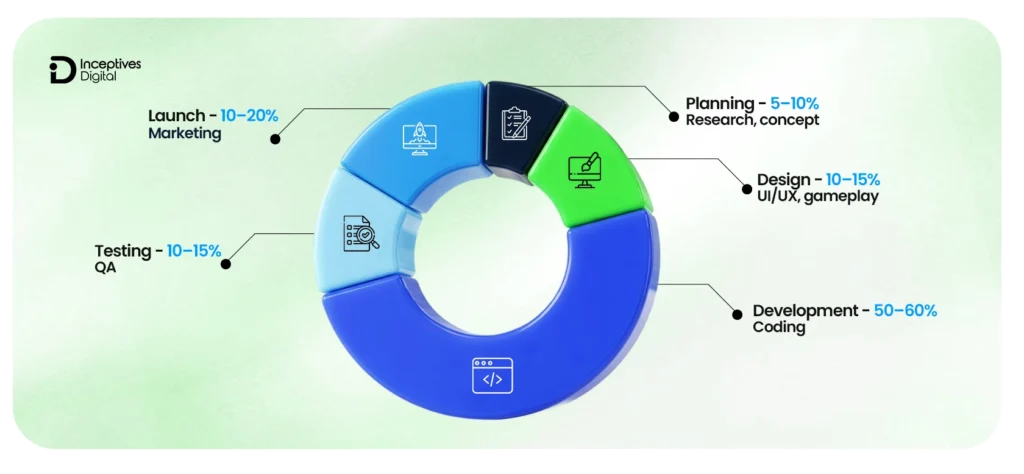
Estimating the total mobile game development cost is one thing, but having a clear understanding of what goes into each stage of the mobile game development process helps in planning a better budget. Each phase is equally important and neglecting any one of them can cause serious issues.
1. Planning & Research (Including MVP Cost for Mobile Games)
Your concept undergoes testing at this point before any major investment commences. The project requires market research and competitor analysis, together with establishing your primary gameplay mechanics.
Many businesses at this stage plan a Minimum Viable Product, which is where the MVP cost for mobile games arises. Starting with an MVP helps with early testing and validation of your game development idea before full development.
2. Game Design (Game Design Cost + UI/UX Design Cost)
This phase focuses on how your game looks, feels, and engages users. It incorporates components that include gameplay mechanics, progression systems, and interface design.
Your game design and UI/UX design cost depends heavily on complexity. The development costs for a basic 2D interface design remain low, whereas a complete interactive user interface with animation elements and transition effects requires considerable financial investment.
3. Development (Frontend + Backend Development Cost)
This phase of the project requires the highest level of resource consumption and financial allocations. It consists of building the core gameplay, adding new features, and constructing the necessary technical architecture.
If your game includes complex features such as multiplayer, cloud syncing, or real-time data sharing, a major factor at this stage is the backend development cost. Simply, more advanced games require more development efforts and time.
4. Testing & QA
Testing is the most important phase of the mobile game development process. An attractive user experience is a lifeline for any type of game. Testing makes sure the game is free of bugs, glitches, and performance issues, making this stage critical for a successful launch. to attract maximum players.
5. Launch & Marketing (Including Post-Launch Game Maintenance Cost)
Once your game is live, the expenses don’t stop. This stage includes app store optimization, paid campaigns, and initial user acquisition.
The process doesn’t stop at the launch. To attract maximum players, you need to perform app store optimization and paid campaigns. Moreover, you have to consider the post-launch game maintenance cost as well, which typically is 15 to 20% of the initial game development cost yearly. It includes regular updates, bug fixes, and introduces new features.
Stage-Wise Mobile Game Development Cost Distribution
| Stage | Cost % | What You’re Paying For |
| Planning & Research | 5–10% | Concept validation, MVP development |
| Game Design (UI/UX) | 10–15% | Gameplay systems, UI/UX design |
| Development | 50–60% | Coding, backend, feature integration |
| Testing & QA | 10–15% | Bug fixing, optimization |
| Launch & Marketing | 10–20% | Promotion, maintenance |
Key Takeaway
A major chunk of the mobile game development cost is consumed by development, but the design, backend systems, and maintenance are equally important as well for long-term success.
Now let’s explore the key factors that affect the cost of developing a mobile game.
What Factors Affect Mobile Game Development Cost?
There are a few key factors and decisions you have to make, but they directly impact the overall mobile game development cost. Having a clear understanding of these helps you keep the budget in control and saves you from surprises. Here are the factors that you should keep account of:
1. Game Complexity & Features
As the number of features piles up, it increases the game production cost as well. Games usually involve features such as levels, rewards, AI, or in-game economies. Complexity is the biggest variable that you have to consider when estimating the cost to build a mobile game app from scratch. For example, a game with a single core mechanic costs far less than a game with multiple gameplay mechanics.
Cost impact:
- Fewer features → lower cost
- Advanced mechanics → higher cost
- Feature-heavy games → exponential cost increase
2. Platform Choice
Your platform strategy is a primary deciding factor for both game development timeline and cost. Platforms include two approaches: Native and cross-platform. The native approach involves separate applications for Android and iOS platforms. If we compare Android vs iOS game development costs, the difference is mainly due to the testing and optimization. Android development requires more compatibility, while iOS development emphasizes a lot on platform-specific development.
Building separate applications doubles the cost, and that is where cross-platform development costs become a win-win situation. Cross-platform development operates on both iOS and Android using a single codebase, reducing the development efforts and budget.
Cost impact:
- Single platform → controlled cost
- Multi-platform (separate builds) → higher cost
- Cross-platform → cost-efficient but not always cheapest
3. Game Engine
The more advanced your game engine is, the more it will cost in terms of both time and money. For example, the Unity game development cost is usually lower compared to Unreal. Unity is the most popular game engine used in mobile game development. On the other hand, the Unreal Engine game development cost is higher because it requires experienced game developers and takes longer.
Cost impact:
- Easier tools → faster, cheaper builds
- Advanced engines → higher development cost
4. Graphics & Design
Visual quality is a major factor in a mobile game’s success because it is the first impression of the game that influences the user’s decision of whether he should play your game or abandon it. The gap between the cost of 2D vs 3D game development is very significant. 2D games take less time and effort to develop, while 3D game development includes rendering, modeling, and animations that together increase the time and budget.
Cost impact:
- Simple visuals → lower cost
- High-end graphics → higher cost
5. Backend & Multiplayer
The online functions make total changes to the existing cost structure.
Online functionality needs servers, APIs, and data handling that totally shakes the mobile game backend development cost. Even basic online features need specific infrastructure that increases the initial and ongoing costs.
For example, the cost to create a multiplayer mobile game is notably high because it requires real-time synchronization, matchmaking systems, and regular maintenance.
Cost impact:
- Offline games → lower cost
- Online features → moderate increase
- Real-time multiplayer → major cost increase
6. Team & Hiring Model
Your game’s success is heavily impacted by the type of team that is working on your project. You can hire freelancers, an in-house team, or a mobile app development company with extensive experience in game development. Location and experience are the factors that create a difference in the cost to hire a mobile game developer. Hiring freelancers is cheaper but poses reliability issues, while an in-house team offers reliability but can be the most costly option. Working with an experienced agency brings industry experience, reliability, and cost-effective strategies that can really streamline the game development process.
Cost impact:
- Freelancers → lower cost, higher risk
- In-house → highest cost
- Agency → balanced cost and efficiency
Key Takeaway
All elements of this situation require direct assessment because they impact your financial resources. The key is to align your game’s scope with what you actually need, not everything you could build.
Next, we’ll break down mobile game development cost by genre, so you can see how pricing changes based on the type of game you’re planning.
Mobile Game Development Cost by Genre
Each game genre has its own complexity level, features, and technical requirements that impact the cost. This makes it one of the practical ways for estimating your budget by having a look at the mobile game development cost by genre. Here are the industry estimates based on genres.
1. Hyper-Casual Game Development Cost
Hyper-casual games represent the cheapest game development option for developers. The games use one basic game mechanic, without extra design work, and track player progress through short gameplay experiences
The typical hyper casual game costs stay low because these games:
- Use basic graphics
- Have limited features
- Require little to no backend infrastructure
Estimated Cost: $10,000 – $30,000
Best for: Quick launches, testing ideas, ad-based monetization
2. Casual Game Development Cost
Casual games provide a deeper gameplay experience than hyper-casual games. Games that fall under this category include match-3 games, puzzle games, and endless runner games.
They require better UI/UX, together with better progression systems and refined gameplay elements, which will increase development costs.
Estimated Cost: $30,000 – $100,000
What increases cost here:
- Multiple levels
- Improved design and animations
- Basic monetization systems
3. Mid-Core Game Development Cost
Mid-core games offer advanced gameplay features that create more complex gaming experiences. This category includes role-playing games, simulation games, and strategy games.
The RPG game development cost and strategy game development cost are higher due to:
- Character progression systems
- In-game economies
- Advanced gameplay mechanics
- Partial backend requirements
Estimated Cost: $100,000 – $300,000
Best for: Games focused on engagement and long-term retention
4. Multiplayer / Hardcore Game Development Cost
This category includes pretty ornate digital games, featuring lots of features, and normally in real-time multiplayer with dynamic 3D environments.
Technical requirements like server infrastructure, matchmaking systems, and real-time synchronization increase the multiplayer game development cost. Similarly, the 3D game development cost increases due to complex graphics, animations, and rendering.
Estimated Cost: $300,000 – $1M+
What drives cost:
- Real-time multiplayer systems
- High-quality 3D graphics
- Scalable backend infrastructure
Key Takeaway
Your genre choice establishes the basis for your complete budget. Simpler genres enable developers to create games at a faster pace and with fewer financial resources, whereas multiplayer-driven games need substantial funding for their development process.
Next, we’ll take apart feature-based mobile game development costs for you to understand how individual features affect your budget.
Feature-Based Mobile Game Development Cost
Every new feature requires additional time for development, testing, and integration activities. It is essential to understand the mobile game development cost per feature at this point.
A basic game will turn into an expensive project when developers add multiple features without establishing their development priorities.
Estimated Mobile Game Development Cost by Feature
| Feature | Estimated Cost |
| Login system | $2K – $5K |
| Multiplayer | $10K – $50K+ |
| In-app purchases | $3K – $10K |
| Ads integration | $1K – $5K |
| Leaderboards | $2K – $8K |
| Cloud saving | $3K – $10K |
How Features Impact Your Budget
- Core vs Optional Features
Essential gameplay elements require implementation, while additional features such as leaderboards and cloud saving should be introduced according to strategic plans to maintain cost efficiency. - Multiplayer is a Major Cost Driver
Inclusion of multiplayer functionality will increase your project’s budget from mid-range to high-end because of the requirements for backend infrastructure and real-time syncing capabilities. - Monetization Features Add Complexity
Implementing in-app purchases and ads requires developers to create secure systems that must undergo testing while meeting the requirements of app store regulations. - Stacking Features Increases Cost Quickly
Adding several mid-level features exceeds the cost of developing a core game, which has only a minor increase in complexity.
So next, let us take a closer look at how the development team’s location and hiring models have an impact on your overall cost.
Cost by Development Location (Outsourcing vs In-House)
You would experience differences in the mobile game development cost across different regions. That is because the hourly rates for developers are different. So hourly rates, team structure, and location direct the overall budget.
Here is a quick snapshot of hourly development rates across different regions.
Hourly Game Developer Rates by Region
| Region | Hourly Rate |
| USA | $80–$150 |
| Europe | $60–$120 |
| Eastern Europe | $40–$80 |
| South Asia | $20–$50 |
How Location Impacts the Mobile Game Development Cost
- Higher-Cost Regions (USA, Western Europe)
Comparatively higher game development services pricing because it provides both experienced teams and improved communication services. - Mid-Range Regions (Eastern Europe)
Provides a balance between affordable rates and high-quality services, which attracts companies to this region. - Cost-Effective Regions (South Asia)
Hiring developers from countries with lower hourly rates is a great way to scale development with less overhead costs. It is certainly a way to hire developers best suited for the project, in case the budget is a concern.
Outsourcing vs In-House: Cost Perspective
In-House Team
- The highest cost is due to salaries, tools, and overhead
- Full control over development
- Best suited for long-term projects
Outsourcing
- Lower upfront and operational costs
- Access to a complete team without hiring individually
- Faster project execution in most cases
Next, let’s look at the hidden costs in mobile game development that are usually overlooked, yet these costs have the potential to greatly affect their financial resources.
Hidden Costs in Mobile Game Development
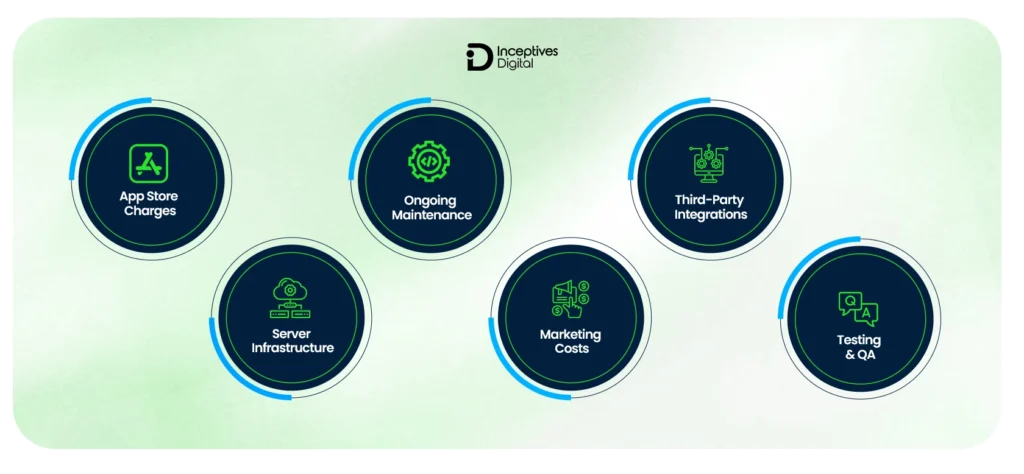
There are some hidden costs in mobile game development that most companies neglect during the initial development estimation. They don’t show up early on, but they can give a sudden surprise in the future if ignored early on.
App Store Fees
You must pay to publish your game. Both Apple and Google charge developer account fees and take a 15–30% commission on in-app purchases and subscriptions. Your revenue will face direct impact from this fee structure if your business depends on monetization as a fundamental element of its operations.
Server & Backend Costs
If your game includes online features, you’ll need to account for server costs for multiplayer games. This includes hosting, databases, APIs, and scaling infrastructure as your user base grows. These costs are ongoing and increase with player activity.
Maintenance & Updates
Post-launch expenses are often underestimated. The maintenance cost (15–25%) of your initial development budget typically goes into:
- Bug fixes
- OS compatibility updates
- Performance improvements
- New feature rollouts
Marketing & User Acquisition
Building the game is only half the work. Getting users is where real spending begins. Marketing costs include:
- Paid ads (CPI campaigns)
- Influencer promotions
- App Store Optimization (ASO)
Without proper investment here, even a well-built game may struggle to gain traction.
Third-Party Tools & Integrations
Many games depend on outside services, such as analytics tools, advertising networks, and payment processing systems. These services usually require customers to pay either subscription fees or usage-based charges, which increases your ongoing expenses.
Testing & Device Compatibility
Mobile games need to function properly on multiple devices. The testing process demands testing across various screen sizes, different operating system versions, and multiple hardware setups. This rigorous testing requires both time and testing equipment and sometimes needs outside quality assurance assistance.
Key Takeaway
These hidden costs will increase your total budget when you do not plan for them in advance. Factoring them in from the start helps you build a more realistic and sustainable financial plan.
Next, let’s break down the mobile game development timeline and how it impacts cost.
Mobile Game Development Timeline and Its Impact on Cost
Your mobile game development timeline depends on the available financial resources. The development period of your game directly impacts the total costs because longer development times result in increased expenses for development, testing, and project management.
Typical Development Timelines by Complexity
- Simple games (Hyper-casual): 1–3 months
- Medium complexity (Casual): 3–6 months
- Advanced games (Mid-core): 6–12 months
- High-end / Multiplayer games: 12+ months
How Timeline Impacts Cost
- More Development Hours = Higher Cost
Development work gets charged either by hourly rates or monthly fees. An extended project duration means increased payments to developers, designers, and QA teams. - Extended Testing Cycles
Complex games need to cover various devices and scenarios, which results in increased testing requirements and development expenses. - Project Management Overhead
Project budget increases because longer projects require additional project management activities, multiple rounds of changes, and double-checking work.
How Complexity Drives Timeline (and Cost)
Timeline and complexity go hand in hand:
- Simple games
Fewer features, minimal design → shorter timeline → lower cost - Feature-rich games
Multiple systems, better UI/UX → longer timeline → higher cost - Multiplayer or 3D games
Backend, real-time syncing, advanced graphics → longest timeline → highest cost
Key Takeaway
The faster you can build without compromising quality, the more you control your budget. The most effective way to control both your mobile game development budget and time requires you to maintain your project scope while avoiding unnecessary features.
Next, let’s look at real-world mobile game development cost examples to make these numbers more practical.
Real-World Mobile Game Development Cost Examples
Real-world mobile game cost examples help connect estimated costs to actual game types. The examples below show how costs increase with project complexity, although exact budget numbers differ between projects.
Simple Puzzle Game Cost
Development costs for simple puzzle games are the lowest because they require minimal financial investment. These apps require only basic game elements, an organized user interface, and a sequential level advancement system to operate effectively.
Example: Games similar to Candy Crush-style mechanics
Estimated Cost Breakdown:
- Core gameplay + levels → $10K – $25K
- UI/UX design → $5K – $15K
- Basic monetization (ads/IAP) → $3K – $10K
Total Estimated Cost: $20,000 – $60,000
These kinds of games can be a good way to quickly launch and test the market demand when little investment cost is involved.
Multiplayer Battle Game Cost
Multiplayer games create major difficulties because players interact simultaneously, and multiple systems work together to support gameplay.
Example: Action-based games draw their inspiration from Call of Duty Mobile, while John Wick-style gameplay provides a cinematic combat experience.
Estimated Cost Breakdown:
- Core gameplay mechanics → $50K – $120K
- Multiplayer systems → $30K – $100K+
- Backend infrastructure → $20K – $80K
- UI/UX + animations → $20K – $50K
Total Estimated Cost: $150,000 – $400,000+
It turns out here that multiplayer systems and server architecture are the big cost drivers.
3D RPG Game Cost
3D RPG and open-world games are among the most expensive due to their scale, visuals, and gameplay depth.
Example: High-end games like Grand Theft Auto VI reflect the level of complexity involved in large-scale game development. While mobile versions are smaller in scope, they still require significant investment.
Estimated Cost Breakdown:
- 3D modeling & animation → $80K – $200K
- Game systems & mechanics → $70K – $150K
- Backend (if online features exist) → $30K – $100K
- Testing & optimization → $20K – $50K
Total Estimated Cost: $250,000 – $800,000+
These games require longer timelines, larger teams, and ongoing updates.
Next, let’s break down cost optimization strategies to help you build efficiently without overspending.
Mobile Game Monetization vs Development Cost (ROI Perspective)
Understanding cost is only half the equation. The actual challenge lies in determining whether your game will recoup its expenses and produce profit. The process of examining mobile game production costs together with their potential revenue results becomes essential at this point.
Even a technically sound game finds it difficult to break even without a proper monetization strategy. On the other hand, you will see a game with well-planned monetization recovers the investments as well as increases the revenue over time.
Common Mobile Game Monetization Strategies
Successful games need to combine multiple mobile game monetization methods because they cannot succeed with only one revenue stream.
- Ads (Ad-Based Monetization)
Functions best with hyper-casual and casual games. It generates revenue through user impressions and user clicks, which works well for games that attract many players. - In-App Purchases (IAPs)
Serve as the most profitable business model. Players pay for in-game items, upgrades, or virtual currency. - Subscriptions
Operates in advanced games. It generates ongoing income through its premium features, exclusive content, and ad-free experiences.
How Revenue Models Impact ROI
Each monetization model affects how quickly you recover your investment:
- Ads → Lower revenue per user, but works at scale
- IAPs → Higher revenue per user, depends on engagement
- Subscriptions → Stable recurring income, requires strong retention
Most games combine these to maximize revenue potential.
Understanding the Break-Even Point
Your break-even point is when your total revenue matches your development and operational costs.
Simple Example:
- Development cost → $100,000
- Monthly revenue → $10,000
- Break-even time → ~10 months
The faster you reach this point, the lower your financial risk.
Key Factors That Influence ROI
- User acquisition cost (how much you spend to get players)
- Player retention (how long users stay engaged)
- Monetization model efficiency
- Game quality and user experience
Key Takeaway
Your game’s success depends on aligning development costs with a realistic revenue strategy. Strong monetization strategies ensure that your investment doesn’t just get recovered, but continues generating returns over time.
Next, let’s look at cost optimization strategies to help you reduce development expenses without compromising quality.
Cost Optimization Strategies for Mobile Game Development
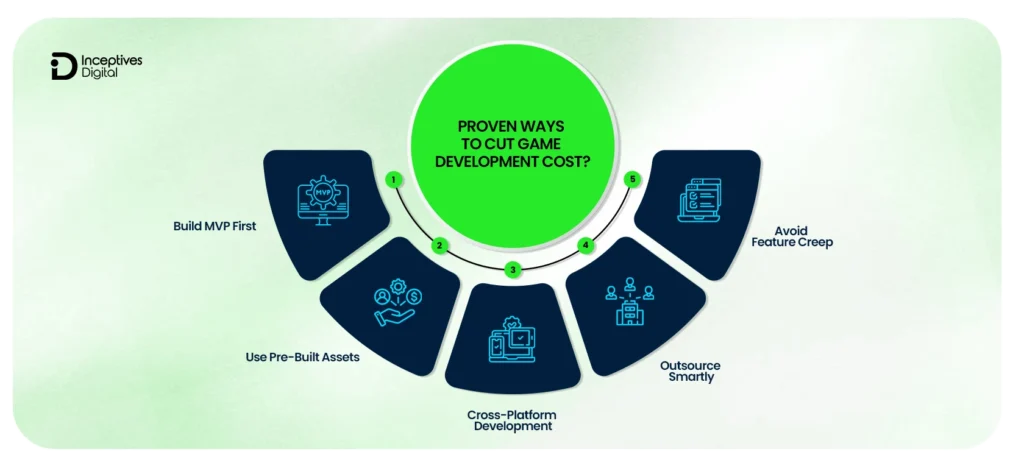
Mobile game budget management requires more than just finding ways to cut costs. It requires specific decisions in the initial stages. Businesses need to implement appropriate cost optimization strategies for game development to lower expenditures without affecting the game quality.
Build an MVP First
You should begin your project with a basic version of the game that helps test its main concept. MVP cost for mobile games helps you test gameplay and collect user opinions while preventing unnecessary spending on features that might fail to function.
Use Pre-Built Assets
Developers should start by using available asset libraries containing pre-made characters, environments, and user interface elements. In the early stages, a project will benefit from this approach because it helps to save both time and design expenses.
Choose Cross-Platform Development
Creating a single game build that works on multiple platforms eliminates the need for redundant development work. Cross-platform development needs less work because of its single development approach compared to native version development.
Outsource Smartly
Hiring the right team at the right cost creates major advantages for organizations. Development projects become more budget-friendly through outsourcing particular tasks such as design work and quality assurance activities.
Avoid Feature Creep
The mobile game development process becomes more expensive when excessive features are added. After launching your game, you should use actual player feedback to determine which gameplay elements to develop.
Key Takeaway
Cost control depends on effective planning and prioritization because these activities serve as the essential foundation. The cost optimization strategies for game development enable you to create a high-quality game while maintaining your game development budget requirements.
Next, let’s compare in-house vs outsourcing costs to help you decide the best approach for your project.
How to Estimate Mobile Game Development Cost (Step-by-Step)
A realistic budget requires you to use a structured method for its development. This step-by-step checklist provides complete instructions for estimating mobile game development costs based on your project requirements and available resources.
Step-by-Step Mobile Game Development Cost Estimation Checklist
1. Define Your Game Idea
Start with a clear concept. What type of game are you building? What is the main gameplay loop of your game? The project needs a specific idea because it will help prevent scope confusion that occurs during development.
2. Choose the Right Genre
Your genre sets the baseline for cost. Hyper-casual games require lower budget needs, which increase for RPGs and multiplayer games.
3. Select Features Carefully
List all the features you want, then prioritize them. Start by focusing on essential features because this approach prevents any cost overruns
4. Decide Your Platform
Choose whether you’re building for Android, iOS, or both. Your platform decision directly impacts development time and budget.
5. Choose Your Development Team
Decide between freelancers, an in-house team, or an agency. Each option comes with different cost structures and levels of control.
6. Estimate Your Budget Range
Combine all the above factors to arrive at a realistic range. Always include a buffer for unexpected expenses and post-launch updates.
Key Takeaway
Accurate estimation depends on establishing a clear understanding of project requirements. Mobile game development budget management becomes simpler when you define your project components with exact specifications.
Final Thoughts
There is no universal cost to develop a mobile game. Your actual mobile game development cost depends on the scope of your game idea, the features you prioritize, and the development approach you follow. Ensure you understand the main cost drivers and plan every step meticulously with a tight focus on scope, so you can create a game that is aligned with your vision and game development budget.
If you want to develop your next game idea, you should first create a budget and growth plan that aligns with your concept. Whether you’re validating an MVP or scaling a full product, the right approach to mobile game development services can make the difference between overspending and building something sustainable.
CTA SECTION START
cta title: Start Building Your Mobile Game With a Clear Budget Plan
cta des: Get a clear cost estimate and expert guidance to build your mobile game the right way without overspending or unnecessary delays
cta button: Get Your Game Cost Estimate
CTA SECTION END
Frequently Asked Questions About Mobile Game Development Cost
Mobile game development costs typically range from $10,000 to $500,000+, depending on complexity, features, platform, and team structure.
Key factors include game complexity, features, platform choice, graphics quality, backend requirements, and the development team you hire.
Development time can range from 1–3 months for simple games to 12+ months for complex or multiplayer games, depending on scope and features.
The most cost-effective approach is to build an MVP first, use pre-built assets, choose cross-platform development, and limit features to essentials.
Yes, but only for very simple games with minimal features, basic design, and no advanced functionality like multiplayer or complex backend systems.
SIDEBAR LIST START
- How Much Does Mobile Game Development Cost(Complete Cost Breakdown Guide)
- How Much Does It Really Cost to Develop a Mobile Game?
- Mobile Game Development Cost Overview (Quick Snapshot)
- Mobile Game Development Cost Breakdown by Stages
- What Factors Affect Mobile Game Development Cost?
- Mobile Game Development Cost by Genre
- Feature-Based Mobile Game Development Cost
- Cost by Development Location (Outsourcing vs In-House)
- Hidden Costs in Mobile Game Development
- Mobile Game Development Timeline and Its Impact on Cost
- Real-World Mobile Game Development Cost Examples
- Mobile Game Monetization vs Development Cost (ROI Perspective)
- Cost Optimization Strategies for Mobile Game Development
- How to Estimate Mobile Game Development Cost (Step-by-Step)
- Final Thoughts
- FAQs
SIDEBAR LIST END