Short-form videos have reshaped how people use social media. They demand quick and personal videos as soon as they start an app. They are 2.5x more likely to be watched than long-form videos, and 85% of users prefer videos under 15 seconds. Given the enormous demand for short-form videos, companies such as Facebook and Instagram are starting Reels in an attempt to compete with TikTok.
It is not so easy as it sounds. Building a TikTok-like app is a lot more than just adding a video feed. It is building a system that can learn from users, provide relevant content right away, and scale without problems. But such a system needs the right tech stack and architecture, prioritization of features, and planning from the very start.
Such a task can seem overwhelming, but building an app to match TikTok is easy with the right company. They know how to manage the development costs and ensure the app is stable. You should select the right mobile app development company very carefully.
This guide will explain how to develop a TokTok-like application through technical stack details, cost/ timeline estimation, and essential development tips. This guide provides instructions for developing TikTok-like applications while showing developers how to create applications that attract user attention.
What Makes TikTok So Addictive? (Core Product Breakdown)
It is very important to understand how TikTok actually works before jumping directly to the development phase. The main secret of the short videos is how these are delivered, consumed, and optimized in real time.
The Core Features Behind TikTok’s Engagement
- Infinite Scroll Feed
Content loads instantly without any delays. Users don’t choose their viewing content because the app makes those decisions for them. - Personalized Recommendation System
The feed changes according to the user patterns, which include their watch time, replays, likes, and skips. - Built-in Video Creation Tools
Content creation becomes quick and simple through filters, together with effects, music, and editing tools. - Social Interaction Layer
Feedback loops, which use likes, comments, shares, and follows, create mechanisms that increase user interaction. - Creator-Friendly Ecosystem
A combination of easy content publishing and increased visibility leads to a higher rate of content creation.
How TikTok’s Content Loop Works (Simplified)
This is where the real magic happens:
- User opens the app
- The system instantly shows curated content
- User interacts (watch, like, skip, share)
- Data is captured and analyzed
- Feed improves in real time
Upon every swipe, the cycle continues-this made every experience highly personalized.
Why This Model Works So Well
- Removes decision fatigue (no need to search)
- Delivers instant gratification
- Continuously adapts to user preferences
- Keeps users engaged for longer sessions
Key Takeaway Before You Build
If you want to develop a TikTok-style app, then your focus should extend beyond its features. You need to build systems that actually provide content distribution, user interaction, and the application’s ability to learn from user behavior over time.
Adopting this framework is going to completely determine how you will approach features, technology stack, and development in the next steps.
Types of Apps You Can Build (Don’t Copy TikTok Blindly)
You have to be very clear and well-informed about your app development idea. Straight away, copying TikTok should not be your focus. Instead, adapt to the specific use case or a targeted audience. Here TikTok-like app ideas that you can think of:
1. Niche Short-Video Platforms
In a niche-based model, the focus is only on a specific type of audience, like fitness, education, fashion, or food. It increases content relevance, engagement, and reduces competition by narrowing down your focus audience. It is one of the best approaches for market entry.
2. Social Media Apps with Video-First Experience
Here, short-form video becomes the core of a broader social platform. Users can follow, interact, and engage, but the experience revolves around video consumption. This approach has high growth potential but also comes with strong competition and higher development complexity.
3. Creator Economy Platforms
These platforms are built for creators who want to grow and monetize their content. Features like subscriptions, tipping, and analytics are central. With creators actively looking for better earning opportunities, this model is gaining traction.
4. Brand or Community-Based Apps
This type leverages an existing audience, such as a brand or community. Instead of building from scratch, you offer users a more engaging way to consume content. It often leads to faster adoption and stronger retention.
Quick Comparison to Help You Decide
| App Type | Target Audience | Competition Level | Monetization Potential |
| Niche Video App | Specific users | Low–Medium | Medium–High |
| Social Platform | General users | Very High | High |
| Creator Platform | Influencers | Medium | Very High |
| Brand App | Existing audience | Low | High |
Step-by-Step Process to Make an App Like TikTok
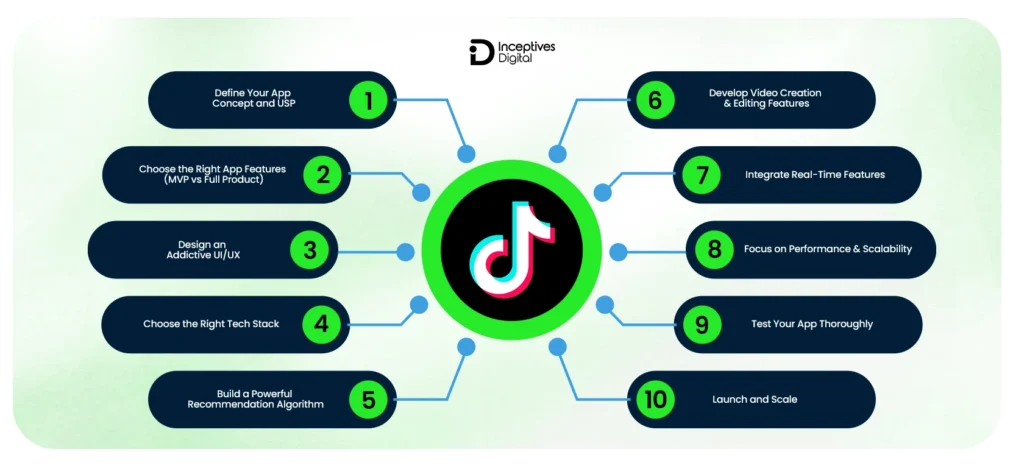
Creating a TikTok-like platform requires strategic decisions, which will determine how your product will perform in the future and its operational efficiency and capacity to grow. Here is a complete guide that shows all the necessary steps involved in the app development process of a concept like TikTok.
Step 1: Define Your App Concept and USP
In this phase, you need to determine what type of audience you will target and the type of content your application will deliver. Focusing on a niche mostly results in better than targeting a broader audience. Define what makes your app unique, for example, better content formats and creator-focused features. Validate your idea before heading towards the next steps by competitor analysis, and check if you are actually solving a real problem. When a user is not convinced by your app’s clear USP to switch from another app to your app, then there is something wrong with the intricate design of your app idea.
Step 2: Finalize Features (MVP First, Not Full Product)
One of the most significant mistakes consists of simply trying to build everything. Following this reasoning, an MVP (Minimum Viable Product) with only the most essential features should be focused on instead.
Must-Have Features (MVP)
| Feature | Description |
| User Authentication | Signup, login, and profile setup |
| Video Upload | Record or upload short videos |
| Video Feed | Scrollable, personalized content feed |
| Engagement Tools | Likes, comments, shares |
| Search & Discovery | Find users and trending content |
You can implement advanced features once your MVP is stable, such as AI recommendations, live streaming, and monetization tools, which can be explored.
Step 3: Design a Seamless UI/UX
Your app needs to deliver a fast, easy-to-use, and seamless design because these elements will keep users returning to your app. Users should experience immediate feedback during all interactions, including swiping through videos and tapping likes. Your focus should be on one-handed usability, smooth navigation, and fast content loading. Avoid complex design, try to keep everything simple for maximum engagement.
Step 4: Choose the Right Tech Stack
Your tech stack directly impacts performance and scalability.
Recommended Tech Stack
| Component | Suggested Tech |
| Frontend | Flutter / React Native |
| Backend | Node.js |
| Database | MongoDB / PostgreSQL |
| Storage | AWS S3 |
| CDN | AWS CloudFront |
The aim should be to develop a system that can handle high traffic volume while delivering video content with improved speed and providing instant interactive features that operate without any delay.
Step 5: Build the Recommendation Engine
A recommendation engine is a foundation for an app like TikTok. It tracks user activities like watch time, likes, shares, and skips. Using this data, it continuously improves the content feed by recommending personalized content. This keeps the users engaged and coming back. A recommendation engine can make a huge difference in the success of your mobile applications. You can improve the engine over time with advanced machine learning models.
Step 6: Develop Video Creation and Editing Features
Content creation needs to be quick and accessible. Users will not create content if they find the process too complex. You should begin with basic features, which include trimming, filters, music integration, and speed control. Your app development should start with basic features and can expand later to include advanced tools like AR effects and transitions.
Step 7: Add Real-Time Features
Users stay more engaged with products they experience through direct interactive features. It includes push notifications, live streaming, and messaging as its core features. The combination of WebSockets and Firebase technologies delivers effective solutions for implementing these requirements.
Step 8: Optimize for Performance and Scalability
Video applications require substantial system resources, which makes it essential to improve their operational efficiency. The project needs to achieve objectives like decreasing loading times, reducing video file sizes through compression, and implementing CDNs for improved content delivery speed. Your app has to function properly because it will receive increasing user traffic.
Step 9: Test Before You Launch
Your application performance testing needs to be executed in real environmental conditions. The testing process requires you to perform functional tests, together with performance tests and security tests. The identification of bottlenecks needs to occur at an early stage because this process prevents problems after the launch.
Step 10: Launch and Improve Continuously
You should start your application by focusing on a limited group of users. Afterward, you need to study their feedback to determine which features they want. The application needs ongoing support, together with scheduled updates, to maintain its market position, security, and operational efficiency.
Key Takeaway
Developing TikTok-like applications requires a structured mobile app development process, which needs multiple development phases to be completed before proceeding to the next phase. Successful execution of the project establishes an effective foundation that enables the organization to expand its operations while maintaining system stability.
How Much Does It Cost to Make an App Like TikTok?
Factors like complexity, number of features, and the extent to which you want the app to expand determine the cost to develop an app like TikTok. An MVP costs comparatively less than a full-fledged application with advanced algorithms and video processing. Here is a stage-wise development cost breakdown for building an app like TikTok.
The development cost for a TikTok-like app depends on three factors: project complexity, the number of features, and the size of the application. An MVP costs comparatively less than a full-fledged application with advanced algorithms and video processing. The following breakdown shows stage-wise development costs for creating a TikTok-style application.
Cost Breakdown by Development Stage
| Stage | Estimated Cost |
| UI/UX Design | $5,000 – $15,000 |
| Frontend Development | $20,000 – $50,000 |
| Backend Development | $25,000 – $60,000 |
| Video Features | $15,000 – $40,000 |
| Testing & QA | $5,000 – $15,000 |
Total Estimated Cost
- MVP (Minimum Viable Product) Cost: $50,000 – $120,000
- Full-Scale App: $150,000 – $300,000+
Factors That Affect the Cost of Developing an App Like TikTok
- Feature complexity: Advanced features, for example, AI recommendations, live streaming, or AR filters
- Video infrastructure: Storage, compression, and streaming setup require significant resources
- Scalability requirements: Apps built for large audiences need stronger backend architecture and cloud support
- Development approach: Costs vary depending on whether you build in-house or hire a mobile app development company
Monetization Strategies for TikTok-Like Apps
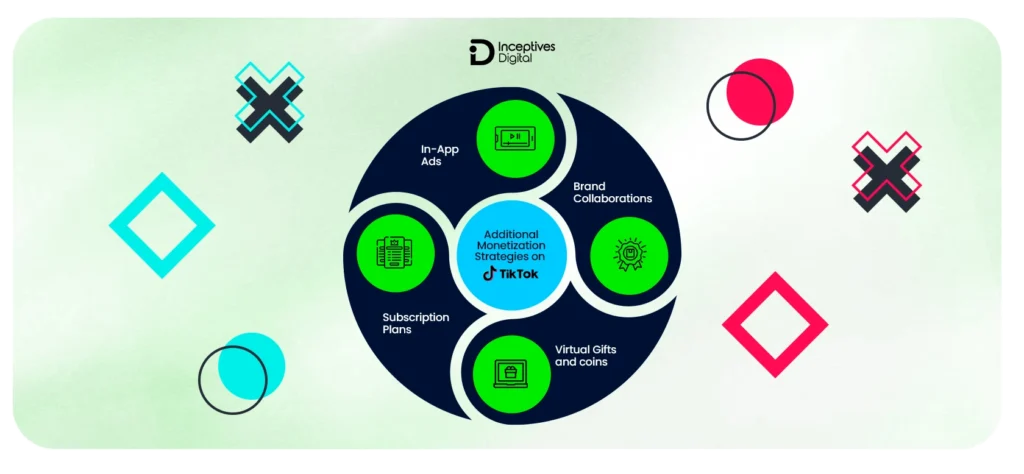
It is one of the most important parts after the development process ends. You have to apply effective app monetization strategies in a way that generates maximum ROI as well as maintains the overall user experience.
1. In-App Advertising
Mobile applications use this method as the primary method for revenue generation. It lets you display advertisements in a manner that makes them seem like they belong to the complete video content. This makes significant profits while maintaining a positive experience for your users. You can use sponsored videos, banner ads, and branded tasks as advertisement formats to show ads in a straightforward manner.
2. Subscription Plans
The app enables you to create two sections, which contain free content and premium content that users can access through subscription payments. Premium features can be ad-free browsing, exclusive content, or advanced tools. This revenue model becomes advantageous when your app delivers valuable content that users will choose to pay for.
3. Virtual Gifts and Coins
The system allows users to buy in-game currency, which they can use to send gifts to other creators during live streaming and video broadcasts. The platform generates revenue through commission payments, which establish a strong financial base for the creator economy.
4. Brand Collaborations
Through the brand partnership model, you can use influencers and sponsored content for product marketing. Your platform will achieve better scalability when it starts expanding and attracting creators who possess wide-reaching audience connections.
Challenges in Building a TikTok-Like App (And How to Solve Them)
Video streaming apps like TikTok must manage high volumes of video content and user activities, which is why even small technical issues can lead to major disruptions in operations, customer satisfaction, and business expansion. All technical and strategic elements of building a TikTok application must receive early attention because failure to do so will result in expensive problems during the development process. Businesses encounter multiple hurdles when they attempt to create an application like TikTok.
Common Challenges in Building a TikTok-Like App and Their Solutions
| Challenge | Solution |
| High server load | Use cloud infrastructure with auto-scaling to handle sudden traffic spikes. The implementation of CDNs together with load balancing will create a system that delivers video content to users without any interruptions. |
| Content moderation | Use artificial intelligence content filtering together with human content moderation to detect any content that may be harmful or unsuitable. This approach protects users who use the platform while establishing trust between users and the system. |
| User retention | Create a recommendation system that develops user preferences in real time. The system uses personalized content to maintain user interest and extend their time on the platform. |
| Competition | You should concentrate your efforts on a particular target audience instead of trying to reach all people. Your business will benefit from clear positioning, enabling you to attract dedicated users who will choose to stay. |
How Long Does It Take to Build an App Like TikTok?
Characteristics like scope, features, and team composition decide how long your app, like TikTok, needs to develop. To launch faster, MVP development is an ideal approach instead of going with a full-scale platform.
Development Timeline by Phase
| Phase | Timeline |
| Planning | 2–4 weeks |
| Design | 4–6 weeks |
| Development | 4–8 months |
| Testing | 3–5 weeks |
What This Timeline Means
You start your planning process by developing your initial concept together with all necessary features and technical elements. The design phase comes next, where designers create a user interface and user experience system that enables users to navigate your application. Next is the development process, which involves creating the frontend, backend, and video systems. Testing verifies that your application operates correctly before it becomes available to users.
Key Takeaway
You should expect your MVP development to take about 4 to 6 months. The complete app development timeline will require 6 to 12 months or more, depending on its complexity and need for scalability.
Best Practices to Ensure Success
Understanding of user behaviour and providing a good user base are the backbones for content-based apps like these. Without focusing on these aspects, even apps with the right features and tech stack fail. A clear understanding of these fundamentals at the beginning can be the real game-changers.
1. Start with MVP, Not the Full Product
Start your TikTok-like app development by creating an MVP that delivers essential functions instead of attempting to include every possible feature. This approach helps evaluate your business concept through market testing, collecting actual user feedback, and maintaining cost efficiency during early development phases.
2. Focus on Retention, Not Just Downloads
The trick is not just getting users to install your app. The trick is to keep users active through the app by providing them with personalized feeds and enabling them to use the app without any interruptions.
3. Optimize for Performance Early
Video-based applications require significant system resources to function. Users will abandon your application when they experience delays or buffering issues. You need to focus on quick loading times, effective video streaming, and reliable backend systems from your project’s start.
4. Keep UI Simple and Fast
A clean interface with an intuitive design lets users access content without any difficulties. Users should maintain their focus on navigation and quick actions while avoiding any clutter. Users will continue using the system for longer time periods when its design becomes more user-friendly.
Do You Need an App Development Company?
Building a TikTok-like app requires developers to create complicated features that can handle live video streams while ensuring the software can handle increased usage. The decision to choose between hiring a professional custom software development company and building an in-house team will determine your project timeline, product quality, and development costs.
When to Hire Professionals
Hiring a development company makes sense if:
- You need to establish a product that meets high standards of quality and scalability to be delivered in a short timeframe.
- Your organization does not possess the necessary expert resources for developing video streaming systems and backend infrastructure, along with AI-based recommendation technologies.
- You want to concentrate on developing organizational strategy and driving business growth while specialists take charge of technical project execution.
A professional team has the ability to assist you in selecting the appropriate technology stack while implementing optimal methods and protecting you from expensive errors.
In-House vs Outsourcing Comparison
| Factor | In-House Team | Outsourcing / App Development Company |
| Cost | Higher upfront, salaries + overhead | Flexible, project-based, or fixed pricing |
| Expertise | Limited to internal skills | Access to specialists in video, AI, and backend |
| Time | Longer ramp-up, hiring delays | A faster, experienced team accelerates development |
| Control | Full control over the process | Moderate control, depends on communication |
| Scalability | Harder to scale quickly | Easy to scale resources as needed |
Key Takeaway
For the development of complex applications such as TikTok, a partnership with a cross-platform app development company provides benefits through reduced risks, enhanced product quality, and faster delivery times.
Conclusion: Turning Your TikTok-Like App Idea Into Reality
Developing an app like TikTok is not just copying and introducing the same features. You have to think out of the box to get recognized and compete with already established giants. A well-thought-out plan, niche identification, and implementation of smart monetization strategies can really boost the app’s potential to be a huge success. Also, you have to be well aware of the estimated app development cost and timeline to dodge common pitfalls.
If you are thinking of developing an app like TikTok, the best way to execute your idea is to collaborate with a team that provides professional mobile app development services. They will help with technical complexities, building a robust backend, an intuitive user interface, and avoiding common pitfalls during the app development process. You can have an after-launch contract for maintenance and updates.
Short-form videos have reshaped how people use social media. They demand quick and personal videos as soon as they start an app. They are 2.5x more likely to be watched than long-form videos, and 85% of users prefer videos under 15 seconds. Given the enormous demand for short-form videos, companies such as Facebook and Instagram are starting Reels in an attempt to compete with TikTok.
It is not so easy as it sounds. Building a TikTok-like app is a lot more than just adding a video feed. It is building a system that can learn from users, provide relevant content right away, and scale without problems. But such a system needs the right tech stack and architecture, prioritization of features, and planning from the very start.
Such a task can seem overwhelming, but building an app to match TikTok is easy with the right company. They know how to manage the development costs and ensure the app is stable. You should select the right mobile app development company very carefully.
This guide will explain how to develop a TokTok-like application through technical stack details, cost/ timeline estimation, and essential development tips. This guide provides instructions for developing TikTok-like applications while showing developers how to create applications that attract user attention.
What Makes TikTok So Addictive? (Core Product Breakdown)
It is very important to understand how TikTok actually works before jumping directly to the development phase. The main secret of the short videos is how these are delivered, consumed, and optimized in real time.
The Core Features Behind TikTok’s Engagement
- Infinite Scroll Feed
Content loads instantly without any delays. Users don’t choose their viewing content because the app makes those decisions for them. - Personalized Recommendation System
The feed changes according to the user patterns, which include their watch time, replays, likes, and skips. - Built-in Video Creation Tools
Content creation becomes quick and simple through filters, together with effects, music, and editing tools. - Social Interaction Layer
Feedback loops, which use likes, comments, shares, and follows, create mechanisms that increase user interaction. - Creator-Friendly Ecosystem
A combination of easy content publishing and increased visibility leads to a higher rate of content creation.
How TikTok’s Content Loop Works (Simplified)
This is where the real magic happens:
- User opens the app
- The system instantly shows curated content
- User interacts (watch, like, skip, share)
- Data is captured and analyzed
- Feed improves in real time
Upon every swipe, the cycle continues-this made every experience highly personalized.
Why This Model Works So Well
- Removes decision fatigue (no need to search)
- Delivers instant gratification
- Continuously adapts to user preferences
- Keeps users engaged for longer sessions
Key Takeaway Before You Build
If you want to develop a TikTok-style app, then your focus should extend beyond its features. You need to build systems that actually provide content distribution, user interaction, and the application’s ability to learn from user behavior over time.
Adopting this framework is going to completely determine how you will approach features, technology stack, and development in the next steps.
Types of Apps You Can Build (Don’t Copy TikTok Blindly)
You have to be very clear and well-informed about your app development idea. Straight away, copying TikTok should not be your focus. Instead, adapt to the specific use case or a targeted audience. Here TikTok-like app ideas that you can think of:
1. Niche Short-Video Platforms
In a niche-based model, the focus is only on a specific type of audience, like fitness, education, fashion, or food. It increases content relevance, engagement, and reduces competition by narrowing down your focus audience. It is one of the best approaches for market entry.
2. Social Media Apps with Video-First Experience
Here, short-form video becomes the core of a broader social platform. Users can follow, interact, and engage, but the experience revolves around video consumption. This approach has high growth potential but also comes with strong competition and higher development complexity.
3. Creator Economy Platforms
These platforms are built for creators who want to grow and monetize their content. Features like subscriptions, tipping, and analytics are central. With creators actively looking for better earning opportunities, this model is gaining traction.
4. Brand or Community-Based Apps
This type leverages an existing audience, such as a brand or community. Instead of building from scratch, you offer users a more engaging way to consume content. It often leads to faster adoption and stronger retention.
Quick Comparison to Help You Decide
| App Type | Target Audience | Competition Level | Monetization Potential |
| Niche Video App | Specific users | Low–Medium | Medium–High |
| Social Platform | General users | Very High | High |
| Creator Platform | Influencers | Medium | Very High |
| Brand App | Existing audience | Low | High |
Step-by-Step Process to Make an App Like TikTok
Creating a TikTok-like platform requires strategic decisions, which will determine how your product will perform in the future and its operational efficiency and capacity to grow. Here is a complete guide that shows all the necessary steps involved in the app development process of a concept like TikTok.
Step 1: Define Your App Concept and USP
In this phase, you need to determine what type of audience you will target and the type of content your application will deliver. Focusing on a niche mostly results in better than targeting a broader audience. Define what makes your app unique, for example, better content formats and creator-focused features. Validate your idea before heading towards the next steps by competitor analysis, and check if you are actually solving a real problem. When a user is not convinced by your app’s clear USP to switch from another app to your app, then there is something wrong with the intricate design of your app idea.
Step 2: Finalize Features (MVP First, Not Full Product)
One of the most significant mistakes consists of simply trying to build everything. Following this reasoning, an MVP (Minimum Viable Product) with only the most essential features should be focused on instead.
Must-Have Features (MVP)
| Feature | Description |
| User Authentication | Signup, login, and profile setup |
| Video Upload | Record or upload short videos |
| Video Feed | Scrollable, personalized content feed |
| Engagement Tools | Likes, comments, shares |
| Search & Discovery | Find users and trending content |
You can implement advanced features once your MVP is stable, such as AI recommendations, live streaming, and monetization tools, which can be explored.
Step 3: Design a Seamless UI/UX
Your app needs to deliver a fast, easy-to-use, and seamless design because these elements will keep users returning to your app. Users should experience immediate feedback during all interactions, including swiping through videos and tapping likes. Your focus should be on one-handed usability, smooth navigation, and fast content loading. Avoid complex design, try to keep everything simple for maximum engagement.
Step 4: Choose the Right Tech Stack
Your tech stack directly impacts performance and scalability.
Recommended Tech Stack
| Component | Suggested Tech |
| Frontend | Flutter / React Native |
| Backend | Node.js |
| Database | MongoDB / PostgreSQL |
| Storage | AWS S3 |
| CDN | AWS CloudFront |
The aim should be to develop a system that can handle high traffic volume while delivering video content with improved speed and providing instant interactive features that operate without any delay.
Step 5: Build the Recommendation Engine
A recommendation engine is a foundation for an app like TikTok. It tracks user activities like watch time, likes, shares, and skips. Using this data, it continuously improves the content feed by recommending personalized content. This keeps the users engaged and coming back. A recommendation engine can make a huge difference in the success of your mobile applications. You can improve the engine over time with advanced machine learning models.
Step 6: Develop Video Creation and Editing Features
Content creation needs to be quick and accessible. Users will not create content if they find the process too complex. You should begin with basic features, which include trimming, filters, music integration, and speed control. Your app development should start with basic features and can expand later to include advanced tools like AR effects and transitions.
Step 7: Add Real-Time Features
Users stay more engaged with products they experience through direct interactive features. It includes push notifications, live streaming, and messaging as its core features. The combination of WebSockets and Firebase technologies delivers effective solutions for implementing these requirements.
Step 8: Optimize for Performance and Scalability
Video applications require substantial system resources, which makes it essential to improve their operational efficiency. The project needs to achieve objectives like decreasing loading times, reducing video file sizes through compression, and implementing CDNs for improved content delivery speed. Your app has to function properly because it will receive increasing user traffic.
Step 9: Test Before You Launch
Your application performance testing needs to be executed in real environmental conditions. The testing process requires you to perform functional tests, together with performance tests and security tests. The identification of bottlenecks needs to occur at an early stage because this process prevents problems after the launch.
Step 10: Launch and Improve Continuously
You should start your application by focusing on a limited group of users. Afterward, you need to study their feedback to determine which features they want. The application needs ongoing support, together with scheduled updates, to maintain its market position, security, and operational efficiency.
Key Takeaway
Developing TikTok-like applications requires a structured mobile app development process, which needs multiple development phases to be completed before proceeding to the next phase. Successful execution of the project establishes an effective foundation that enables the organization to expand its operations while maintaining system stability.
How Much Does It Cost to Make an App Like TikTok?
Factors like complexity, number of features, and the extent to which you want the app to expand determine the cost to develop an app like TikTok. An MVP costs comparatively less than a full-fledged application with advanced algorithms and video processing. Here is a stage-wise development cost breakdown for building an app like TikTok.
The development cost for a TikTok-like app depends on three factors: project complexity, the number of features, and the size of the application. An MVP costs comparatively less than a full-fledged application with advanced algorithms and video processing. The following breakdown shows stage-wise development costs for creating a TikTok-style application.
Cost Breakdown by Development Stage
| Stage | Estimated Cost |
| UI/UX Design | $5,000 – $15,000 |
| Frontend Development | $20,000 – $50,000 |
| Backend Development | $25,000 – $60,000 |
| Video Features | $15,000 – $40,000 |
| Testing & QA | $5,000 – $15,000 |
Total Estimated Cost
- MVP (Minimum Viable Product) Cost: $50,000 – $120,000
- Full-Scale App: $150,000 – $300,000+
Factors That Affect the Cost of Developing an App Like TikTok
- Feature complexity: Advanced features, for example, AI recommendations, live streaming, or AR filters
- Video infrastructure: Storage, compression, and streaming setup require significant resources
- Scalability requirements: Apps built for large audiences need stronger backend architecture and cloud support
- Development approach: Costs vary depending on whether you build in-house or hire a mobile app development company
Monetization Strategies for TikTok-Like Apps
It is one of the most important parts after the development process ends. You have to apply effective app monetization strategies in a way that generates maximum ROI as well as maintains the overall user experience.
1. In-App Advertising
Mobile applications use this method as the primary method for revenue generation. It lets you display advertisements in a manner that makes them seem like they belong to the complete video content. This makes significant profits while maintaining a positive experience for your users. You can use sponsored videos, banner ads, and branded tasks as advertisement formats to show ads in a straightforward manner.
2. Subscription Plans
The app enables you to create two sections, which contain free content and premium content that users can access through subscription payments. Premium features can be ad-free browsing, exclusive content, or advanced tools. This revenue model becomes advantageous when your app delivers valuable content that users will choose to pay for.
3. Virtual Gifts and Coins
The system allows users to buy in-game currency, which they can use to send gifts to other creators during live streaming and video broadcasts. The platform generates revenue through commission payments, which establish a strong financial base for the creator economy.
4. Brand Collaborations
Through the brand partnership model, you can use influencers and sponsored content for product marketing. Your platform will achieve better scalability when it starts expanding and attracting creators who possess wide-reaching audience connections.
Challenges in Building a TikTok-Like App (And How to Solve Them)
Video streaming apps like TikTok must manage high volumes of video content and user activities, which is why even small technical issues can lead to major disruptions in operations, customer satisfaction, and business expansion. All technical and strategic elements of building a TikTok application must receive early attention because failure to do so will result in expensive problems during the development process. Businesses encounter multiple hurdles when they attempt to create an application like TikTok.
Common Challenges in Building a TikTok-Like App and Their Solutions
| Challenge | Solution |
| High server load | Use cloud infrastructure with auto-scaling to handle sudden traffic spikes. The implementation of CDNs together with load balancing will create a system that delivers video content to users without any interruptions. |
| Content moderation | Use artificial intelligence content filtering together with human content moderation to detect any content that may be harmful or unsuitable. This approach protects users who use the platform while establishing trust between users and the system. |
| User retention | Create a recommendation system that develops user preferences in real time. The system uses personalized content to maintain user interest and extend their time on the platform. |
| Competition | You should concentrate your efforts on a particular target audience instead of trying to reach all people. Your business will benefit from clear positioning, enabling you to attract dedicated users who will choose to stay. |
How Long Does It Take to Build an App Like TikTok?
Characteristics like scope, features, and team composition decide how long your app, like TikTok, needs to develop. To launch faster, MVP development is an ideal approach instead of going with a full-scale platform.
Development Timeline by Phase
| Phase | Timeline |
| Planning | 2–4 weeks |
| Design | 4–6 weeks |
| Development | 4–8 months |
| Testing | 3–5 weeks |
What This Timeline Means
You start your planning process by developing your initial concept together with all necessary features and technical elements. The design phase comes next, where designers create a user interface and user experience system that enables users to navigate your application. Next is the development process, which involves creating the frontend, backend, and video systems. Testing verifies that your application operates correctly before it becomes available to users.
Key Takeaway
You should expect your MVP development to take about 4 to 6 months. The complete app development timeline will require 6 to 12 months or more, depending on its complexity and need for scalability.
Best Practices to Ensure Success
Understanding of user behaviour and providing a good user base are the backbones for content-based apps like these. Without focusing on these aspects, even apps with the right features and tech stack fail. A clear understanding of these fundamentals at the beginning can be the real game-changers.
1. Start with MVP, Not the Full Product
Start your TikTok-like app development by creating an MVP that delivers essential functions instead of attempting to include every possible feature. This approach helps evaluate your business concept through market testing, collecting actual user feedback, and maintaining cost efficiency during early development phases.
2. Focus on Retention, Not Just Downloads
The trick is not just getting users to install your app. The trick is to keep users active through the app by providing them with personalized feeds and enabling them to use the app without any interruptions.
3. Optimize for Performance Early
Video-based applications require significant system resources to function. Users will abandon your application when they experience delays or buffering issues. You need to focus on quick loading times, effective video streaming, and reliable backend systems from your project’s start.
4. Keep UI Simple and Fast
A clean interface with an intuitive design lets users access content without any difficulties. Users should maintain their focus on navigation and quick actions while avoiding any clutter. Users will continue using the system for longer time periods when its design becomes more user-friendly.
Do You Need an App Development Company?
Building a TikTok-like app requires developers to create complicated features that can handle live video streams while ensuring the software can handle increased usage. The decision to choose between hiring a professional custom software development company and building an in-house team will determine your project timeline, product quality, and development costs.
When to Hire Professionals
Hiring a development company makes sense if:
- You need to establish a product that meets high standards of quality and scalability to be delivered in a short timeframe.
- Your organization does not possess the necessary expert resources for developing video streaming systems and backend infrastructure, along with AI-based recommendation technologies.
- You want to concentrate on developing organizational strategy and driving business growth while specialists take charge of technical project execution.
A professional team has the ability to assist you in selecting the appropriate technology stack while implementing optimal methods and protecting you from expensive errors.
In-House vs Outsourcing Comparison
| Factor | In-House Team | Outsourcing / App Development Company |
| Cost | Higher upfront, salaries + overhead | Flexible, project-based, or fixed pricing |
| Expertise | Limited to internal skills | Access to specialists in video, AI, and backend |
| Time | Longer ramp-up, hiring delays | A faster, experienced team accelerates development |
| Control | Full control over the process | Moderate control, depends on communication |
| Scalability | Harder to scale quickly | Easy to scale resources as needed |
Key Takeaway
For the development of complex applications such as TikTok, a partnership with a cross-platform app development company provides benefits through reduced risks, enhanced product quality, and faster delivery times.
Conclusion: Turning Your TikTok-Like App Idea Into Reality
Developing an app like TikTok is not just copying and introducing the same features. You have to think out of the box to get recognized and compete with already established giants. A well-thought-out plan, niche identification, and implementation of smart monetization strategies can really boost the app’s potential to be a huge success. Also, you have to be well aware of the estimated app development cost and timeline to dodge common pitfalls.
If you are thinking of developing an app like TikTok, the best way to execute your idea is to collaborate with a team that provides professional mobile app development services. They will help with technical complexities, building a robust backend, an intuitive user interface, and avoiding common pitfalls during the app development process. You can have an after-launch contract for maintenance and updates.
CTA SECTION START
cta title: Start Building Your Own Short-Video App Today
cta des: Get expert guidance and build a TikTok-like app that engages users, scales easily, and grows your audience fast.
cta button: Let’s Connect
CTA SECTION END
An MVP can cost $50,000–$120,000, while a full-featured app ranges from $150,000–$300,000+, depending on features and scalability.
TikTok uses a mix of Node.js for backend, MongoDB/PostgreSQL for databases, Flutter/React Native for frontend, and AWS for storage/CDN, along with AI-driven recommendation algorithms.
A basic MVP can take 4–6 months, while a full-scale app may take 6–12+ months, depending on complexity and team size.
Yes, by starting with a focused MVP, leveraging niche audiences, and potentially using a mobile app development company to handle complex features.
Through in-app ads, subscriptions, virtual gifts/coins, and brand collaborations, often combining multiple monetization strategies for maximum revenue.
SIDEBAR LIST START
- How to Make an App Like TikTok (Step-by-Step Development Guide)
- What Makes TikTok So Addictive? (Core Product Breakdown)
- Types of Apps You Can Build (Don’t Copy TikTok Blindly)
- Step-by-Step Process to Make an App Like TikTok
- How Much Does It Cost to Make an App Like TikTok?
- Monetization Strategies for a TikTok-Like App
- Challenges in Building a TikTok-Like App (And How to Solve Them)
- How Long Does It Take to Build an App Like TikTok?
- Best Practices to Ensure Success
- Do You Need an App Development Company?
- Conclusion: Turning Your TikTok-Like App Idea Into Reality
- FAQs: TikTok-Like App Development
SIDEBAR LIST END