You probably have a solid app idea right now. Maybe it solves a real problem. Maybe it even feels like “this could be the next big thing.”
But founders have kept one thing in mind that building a mobile app is not a difficult task. What most founders struggle with is building a successful mobile app that people really use.
Recent data shows that nearly 80% of mobile apps fail within the first year, and one of the biggest reasons is simple. They never validated real demand before development. Even more telling, 43% of startups fail because there’s no market need at all. In other words, the idea wasn’t tested; it was assumed.
That’s exactly why understanding how to validate a mobile app idea isn’t just a “nice step” in the process. It’s the difference between building a product people use and launching something that quietly disappears in the app store.
And this is where many founders go wrong. They jump straight into development or hire a mobile app development company, thinking execution will fix everything. It doesn’t. If the core idea isn’t validated, even the best-built app won’t survive.
This guide is built to change that.
Instead of vague advice, you’ll learn practical, real-world validation steps, from testing demand and analyzing competitors to gathering user feedback and measuring actual interest. By the end, you won’t just have an idea. You’ll know whether it’s worth building at all.
What Does It Mean to Validate a Mobile App Idea?
Validating your mobile idea actually means conducting extensive research and gathering real signals for your mobile app idea. The primary purpose of the validation process is to verify that your app actually solves a problem and that the solution is highly demanded in the market.
Jumping directly to the mobile app development process without validating leads to a useless app. Developing a useless app is like betting on a wheelchair user in a marathon. So it is very important to assess the market before starting the development process to make sure your app attracts users and cultivates real ROI.
The difference between an assumption and a real signal is simple:
- Assumptions: What you think users want.
- Real signals: What users actually do or say when presented with your idea.
Quick Snapshot Table: Idea vs Validation
| Aspect | Idea | Validation |
| Focus | Concept | Real demand |
| Evidence | Assumptions | Data & feedback |
| Risk | High | Reduced |
Validation is the first step in turning an idea into a product people actually need.
Why Validating Your App Idea Is Non-Negotiable
You could save time up front by skipping the idea validation process, but eventually it will lead to greater losses. Developing a mobile app without analyzing the market demand is just like investing your efforts and capital in a solution that is not needed by the users.
This is why market research for app validation has so much importance. It assists you in understanding your audience, identifying true demand, and recognizing gaps long before publishing your app on app stores. Instead of guessing, you’re making decisions based on actual data and user behavior.
Validation also plays a direct role in reducing product failure risk. By testing your idea early, you can:
- Avoid building unnecessary features
- Catch weak concepts before they become expensive mistakes
- Focus only on what users actually value
Validation isn’t an extra step. In fact, it’s what protects your app development cost, timeline, and chances of success.
Step-by-Step Process to Validate Your Mobile App Idea
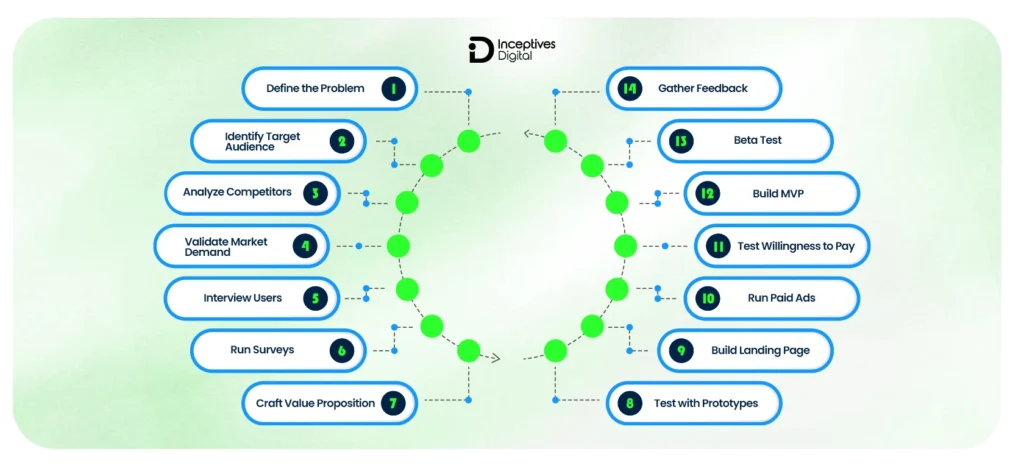
Here is a detailed breakdown of the step-by-step process to validate your mobile app idea.
Step 1 – Define the Problem Clearly (Before the Solution)
Clarity on the problem is essential, so don’t jump to the features straightaway. The best way to start is by focusing on the pain points that your app targets to solve. Early-stage ways to test mobile app concepts include simple surveys or quick interviews.
Checklist:
- Who faces this problem?
- How is it currently solved?
Step 2 – Identifying Your App Target Audience
Refining your niche makes sure you focus on what matters the most. Early identification of the app’s target audience helps move the process in the right direction. Understanding your target audience’s behaviour is important to keep your app features aligned with their demands.
Basic User Persona Example:
| Attribute | Example |
| Age | 25–40 |
| Location | Urban U.S. |
| Behavior | Uses multiple apps daily |
| Pain Point | Task management inefficiencies |
Step 3 – Competitor Analysis for App Ideas
List down your potential competitor apps on the App Store and Google Play. Read their client reviews to identify feature gaps and app monetization opportunities that you can leverage to outperform them.
Focus Areas:
- Missing features
- Pricing models
- User complaints
Competitor Analysis Table:
| App Name | Strength | Weakness | Opportunity |
| App A | Intuitive interface, strong reviews | Limited integrations, high cost | Offer better integrations and lower pricing |
| App B | Popular among target users, fast performance | Poor onboarding, cluttered UI | Simplify onboarding and improve UX |
| App C | Free version attracts users | Ads disrupt experience | Provide an ad-free or premium experience |
Step 4 – Assessing App Market Demand with Data
Verify demand through analysis of search patterns together with current market trends and online community activities. Use social media analysis for app ideas while monitoring user discussions to gauge interest in app ideas.
Tools & Channels:
- Google Trends
- Reddit, Quora
Step 5 – Conducting App Idea Interviews with Real Users
You should replace your current assumptions with direct evidence. User feedback for the app idea is invaluable. Validate your mobile app idea through either 1-on-1 interviews or focus group research.
Sample Questions:
- How do you solve this problem now?
- What frustrates you most?
- Would you pay for a better solution?
Step 6 – Using Survey Tools for App Ideas (At Scale)
Through surveys, you can test your app on a wider audience, unlike one-to-one interviews. Strategically prepare questions that are focused on clear and concise answers to get actionable insights. For surveys, you can use tools like Typeform or Google Forms.
Step 7 – Create a Strong Value Proposition
Create an impactful one-liner that defines your app’s purpose, target audience, and what’s better in it. Define the value proposition, because it is a main element for testing app ideas and messaging tests before launching.
Step 8 – Prototype Testing for Mobile Apps (Without Coding)
You need to create either low-fidelity or clickable prototypes to evaluate both usability and conceptual design. Designing tools like Figma or Adobe XD to early test your app’s usability through a prototype before committing to full development.
Step 9 – Build a Landing Page to Test Demand
You can test user interest through a landing page. Communicate the problem and its solution through this and include a sign-up CTA as well. It is a practical method in pre-launch app idea validation and analyzing the interest in your app ideas based on real user actions.
What to include:
- Clear headline (problem + solution)
- Key benefits or features
- Visuals (mockups or screenshots)
- CTA (email signup or waitlist)
Metrics to track:
| Metric | What It Indicates |
| Conversion Rate | Level of interest |
| Sign-ups | Demand signal |
| Bounce Rate | Clarity of messaging |
Step 10 – Run Paid Campaigns to Validate Interest
Drive targeted traffic to your landing page. Through paid campaigns, businesses can evaluate an app’s market demand, along with testing the marketing messages before they develop their applications.
Step 11 – Test Willingness to Pay Early
To test whether the users are willing to pay, you can introduce pre-orders or early access. This approach makes a clear difference between real interest and curiosity, making it an important step in mobile app idea validation.
Step 12 – Build a Minimum Viable Product for Apps
When initial signals show positive results, proceed with developing a minimum viable product for applications. Starting with an MVP helps with early testing of the core functionality of the app, as well as gathering valuable feedback to further enhance the app and align it with the audience demand.
Step 13 – Beta Testing for App Validation
Publish the minimum viable product to initial users. Gather information about user behavior together with feedback about product usability. The beta testing process helps validate your app idea while refining its features to match actual user requirements.
Step 14 – Crowdsourcing Feedback for App Improvements
Utilize online platforms such as Reddit and Product Hunt to gather additional information. Gathering user feedback through crowdsourcing helps in discovering hidden user problems and potential business growth areas.
Key Success Metrics You Should Track for App Idea Validation
In validating a mobile app idea, a clear distinction between vanity and real metrics is important. Some metrics look very impressive, but they are useless in projecting your app idea’s potential. Your goal should be to focus on success metrics for app ideas that indicate actual growth potential and user intent.
Table: Vanity vs Real Metrics
| Vanity Metrics | What They Show | Real Metrics | What They Show |
| Page Views | Traffic volume | Conversion Rate | % of users taking action |
| Likes / Shares | Surface-level interest | Sign-ups | Actual intent to use |
| App Downloads | Initial curiosity | Retention Intent | Likelihood to keep using |
| Impressions | Visibility | CAC (Customer Acquisition Cost) | Cost to acquire real users |
What Actually Matters
- Conversion Rate
Indicates the number of people who have moved to action (such as signing up). This is a strong sign of real interest. - Retention Intent
To evaluate whether you are really solving a meaningful problem with your app, measure the rate of customers coming back. - Customer Acquisition Cost (CAC)
See how much it costs to onboard a user. If the CAC cost is too high, it is very likely that your app idea lacks sustainability.
Keep an eye on the metrics that represent real user behaviour rather than just attention. You will only know whether your app idea is good enough or not through these indicators.
Common Mistakes to Avoid in Mobile App Idea Validation
In validating a mobile app idea, it is very likely that you will get misleading results because of some mistakes that are avoidable with proper measures. Misleading results create a false sense of validation that could lead to a decision you will regret later.
Here are the most common ones to watch out for:
1. Ignoring Negative Feedback
Positive feedback is always a huge motivation, but keep an eye on the negative feedback as well. These are the responses that will help you identify flaws that are affecting user interest. In case negative responses are overwhelming, it is an indicator to modify or even rethink your idea.
2. Over-Relying on Surveys
Surveys mostly represent people’s opinions, not what they do. So avoid relying on surveys alone. Without assessing real user behaviour, the data is not really reliable for making important decisions based on it.
3. Skipping Competitor Analysis for App Ideas
Leverage competitor analysis for app idea validation to make sure you don’t miss out on valuable insights. It reveals what is working for them, what is not, and where they are lacking so that you can take advantage of it.
4. Not Validating Willingness to Pay
Evaluate your app idea’s potential if it can convert interest into revenue. If your app fails to make users pay for it, then it is a strong sign that your idea may struggle financially or even fail to recover the investment.
Avoiding these mistakes ensures your validation process is based on real signals, not assumptions.
How Long Does It Take to Validate a Mobile App Idea?
Mobile app validation is not a very long process. Generally, it takes 2 to a maximum of 6 weeks of the overall app development timeline. The exact time depends on the approach you follow to gather data and test assumptions.
The key is to align each validation step with clear execution phases:
Typical Validation Timeline
| Phase | Duration | What You Do |
| Research | 3–5 days | Define problem, analyze competitors |
| User Insights | 1–2 weeks | Interviews, surveys, feedback |
| Testing | 1–2 weeks | Landing pages, prototypes, ads |
| Validation | Ongoing | Measure results and refine |
Perfection is not the goal and cannot be achieved. Your primary goal should be to test with a good base, moving forward on real feedback. Just take enough time to make a confident decision between moving forward with the idea or dropping the idea.
When to Pivot or Drop Your App Idea
If you are considering a mobile app idea, it is not a must that it will be a success. That is what mobile app validation is all about: to discover whether your idea has the potential to be one of the big names in your targeted niche. Early identification of the warning signs saves wastage of resources and time.
No Traction
If your landing page ads and outreach efforts do not produce sign-ups and user engagement, then this shows that users have no interest in your app. Generally, lower traction indicates that the solution isn’t compelling or the problem is not strong.
Weak Validation Signals
Low conversion rates, high bounce rates, or poor interactions are a big red flag, indicating that your prototype is not getting much attention. It means your app idea is not resonating with your intended audience.
Poor Feedback Trends
When users display confusion, indifference, and show no interest in the content, it serves as a major warning signal. The chances of success for the gimmick drop to almost zero when users fail to understand its intended value.
You are left with two options at this moment. Either modify or refine your current idea, or drop this idea and proceed with a new project that has a better concept.
Tools and Resources for Faster App Idea Validation
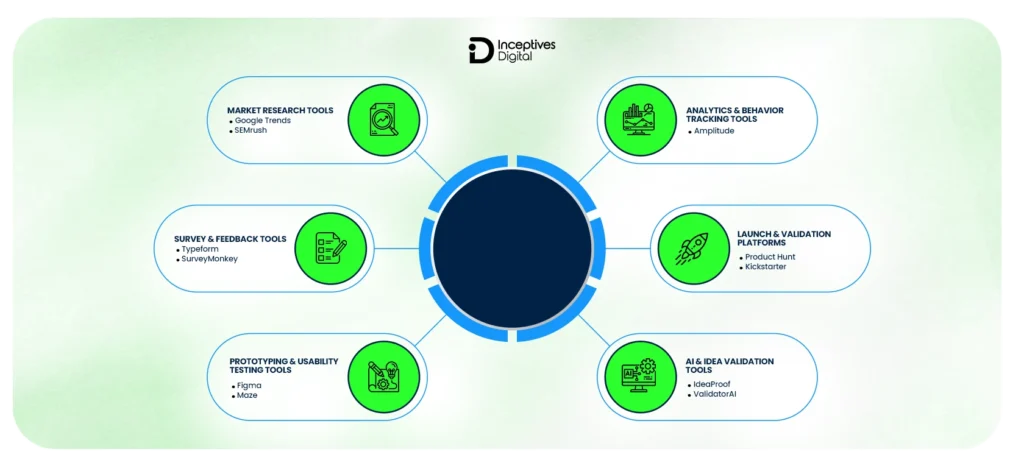
Using the right tools can speed up your validation process and help you make decisions based on real data instead of assumptions. Here’s a simple breakdown of essential tools across each stage:
Categorized Table:
| Category | Tools |
| Research | Google Trends |
| Surveys | Typeform |
| Prototyping | Figma |
| Analytics | Google Analytics |
These tools support different parts of the validation process, from market research for app validation to collecting user feedback for app ideas and analyzing real user behavior. The goal isn’t to use every tool, but to pick the ones that help you validate faster and more effectively.
Final Thoughts: Validate First, Build Smart
Validating your app idea isn’t about proving it will work. It’s about testing whether it should be built in the first place. By focusing on real user behavior, market demand, and measurable signals, you reduce risk and make smarter decisions early on. From identifying the right audience to testing demand with landing pages and prototypes, each step helps you move forward with clarity instead of guesswork.
If your idea shows strong validation signals, the next step is turning it into a real product with the right approach. Working with experienced teams that offer mobile app development services in USA can help you move from concept to launch efficiently, while staying aligned with what users actually want.
CTA SECTION START
cta title: Ready to Turn Your Validated App Idea Into a Scalable Product
cta des: Got strong validation signals? Take the next step with expert mobile app development services and build an app that users actually want
cta button: Start Your App Project
CTA SECTION END
Common Questions About Validating a Mobile App Idea
The most effective mobile app idea validation techniques include conducting user interviews, analyzing competitors, building landing pages, and testing prototypes. Combining multiple methods gives you a clearer picture of real demand instead of relying on a single data point.
You can test your idea without development by creating a landing page, running ads, conducting surveys, and using clickable prototypes. These are proven ways to test mobile app concepts without investing in full development.
User feedback for app idea validation helps you understand real pain points, expectations, and usability issues. It ensures you’re building something people actually need, not just what you assume they want.
Focus on key success metrics for app ideas such as conversion rates, sign-ups, engagement, and willingness to pay. These metrics indicate real interest and help you decide whether to move forward.
A minimum viable product for apps is not always required at the early stage. You can validate ideas through research, interviews, and prototypes first. However, an MVP becomes useful when you need deeper insights into user behavior and functionality.
SIDEBAR LIST START
- How to Validate Your Mobile App Idea (Step-by-Step Guide)
- What Does It Mean to Validate a Mobile App Idea?
- Why Validating Your App Idea Is Non-Negotiable
- Step-by-Step Process to Validate Your Mobile App Idea
- Key Success Metrics You Should Track for App Idea Validation
- Common Mistakes to Avoid in Mobile App Idea Validation
- How Long Does It Take to Validate a Mobile App Idea?
- When to Pivot or Drop Your App Idea
- Tools and Resources for Faster App Idea Validation
- Final Thoughts: Validate First, Build Smart
- Common Questions About Validating a Mobile App Idea
SIDEBAR LIST END