In most of the app failures, the idea is blamed, but that is not true for everyone. A larger number of apps struggle due to performance and growth issues. Research found that apps that take longer than three seconds encounter a 53% decline in users. It highlights how crucial the architecture and tech stack are for an app’s success.
Just think about the famous companies like Uber, TikTok, and Instagram. They handle billions of users daily. Attractive design is not enough at this level of scalability. Reaching those heights requires the right tech stack for mobile app development. It will play a huge role in whether your app will get the kind of recognition they have or will get unnoticed like the millions of apps on the App Store and Google Play Store.
If your plan is to build an application, a wise option would be collaborating with an experienced mobile app development company. They will help map a clear strategy, right architecture planning to ensure a fast, reliable, scalable mobile application.
Read this guide till the end to learn how a mobile app architecture works, how to decide on a strong tech stack, and what will be the best combination of technologies according to your business objectives.
What is Mobile App Architecture? Understanding Its Role in Scalable App Development
A mobile app architecture is what makes sure the functionality and interactivity of each component of a mobile application. It ensures the app meets the required standards and handles growth over time. There are different types of mobile app architecture. The suitable one depends upon the app’s complexity and your scalability needs.
Key Components of Mobile App Architecture
1. Frontend (Client-Side)
It is the first impression of your application that allows users to interact. It includes a user interface, navigation, animations, and overall user experience. React Native, Flutter, Swift, and Kotlin are the most common technologies used in frontend development.
2. Backend (Server-Side)
Backend is the brain behind core logics, user authentications, push notifications, and API management. Common tools used in backend development include Node.js, Python, Java, Ruby on Rails, and .NET, along with cloud platforms to ensure reliability and scalability.
3. Database
A database is a storage space for managing and storing the overall app data, such as user profiles, transactions, and other content. Commonly used databases are:
- SQL (MySQL, PostgreSQL)
- NoSQL (MongoDB, Firebase, DynamoDB)
4. APIs (Application Programming Interfaces)
Facilitate communication between frontend and backend, third-party integrations, and microservices via RESTful APIs, GraphQL, or WebSocket APIs.
Types of Mobile App Architecture: Choosing the Right Architecture for Scalable Mobile Apps
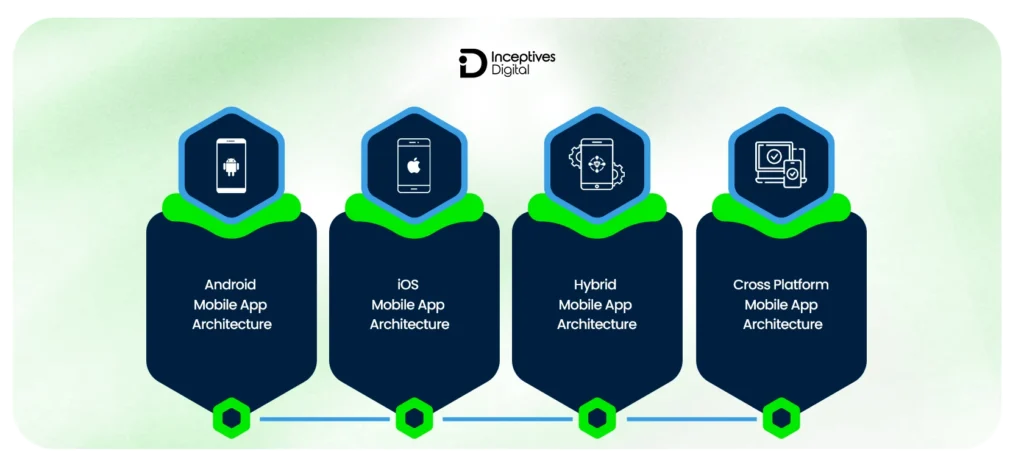
Your app requires an appropriate mobile application architecture because it needs to handle increasing user demands and new features that will be added over time. Your application performance depends on the architectural design you choose because it determines your system’s capacity to manage user traffic, process information, and work with current technological advancements.
A well-planned, scalable mobile app architecture delivers improved performance, together with quicker updates and reduced future maintenance expenses. The following section presents the most commonly used architectural designs together with their appropriate usage situations.
iOS Mobile App Architecture
iOS architecture applies specifically to Apple devices to improve performance and security and create a seamless user experience. The primary programming language for iOS app development used by developers is Swift, along with Apple’s official software development kits.
When to Choose iOS Architecture
- Premium user experience focus
- High-security applications
- Apps targeting Apple ecosystem users
Android Mobile App Architecture
Android architecture system supports various devices because it allows multiple devices to function properly on different screen sizes and hardware specifications. The tech stack for Android app development uses both Kotlin and Java programming languages, together with Android SDKs.
When to Choose Android Architecture
- Wider audience reach
- Device compatibility requirements
- Scalable consumer apps
Cross-Platform Mobile App Architecture
Cross-platform architecture enables developers to create applications that run on multiple platforms by using one shared codebase. The standard technology stack used in cross-platform app development incorporates both Flutter and React Native.
When to Choose Cross-Platform Architecture
- Faster time-to-market
- Cost-efficient development
- MVP and startup apps
Hybrid Mobile App Architecture
Hybrid architecture combines web and native technologies, which allow developers to create applications through web technologies packaged inside a native container. The two main tools used in hybrid app development are Apache Cordova and Ionic.
When to Choose Hybrid Architecture
- Simple applications
- Content-based apps
- Quick MVP launches
Scalable Mobile App Architecture Patterns for Modern App Development
To make sure your app functions smoothly during peak traffic times and remains maintainable with increasing features. To help you decide the best choice for your mobile app, we have listed the most effective mobile app architecture patterns:
1. Monolithic vs Microservices Architecture for Scalable Mobile App Development
Monolithic Architecture
A unified codebase delivers simple development for initial tasks but presents challenges when your application needs to expand.
Microservices Architecture
It divides the application into separate modules, which allow for better scaling, updating, and maintenance processes.
Technologies & Tools:
- Docker
- Kubernetes
- Spring Boot
- Node.js microservices frameworks
Best For: Large-scale apps, high-traffic systems, apps with multiple integrations.
2. Serverless Architecture and Cloud-Based Tech Stack
A serverless configuration eliminates the requirement for handling physical servers. The cloud looks after scaling, storage, and execution automatically.
Technologies & Tools:
- Amazon Web Services (AWS Lambda, API Gateway)
- Google Cloud Platform (Cloud Functions)
- Firebase
- Azure Functions
Best For: Apps with unpredictable traffic, rapidly growing startups, and event-driven systems.
3. Layered (N-Tier) Architecture
It divides the app into distinct layers, including presentation, business logic, and data components. Layered architecture enables better system maintenance through its design, allowing separate teams to develop each system component.
Technologies & Tools:
- .NET N-Tier framework
- Java EE
- Spring MVC
- Django
Best For: Enterprise apps, complex workflows, and apps requiring long-term maintainability.
4. Event-Driven Architecture
Handles real-time event processing through its ability to utilize messaging systems and event queues. It performs best when the app needs to respond instantly to user interactions and changes in data.
Technologies & Tools:
- Apache Kafka
- RabbitMQ
- AWS SNS/SQS
- Google Cloud Pub/Sub
Best For: Messaging apps, ride-hailing platforms, live streaming apps.
What is a Tech Stack in Mobile App Development?
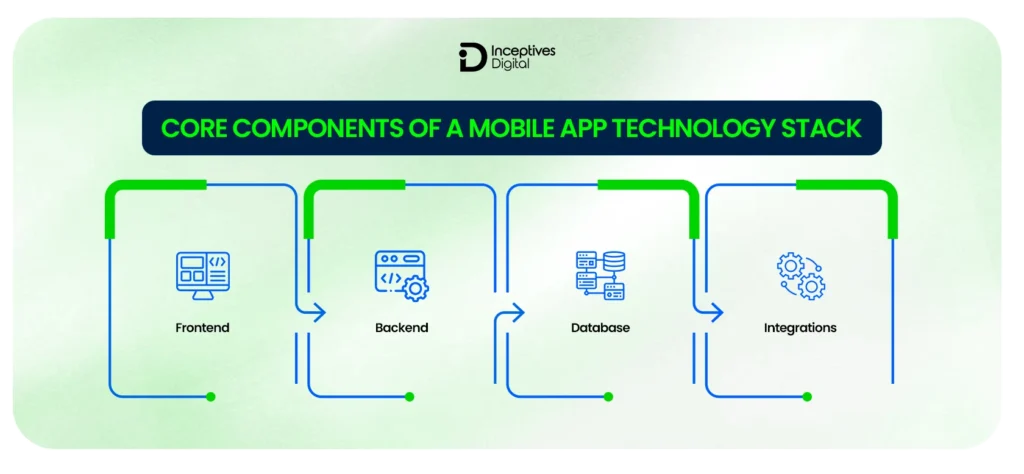
Tech stack for a mobile app development process is a set of tools that include programming languages, frameworks, libraries, and databases. The tech stack you choose determines the way your app functions, handles data, server connections, and provides user experience. Let’s break down the components of the tech stack for the mobile app to explore it in more detail.
Key Components of a Mobile App Tech Stack: Tools and Technologies for Mobile App Development
A mobile app tech stack includes four essential parts: frontend, backend, database system, and APIs. The application requires specific tools and technologies at each layer to maintain its efficient operation while handling increased user demand. Here are the four main components of the mobile app development tech stack.
1. Frontend Technologies for Mobile App Development and Front-End Development Tech Stack
Users interact with the frontend of the application. The frontend controls the interface and navigation system and the total user experience of the application.
Popular Frontend Technologies:
- Flutter
- React Native
- Swift (iOS)
- Kotlin (Android)
- UI/UX design tools (Figma, Adobe XD)
2. Backend Technologies and Software Development Tech Stack for Mobile Apps
The backend provides essential support to the application by managing user authentication, executing server-side operations, delivering push notifications, and enforcing business regulations.
Common Backend Technologies:
- Node.js
- Python (Django, Flask)
- Java (Spring Boot)
- Ruby on Rails
- .NET
- Cloud platforms (AWS, Firebase, Google Cloud)
3. Database Technologies in Mobile App Development Tech Stack
Databases store and manage application data that includes user profiles, transaction records, and content items. The database you choose has a direct effect on your app’s performance.
Database Options:
- SQL: MySQL, PostgreSQL
- NoSQL: MongoDB, Firebase Realtime Database, DynamoDB
4. APIs and Integrations in Modern Mobile App Tech Stack
APIs enable various components of an application to connect while also enabling the application to connect with external services. These components make sure the app functions properly, ensure data transfer, and modular architecture.
Common API Technologies:
- RESTful APIs
- GraphQL
- WebSocket APIs
- Third-party services (payment gateways, analytics, cloud services)
How to Choose the Right Tech Stack for Mobile App Development
Selecting the right tech stack requires businesses to establish technology requirements that support operational objectives, meet customer demands, and sustain future development needs. The following framework provides a practical solution to help you select the right tech stack for your mobile app.
1. Define Business Goals Before Choosing the Tech Stack
You need to define your app’s purpose before you begin developing it. Your technology decisions will be determined by your objectives, which can be either fast market entry, high system performance, or long-term growth.
For instance, a quicker and cost-efficient stack might be necessary for a Minimum Viable Product, while a larger-scale product will need to have more structured and scalable solutions.
2. Understand Target Audience and Platform Requirements
Your audience determines where and how your app should perform. You need to consider factors, such as device usage, location, and platform usage between iOS, Android, or both.
A cross-platform solution works well when users of your app access multiple platforms. Native development provides optimal performance for applications that require performance as their main focus.
3. Evaluate App Complexity and Feature Requirements
Complexity level of your application is a key factor in deciding the tech stack for your mobile app.
Basic feature applications require simpler technology stacks, whereas advanced applications that use real-time updates, integrations, and handle large volumes of data require advanced backend technologies and architectural frameworks.
4. Choose a Scalable Mobile App Architecture and Tech Stack
You should create plans that accommodate future growth needs. A properly built scalable mobile architecture enables your application to manage rising user numbers, new system capabilities, and added external connections without experiencing performance problems.
Early selection of scalable technologies protects organizations from future expensive migration and rebuilding costs.
5. Budget, Timeline, and Development Cost Considerations
Your budget and app development timeline determine the tech stack choice. Some technologies enable faster development times, whereas other technologies need extended development times but provide superior long-term advantages.
Sustainable decision making needs cost, performance, and scalability to be balanced against each other.
6. Team Expertise and Hiring or Staff Augmentation Strategy
The success of your stack choice is largely dependent on your team of developers. It is crucial to choose technologies that your team has gained experience with or can quickly adapt to.
You should hire staff augmentation services if your organization needs specialized developers to boost its development capacity without committing to permanent employment.
Common Mistakes to Avoid When Choosing a Tech Stack for App Development
Most of the time, businesses neglect the importance of a tech stack for a mobile app, which later on results in performance issues, budget overruns, and maintenance problems. To help you avoid such costly mistakes, we have curated a list that includes the most common mistakes businesses make when choosing a mobile app tech stack.
1. Choosing Technology Based on Trends Instead of Needs
You should pick frameworks or tools that best suit your project instead of picking based on the basis of popularity. Define your goals, core features, and target audience, and choose the best that suits your situation.
2. Ignoring Scalability from the Start
When developers create applications without planning for future growth. The app suffers from performance problems that require expensive redesigns for resolution. Mobile app developers must select software stacks that allow creating mobile applications that will grow with business needs throughout the entire project.
3. Overcomplicating the Tech Stack
Excessive usage of tools, frameworks, and services leads to challenges in both development and maintenance processes. The most effective and manageable tech stack for app development and maintenance work is a basic technology stack.
4. Not Considering Team Expertise
Development becomes slower, and errors increase when your team selects an unfamiliar technology stack. Your tech stack should match your team’s capabilities, or you must recruit or train employees.
5. Ignoring Long-Term Maintenance Costs
Some technologies may seem cost-effective initially, but become expensive to maintain after the launch. Assess updates and scalability requirements, together with support options, before reaching a final decision.
6. Poor Integration Planning
Your application requires planning for third-party integrations, APIs, and future features to function properly. Your integration needs should be supported by your stack from the beginning of your project.
7. Skipping Proper Testing and Validation
Tech stack selection for MVPs requires early testing to prevent major problems. The verification of your technology choices needs to be conducted through prototype development and small-scale experiments before you proceed with complete app development.
Cost and Scalability Considerations in Mobile App Architecture and Tech Stack Selection
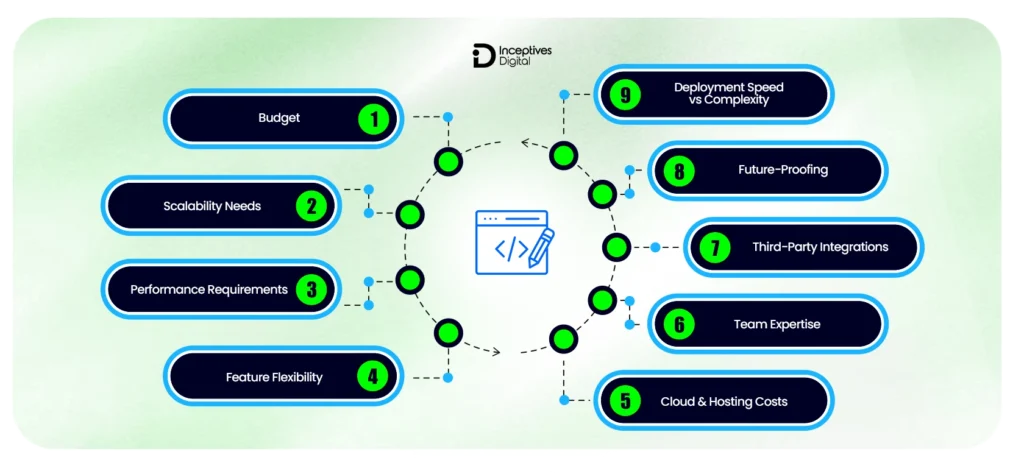
Your mobile app architecture and tech stack decision not only impact the long-term growth, but also the app development cost. Here are the important factors you should consider before making the final decision.
1. Initial Development Cost vs Long-Term Investment
A simpler tech stack may reduce upfront costs, but it will create higher expenses later when the system needs to scale or new features need to be added. The correct architectural investment is needed at the beginning because it protects the organization from expensive future construction work.
2. Scalability and Future Growth
Your architecture design must support user growth, traffic surges, and new feature development while maintaining system performance. Scalable systems provide benefits because they decrease operational downtime and maintain steady user experiences.
3. Infrastructure and Cloud Costs
A significant proportion of total expenses comes from hosting, servers, and cloud services. Flexibility and scalability are the two major benefits of a cloud-based solution, which must be implemented with consideration to avoid overspending.
4. Performance and Resource Optimization
When you spend less time using the added resources, this leads to cost and speed being directly proportional. A properly optimized architecture will lead to quicker load times and overall better performance while not overusing infrastructure.
5. Maintenance and Upgrade Costs
This increases the cost of mobile app maintenance, updates, and bug fixing. Using the correct technologies makes your app easier to maintain & update with time.
6. Choosing the Right Development Approach
Choosing the right balance between cost and scalability often needs customized solutions. Template-based software can also be customized, but many businesses prefer custom software development as it allows them to develop applications for a price that suits them and within their specific terms of future growth.
Real-World Mobile App Tech Stack Examples and Architecture Use Cases
Exploring real-world app development tech stacks will help you make better decisions. Applications select their technology stack and system architecture based on maximum user capacity, required performance, and expected user behavior.
E-commerce App (Example: Amazon)
E-commerce apps need to handle massive traffic, secure payments, and real-time inventory updates.
Typical Tech Stack:
- Frontend: React Native / Native (Swift, Kotlin)
- Backend: Java (Spring Boot), Node.js
- Database: DynamoDB, PostgreSQL
- APIs: REST APIs for payments and logistics
Architecture: Microservices for scalability and fault isolation
Fintech App (Example: PayPal)
Fintech apps prioritize security, compliance, and real-time transaction processing.
Typical Tech Stack:
- Frontend: Native (Swift, Kotlin)
- Backend: Java, Python
- Database: PostgreSQL
- Security: Encryption, secure APIs
Architecture: Microservices with secure API layers
Messaging App (Example: WhatsApp)
Messaging apps require real-time communication and the ability to handle millions of concurrent users.
Typical Tech Stack:
- Frontend: Native apps
- Backend: Erlang-based systems, Node.js
- Database: Distributed databases
- APIs: WebSockets for real-time messaging
Architecture: Event-driven + distributed systems
Ride-Hailing App (Example: Uber)
These apps rely heavily on real-time location tracking, matching algorithms, and scalability.
Typical Tech Stack:
- Frontend: React Native / Native
- Backend: Node.js, Python
- Database: MongoDB
- Integrations: Maps, payment gateways
Architecture: Microservices + event-driven architecture
Fitness App (Example: MyFitnessPal)
Fitness apps focus on tracking user activity, integrating with wearables, and managing user data efficiently.
Typical Tech Stack:
- Frontend: Flutter / React Native
- Backend: Node.js
- Database: Firebase, PostgreSQL
- Integrations: Health APIs, wearable devices
Architecture: Layered or microservices architecture
To see how these approaches are applied in real business scenarios, explore our portfolio, where we build scalable applications by using modern architectural frameworks and optimized technology platforms.
Conclusion: Choosing the Best Tech Stack for Mobile App Development Success
We hope that from the first click on this blog till now, you have got what you are here for. We discussed how a strategic decision in mobile app architecture and tech stack can make a huge difference in your app’s success. A strategic approach not only reduces the overall cost but also plays a key role in enhancing the performance and long-term growth.
If you have made up your mind to revolutionize your business with an advanced mobile app. An ideal option would be partnering with a team that offers reliable mobile app development services. They will make sure the app is aligned with your goal and truly represents your business in the best way possible, while keeping the cost in control and avoiding pitfalls.
CTA SECTION START
cta title: Ready to Build a Scalable Mobile App? Let’s Get Started
cta des: Turn your app idea into a scalable, high-performing product with the right architecture and tech stack tailored to your business goals.
cta button: Get Your Consultation
CTA SECTION END
FAQs on Mobile App Development Tech Stack and Architecture
The best tech stack for mobile app development depends on your app’s needs. Native stacks (Swift, Kotlin) offer top performance, while cross-platform tools like Flutter or React Native are faster and more cost-effective.
To choose the right tech stack, align it with your business goals, app complexity, target audience, budget, and scalability needs. Pick technologies your team can efficiently work with.
A flexible tech stack for mobile apps like Flutter or React Native with Node.js and Firebase works well for startups due to faster development and easy scaling.
Native stacks are platform-specific and deliver better performance. Cross-platform stacks use one codebase for multiple platforms, saving time and cost.
The tech stack for mobile apps affects speed, responsiveness, and scalability. A well-chosen stack ensures smooth performance and supports growth without major rework.
SIDEBAR LIST START
- Mobile App Architecture: How to Choose the Right Tech Stack for Mobile App Development
- What is Mobile App Architecture? Understanding Its Role in Scalable App Development
- Types of Mobile App Architecture: Choosing the Right Architecture for Scalable Mobile Apps
- Scalable Mobile App Architecture Patterns for Modern App Development
- What is a Tech Stack in Mobile App Development?
- How to Choose the Right Tech Stack for Mobile App Development
- Common Mistakes to Avoid When Choosing a Tech Stack for App Development
- Cost and Scalability Considerations in Mobile App Architecture and Tech Stack Selection
- Real-World Mobile App Tech Stack Examples and Architecture Use Cases
- Conclusion: Choosing the Best Tech Stack for Mobile App Development Success
- FAQs on Mobile App Development Tech Stack and Architecture
SIDEBAR LIST END