Why Blockchain Is Essential for Startups?
Gaining customer trust is the biggest challenge that startups face upfront, especially when they have to handle financial transactions, digital assets, and data sharing between multiple parties. Blockchain for startups offers a solution by enabling decentralized, tamper-proof systems where transactions are verified across a distributed network.
This is the reason that has led to industrially based investing in blockchain, particularly in digital identity, supply chain, healthcare, and finance. To your surprise, the global market value of blockchain technology was around $26.9 billion in 2024, which is expected to touch the $1.87 trillion mark by 2034. It highlights long-term growth opportunities in blockchain for startups worldwide.
Blockchain helps solve several core challenges:
- Trustless transactions between parties without intermediaries
- Secure data sharing across decentralized networks
- Automated workflows through smart contracts
To develop secure, scalable applications that provide an excellent user experience, blockchain startups should partner with a reliable blockchain app development company. But be cautious in choosing a company because this decision will decide the fate of your application. Choosing the one with proven experience in blockchain to ensure a smooth development process.
For more details, read this guide to explore the development process, core features, cost estimates, and blockchain startup ideas in simple terms. Let’s start with a quick overview of blockchain for startups.
What Is Blockchain for Startups?
If we compare blockchain with traditional applications, blockchain apps store data on a decentralized network instead of a centralized server. This approach ensures transparency, trust, efficient operations, and reduces third-party dependencies in data sharing and transactions. Often called decentralized apps (dApps), these applications automate workflows, validate transactions, and execute rules through smart contracts without any middleman. Let’s have a quick look at the types of blockchain.
Types of Blockchain
Startups can select different types of blockchain networks according to their specific use case requirements:
1. Public Blockchains
These are open networks that allow anyone to join and participate, ideal for apps requiring full transparency.
2. Private Blockchains
As explained by its name, “private,” these are closed networks that are controlled by a single organization. Ideal for enterprise or compliance-sensitive applications.
3. Consortium Blockchains
Enable multiple organizations to maintain shared control while protecting the data through controlled access, and maintain transparent operations.
4. Hybrid Blockchains
Implement the best from both public and private blockchain setups, where selective access is possible, with some form of decentralization being directed.
A traditional app and a blockchain-based application work differently in terms of data storage, verification, and control mechanisms:
| Feature | Traditional Apps | Blockchain Apps |
| Data Storage | Centralized server | Distributed ledger |
| Security | Standard encryption | Cryptographic validation |
| Transparency | Limited | High |
| Control | Single authority | Decentralized network |
Key Components of a Blockchain Application
To create a blockchain for startups, developers must first learn about its fundamental parts. Each layer protects decentralized applications by providing security measures, maintaining operational transparency, and efficiency.
1. Blockchain Network
For startup applications, the blockchain network serves as a foundation. It stores and verifies transactions through multiple nodes, creating a decentralized system that distributes the control of data. Choosing the appropriate network determines the system’s ability to scale its operational efficiency and capacity to maintain system uptime.
2. Smart Contracts
Consider this as an agreement written in code that is stored on a decentralized network. Smart contracts execute themselves when the predefined conditions are met. It ensures reliability, transparency, and workflow efficiency for blockchain startups, especially for those handling transactions.
3. Distributed Ledger
A distributed ledger works as a shared database that all network nodes maintain. It guarantees that all users access identical verified information, resulting in enhanced transparency and trust. Startups testing new blockchain ideas will find this feature to be the most important.
4. Cryptographic Security
Blockchain uses cryptography for data protection and validating transactions. Through hashing algorithms, it assigns public and private keys to authorize users to access or modify the records. Cryptography becomes a crucial component for applications that are meant to handle sensitive information.
5. Consensus Mechanisms
Consensus mechanisms, such as Proof of Work (PoW) or Proof of Stake (PoS), validate transactions and maintain agreement across all nodes. They prevent fraud and ensure network integrity, which is critical for reliable and scalable blockchain solutions.
Why Startups Are Choosing Blockchain?
A common challenge that digital solutions face during the early stages is to gain customer trust. To make them trustworthy, transparent, and efficient, entrepreneurs are turning towards integrating blockchain for startups. Here are the key benefits of blockchain that are really behind the blockchain adoption trend.
Key Benefits
- Cost Reduction and Operational Efficiency
Blockchain technology enables startups to save time and money because it eliminates intermediary requirements while smart contracts automate their workflows and minimize human error. - Increased Security and Fraud Prevention
The cryptographic security and permanent nature of blockchain technology make it impossible to alter existing data. Startups that need to protect their confidential data will find this security level to be highly beneficial. - Transparent Transactions for Investors and Users
Every transaction is recorded on a shared ledger, which provides complete visibility to stakeholders. Transparent operations are the key to trustworthiness, which is crucial for the success of startups.
Trending Blockchain Startup Ideas
Some of the most popular blockchain startup ideas gaining traction today include:
- Decentralized identity verification platforms
- Supply chain and logistics tracking systems
- NFT marketplaces and digital asset platforms
- Cross-border payment solutions
- Tokenized real estate and asset management
Startups can use blockchain’s special features to create secure products that maintain transparent operations and handle growth needs to succeed in the market competition.
Types of Blockchain Apps by Industry
One of the main benefits of blockchain technology for startups is its ability to function in multiple business sectors. Startups in all sectors, from finance to healthcare and internet-connected devices, now use decentralized technologies to create new digital products. Here are the industries actively utilizing blockchain technology.
1. Blockchain Fintech App Development
Blockchain technology first received adoption from the finance sector, which maintains its position as the primary innovator for this technology. Blockchain for fintech app development enables startups to build platforms that support secure financial transactions without needing traditional banking and payment processing intermediaries.
Common fintech applications include:
- Peer-to-peer lending platforms provide direct borrower-to-lender connections.
- Decentralized finance (DeFi) platforms offer users the ability to trade, lend, and stake digital assets.
- Crypto wallets provide users with secure storage and management to protect their digital currencies.
Financial technology solutions require their developers to select suitable infrastructure. The best blockchain platforms for fintech startups include Ethereum, which supports smart contracts, Polygon for scalable transactions, and Solana for high-performance financial applications.
2. Blockchain Healthcare App Development
Healthcare startups are increasingly exploring blockchain for healthcare app development because the technology improves methods used to store and share sensitive medical data. The traditional healthcare system uses multiple disconnected databases, which create challenges in protecting patient information.
Blockchain can address these issues through:
- Healthcare organizations need secure methods to protect patient information and restrict unauthorized access to medical records.
- Telemedicine platforms that verify patient and provider identities.
- Clinical trial management systems that maintain transparent and immutable research records.
Healthcare startups use blockchain technology to build trust with stakeholders while meeting regulatory requirements and sharing data between different systems through its decentralized and secure framework.
3. Blockchain eLearning App Development
The education sector is also experiencing increased adoption of blockchain through e-learning app development. Startups in this space use blockchain to verify credentials, protect intellectual property, and create more transparent learning ecosystems.
Common use cases include:
- Digital certification verification enables employers to verify academic credentials through instant authentication.
- Secure content distribution that protects course materials from piracy
- Learning platforms use gamified systems to provide students with token rewards for their academic achievements.
These solutions thus help educational start-ups to develop platforms that enable global trust in accomplishments and credentials.
4. Blockchain IoT App Development
Startups are exploring blockchain IoT app development because connected devices have become more common. The data integrity and authentication systems of IoT networks face challenges because thousands of devices connect at the same time.
Blockchain can strengthen IoT ecosystems through:
- Device authentication prevents unverified devices from accessing the network.
- Supply chain tracking enables organizations to monitor product movement in real time.
- Smart city infrastructure enables secure data exchange between its interconnected systems.
Startups can establish decentralized networks that provide enhanced security and transparency by implementing blockchain technology and IoT systems.
Blockchain App Development Process for Startups
Successful blockchain app development needs structured methods that unite technical requirements and business objectives. Founders exploring blockchain for startups need to follow established guidelines that minimize risks while building secure and scalable applications that meet their intended purpose. Here are the steps involved in the blockchain app development process:
Step 1: Define the Business Problem and Validate the Idea
You should start by identifying the main issue that your product will address. You should first validate your blockchain startup ideas and concepts through verification. This helps assess blockchain suitability as the appropriate technology for the specific use case.
Step 2: Choose the Right Blockchain Platform
Selecting the right infrastructure plays a major role in performance, scalability, and development complexity. The common platforms available to users include:
- Ethereum
- Solana
- Hyperledger
- Polygon
The right option depends upon various factors like transaction volume, network costs, and the type of application.
Step 3: Design the Blockchain Architecture
Plan the system architecture by defining data flow together with node interactions and smart contract execution logic. The current stage establishes which data elements should be stored on-chain versus off-chain.
Step 4: Develop Smart Contracts and Backend Integration
Create smart contracts that handle automatic transactions while implementing the fundamental operational rules of the application. The contracts perform their designated tasks whenever particular blockchain conditions are satisfied on the blockchain network.
Step 5: Build the Frontend
Create a web or mobile interface that enables users to interact with the blockchain application. Includes wallet integration and APIs, which enable users to conduct secure transactions.
Step 6: Testing and Security Audits
Through the testing process, verify that the application works properly and is secure. The launch of the project requires smart contract audits and performance testing to discover security weaknesses.
Step 7: Deployment and Maintenance
Deploy the application to the chosen blockchain network. Afterward, track how the application performs. Ongoing maintenance includes fixing bugs, improving features, and scaling the infrastructure as the startup grows.
Key Features Every Blockchain App for Startups Must Include
To develop a blockchain application that efficiently handles transactions, manages digital assets, and remains transparent, certain features have to be utilized. Below are some core features and advanced features as well that are important to achieve operational efficiency and transparency.
Core Features
- Smart contracts for automation
- Wallet integration for transactions
- Token management and interoperability
- Identity verification and privacy
- Secure transaction validation
- User authentication and access control
- Real-time transaction tracking
- Transparent ledger records
Advanced Features for Scalable Applications
- Multi-chain support
- Cross-chain interoperability
- Decentralized storage
- Governance mechanisms
- Token staking and rewards
- API and third-party integrations
- Scalable node infrastructure
- Analytics and monitoring tools
Blockchain App Development Cost for Startups
The actual cost of building a blockchain for startups differs due to factors like the level of complexity, features, and technical requirements. Apart from these additional factors that can affect the blockchain development cost are smart contracts, wallet integration, security audits, and developing decentralized storage. Before investing in a fully advanced platform, blockchain startups begin with a minimum viable product (MVP) to reduce risks and validate the idea.
Estimated Cost by App Complexity
| App Complexity | Estimated Cost | Development Time |
| MVP / Basic dApp | $20K – $60K | 2–4 months |
| Mid-Level dApp | $80K – $180K | 4–8 months |
| Enterprise Platform | $200K+ | 8–12 months |
Blockchain Startup Ideas to Explore
Founders require blockchain ideas for startups that will help them develop secure and transparent systems that can grow without limitations. Startups use decentralized technology to create disruptions in traditional industries, which results in improved operations and unlocks new business models.
Top Blockchain Startup Ideas
- Decentralized Identity Platforms
- Supply Chain Tracking Solutions
- NFT Marketplaces and Ticketing
- Cross-Border Payment Apps
- Tokenized Real Estate or Digital Assets
Founders can find optimal blockchain startup ideas through exploration of these opportunities, which help them create practical blockchain solutions that deliver essential user benefits while establishing a market edge.
Challenges Startups Face in Blockchain Development
Although blockchain for startups offers significant benefits, there are some challenges as well. Founders have to maneuver smartly to build successful blockchain applications:
- Scalability and Network Performance
Blockchain must maintain its performance capability to process high transaction volumes without experiencing system delays.
- Gas Fees and Transaction Costs
High-frequency transactions create difficulties for operational budgets because of their unpredictable network fee structure.
- Regulatory Compliance
Interpreting legal regulations for blockchain technology, cryptocurrency operations, and data protection laws is complicated because legal frameworks differ based on regions.
- Security Vulnerabilities
Protecting decentralized systems, smart contracts, and wallet functions from unauthorized access and security breaches.
- Talent Shortage in Blockchain Development
organizations needs to locate developers who possess expertise in blockchain design, smart contract development, and security measures.
Tips for Startups to Reduce Blockchain Development Cost
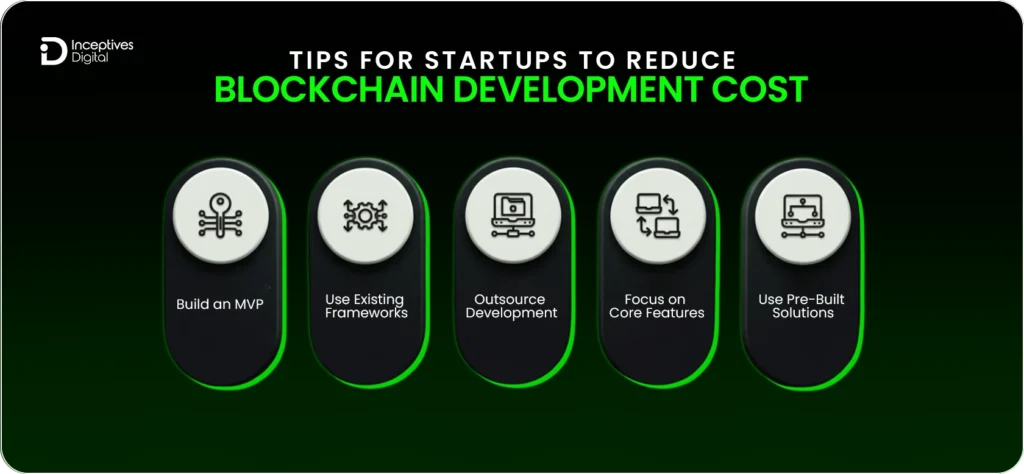
Developing expenses can be reduced through cost-cutting methods without affecting the final product quality. Startups can develop secure, scalable applications by using blockchain technology together with smart planning and appropriate strategic methods. Strategic resource distribution enables organizations to complete testing and product development while reaching the market more quickly.
- Build an MVP first
- Leverage existing blockchain frameworks
- Outsource or use hybrid development teams
- Focus on core features initially
- Use pre-built smart contracts and modules
Future Trends in Blockchain for Startups
The blockchain landscape for startups is experiencing rapid development through the introduction of new technologies and approaches. It creates new methods for building and developing decentralized applications. Startups that adopt these trends early can gain a competitive advantage and unlock innovative business models.
- AI-powered smart contracts and predictive analysis
- Layer 2 scaling solutions and interoperability
- Web3 applications and decentralized marketplaces
- Decentralized identity systems and tokenized ecosystems
- Integration of blockchain with IoT, DeFi, and other emerging technologies
Conclusion: Turning Blockchain Ideas into Startup Success
Blockchain for startups is no longer a dream. It’s a practical approach to developing smart, secure, and trustworthy applications across industries. Founders can innovate problem-solving operational solutions through a clear understanding of the development process, key features, costs, and potential risks. Blockchain opens opportunities in industries like fintech, healthcare, and IoT for startups to outperform existing applications and gain the trust of users.
Collaborating with experienced blockchain development services is the best option for founders who want to utilize the potential of blockchain technology. Professionals can really streamline the overall development process and help you dodge the tricky challenges. A well-defined and strategic approach to blockchain development is the key to success for startups looking to leverage its advantages.
CTA SECTION START
cta title: Build Your Startup’s Blockchain App with the Right Strategy
cta des: Turn your blockchain startup idea into a secure, scalable product. Get expert guidance on architecture, smart contracts, and launch-ready solutions tailored for your business goals.
cta button: Start Your Blockchain Project
CTA SECTION END
Frequently Asked Questions (FAQs)
Blockchain for startups refers to the use of decentralized blockchain technology to build secure, transparent, and automated applications. By using distributed ledgers and smart contracts, startups can create systems that enable trustless transactions and reduce reliance on intermediaries.
The cost of blockchain app development for startups typically ranges from $20,000 to $200,000+, depending on the app’s complexity, required features, smart contract development, integrations, and security audits.
Some of the best blockchain platforms for fintech startups include Ethereum, Polygon, Solana, and Hyperledger, as they support smart contracts, secure transactions, and scalable decentralized applications.
Some of the top blockchain startup ideas include decentralized finance (DeFi) platforms, NFT marketplaces, supply chain tracking systems, decentralized identity platforms, and cross-border payment applications.
The development timeline for a blockchain application usually ranges from 2 to 8 months, depending on the project scope, platform selection, smart contract complexity, and testing requirements.
SIDEBAR LIST START
- Blockchain App Development for Startups: Cost, Process, and Key Features
- Why Blockchain Is Essential for Startups?
- What Is Blockchain for Startups?
- Key Components of a Blockchain Application
- Why Startups Are Choosing Blockchain?
- Types of Blockchain Apps by Industry
- Blockchain App Development Process for Startups
- Key Features Every Blockchain App for Startups Must Include
- Blockchain App Development Cost for Startups
- Challenges Startups Face in Blockchain Development
- Tips for Startups to Reduce Blockchain Development Cost
- Future Trends in Blockchain for Startups
- Conclusion: Turning Blockchain Ideas into Startup Success
- Frequently Asked Questions (FAQs)
SIDEBAR LIST END