Why Healthcare Apps Are Transforming Modern Healthcare?
Healthcare isn’t waiting for the future anymore; it’s already changing in real time. Clinics are moving parts of their work onto apps, patients are checking vitals from home, and doctors are relying on digital systems to keep up with growing demand. A lot of this shift sits under what we now call healthcare app trends, but in practice, it’s just how care is slowly being reorganized.
What stands out is how normal some of this has become. A patient doesn’t always need to walk into a hospital first; sometimes the process starts on a phone, continues through a wearable, and ends with a doctor reviewing live data instead of static reports. It feels gradual, but the system behind it is changing quite a bit.
The scale is already hard to ignore. Over 1.4 billion people are using digital health tools globally, whether that’s a fitness tracker, a telemedicine app, or something that monitors a chronic condition. At the same time, hospitals and healthcare teams are bringing in AI tools to help with documentation, diagnosis support, and handling routine tasks that used to take up a lot of time.
All of this is also changing how healthcare apps are built. It’s no longer just about adding features. Teams have to think about compliance, data flow, integrations with hospital systems, and how real clinicians will actually use the product day to day. That’s where a healthcare app development company usually comes in, especially when the goal is to connect everything without making the system harder to manage.
In the next sections, we’ll go through the healthcare app development trends that are driving this shift and what they actually mean when you look at them in real-world use.
Key Healthcare App Development Trends at a Glance
Before going deeper into each trend, it helps to see the bigger picture first. Healthcare apps today aren’t evolving in isolation. Most of these changes are connected, feeding into each other as hospitals, clinics, and patients start relying more on digital systems for everyday care.
| Trend | Primary Benefit | Main Users |
| AI-Powered Apps | Faster diagnosis | Hospitals |
| Telemedicine | Remote care | Clinics |
| RPM | Continuous monitoring | Chronic care |
| Wearables | Real-time tracking | Patients |
| Generative AI | Workflow automation | Providers |
| Interoperability | Better coordination | Healthcare systems |
What’s interesting is how these healthcare app trends overlap in real use. For example, a telemedicine app often pulls data from wearables, while RPM systems rely on interoperability to actually make that data useful for doctors. Generative AI then sits on top of all of it, helping reduce the manual workload in the background.
Seen together, they’re less like separate technologies and more like parts of the same shifting healthcare system.
1. AI-Powered Healthcare Apps & Predictive Analytics
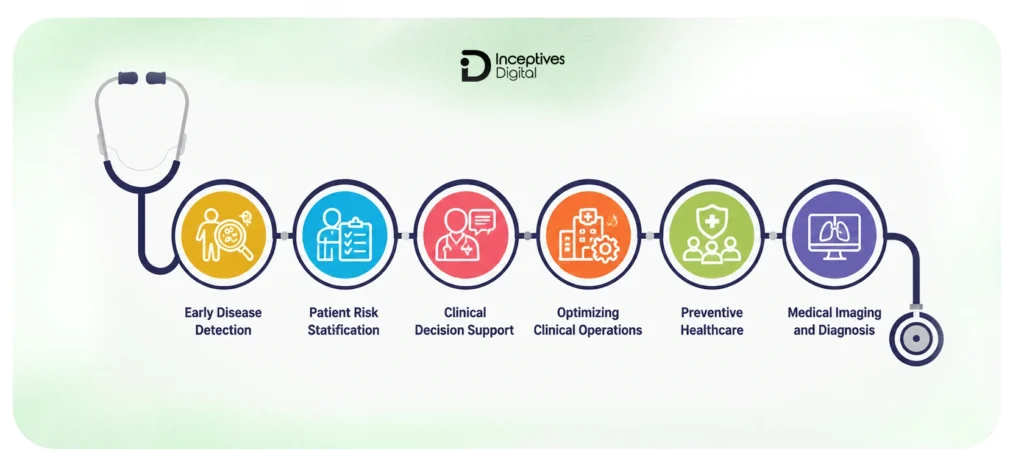
AI has quietly moved from being a “nice feature” in healthcare app development to something that actually changes how care is delivered. Most modern healthcare app trends now circle back to AI in some form, whether it’s helping doctors make quicker decisions or giving patients faster answers before they even visit a clinic.
What’s changed is the scope. Healthcare apps aren’t just logging appointments or tracking steps anymore. They’re starting to read patterns, interpret patient data, and support decisions using machine learning, NLP, generative AI, and predictive analytics. Tools built on models like OpenAI’s GPT are already being used for symptom checking, documentation support, and clinical summaries that would normally take time to prepare manually.
Predictive analytics is another layer that’s getting more attention. Instead of reacting after something goes wrong, these systems look at data from wearables, patient history, and hospital records to flag risks earlier than traditional methods.
How AI Is Improving Healthcare App Functionality?
AI is quietly reshaping how healthcare apps behave in day-to-day use. Instead of just storing information, they’re starting to respond to it in real time.
Some practical shifts include:
- Symptom checkers that guide users before a hospital visit
- Early risk detection based on patient data patterns
- Automated clinical notes using ambient AI tools
- Triage systems that help prioritize urgent cases
- Treatment suggestions based on patient history and live inputs
It’s less about replacing doctors and more about reducing the load they deal with every hour.
Real-World Use Cases of AI in Healthcare Apps
A lot of this is already live in different forms, even if users don’t always notice it.
You’ll see it in:
- GPT-based virtual assistants handling patient queries
- AI copilots summarizing long patient histories for clinicians
- Wearable-connected apps track health changes continuously
- Telemedicine platforms assisting doctors during consultations
- Clinical decision tools that support diagnosis and treatment planning
These aren’t experimental anymore. They’re slowly becoming part of standard healthcare workflows.
Challenges of AI in Healthcare Applications
Of course, this shift isn’t simple. Healthcare is one of those areas where mistakes aren’t forgiving, so AI comes with real constraints.
The main issues are:
- Patient data privacy and strict compliance rules like HIPAA
- Bias in models trained on uneven or incomplete data
- Integration problems with older hospital systems (EHR/EMR)
- Trust gaps when AI is involved in critical decisions
Because of this, most healthcare companies don’t treat AI as plug-and-play. They work with teams that understand both the technical side and the regulatory reality of healthcare systems.
2. Telemedicine Platforms Are Becoming Full Digital Care Ecosystems
Telemedicine app development has moved far beyond simple video calls. What used to be a basic “doctor on screen” experience is now turning into full digital care systems where consultations, follow-ups, prescriptions, and monitoring all sit inside the same healthcare app. This shift is one of the more visible healthcare app trends right now because it directly changes how patients experience care.
Another change happening quietly is the rise of asynchronous care. Patients don’t always need to join live sessions anymore. They can send updates, upload reports, or describe symptoms when it suits them, and doctors respond later. It sounds simple, but it reduces pressure on clinics and makes access easier for patients who can’t always align with appointment schedules.
Telemedicine 2.0 Explained
Modern telemedicine is less about single consultations and more about continuous interaction between patients and healthcare providers. Instead of isolated visits, everything is connected through the same system.
Most telehealth platforms now include:
- Virtual waiting rooms that organize patient flow
- E-prescriptions linked directly to pharmacies
- AI-assisted tools for symptom checking and triage
- Secure messaging for ongoing communication
- Integration with remote monitoring devices
This setup helps care feel more continuous rather than broken into separate visits.
Features Patients Expect in Modern Telehealth Apps
Patient expectations have also shifted. A video call alone doesn’t feel enough anymore.
Most users now expect:
- Simple appointment booking without friction
- Real-time chat with doctors or support staff
- Access to prescriptions and medical records
- Basic symptom guidance through AI tools
- Smooth experience across phone, tablet, and wearables
When these elements work well together, patients are more likely to stay engaged instead of dropping off after one consultation.
Business Benefits for Healthcare Providers
For hospitals and healthcare providers, telemedicine is less about convenience and more about capacity and efficiency.
Some clear advantages include:
- Less crowding in physical facilities
- Faster consultation cycles
- Better patient follow-up and retention
- Lower operational strain on staff
- Reach into remote or underserved areas
Because of this, telemedicine is increasingly being treated as a core part of healthcare delivery rather than an add-on service.
3. Remote Patient Monitoring (RPM) Is Becoming Standard Care
Remote Patient Monitoring (RPM) is no longer something experimental sitting on the sidelines. It’s quickly becoming part of routine care, especially for patients who need ongoing tracking rather than occasional checkups. This is one of those healthcare app development trends that’s changing where care actually happens, shifting more of it into the home instead of hospitals.
The idea is simple: instead of waiting for a patient to show up at a clinic, doctors keep an eye on their health through connected devices. That includes everything from heart activity to glucose levels, depending on the condition being managed.
RPM apps connect directly with medical devices and wearables to track real-time health data such as heart rate, blood pressure, oxygen levels, and blood glucose. This information flows into cloud systems where it can be monitored continuously and flagged when something looks off.
In practice, healthcare providers can:
- Keep track of patients without in-person visits
- Get alerts when readings move outside safe ranges
- Follow recovery progress over time instead of snapshots
- Reduce unnecessary hospital admissions
It naturally pushes care toward prevention rather than reaction.
Wearables + RPM Integration
The real strength of RPM comes when it connects with wearables and IoMT devices. This is where continuous data starts to feel useful instead of overwhelming.
Devices like ECG patches, glucose monitors, and fitness trackers feed constant updates into healthcare apps. Over time, this helps spot patterns that wouldn’t show up in a single appointment.
This setup is especially used for:
- Long-term chronic disease management
- Heart-related monitoring and risk tracking
- Diabetes care and glucose control
- Elderly patient supervision
- Recovery after surgery or hospitalization
As more people adopt wearable tech, RPM is slowly becoming part of standard care instead of a separate layer on top.
RPM Challenges and Compliance Concerns
RPM isn’t frictionless. The more data you collect, the harder it becomes to manage it properly.
Some of the common issues include:
- Keeping patient data secure and compliant with regulations like HIPAA
- Connecting smoothly with EHR/EMR systems
- Ensuring device readings are accurate and consistent
- Handling large volumes of continuous data
- Insurance coverage and reimbursement limits in some regions
Because of this, healthcare providers tend to prioritize RPM systems that are both stable and compliant rather than just feature-heavy.
4. Wearable Healthcare Technology & IoMT Expansion
Wearables have moved a long way from counting steps. They’re now part of real healthcare workflows, feeding continuous health data into medical systems instead of just sitting in fitness apps. Devices like Apple Watch, smart rings, biosensors, and ECG wearables are becoming a regular part of how patients are monitored outside hospitals.
What’s interesting is how quickly the line between fitness and clinical monitoring is fading. Many of these devices now track heart rhythm, oxygen levels, sleep quality, and stress patterns with enough consistency to actually support medical decisions, not just wellness tracking.
How Wearables Are Changing Preventive Healthcare?
The biggest shift wearables bring is timing. Instead of waiting for symptoms to get worse, healthcare providers can pick up early signs much earlier than before.
In real use, wearables help with:
- Continuous heart and rhythm monitoring
- Sleep and stress pattern tracking
- Long-term management of chronic conditions
- Early detection of unusual health changes
- Basic, ongoing health feedback for patients
It also changes patient behavior a bit. People start noticing patterns in their own health instead of only reacting when something feels wrong.
Healthcare App Integration With IoT Devices
Wearables only become useful at scale when they connect properly with healthcare apps and clinical systems. That’s where IoMT integration comes in.
Most modern healthcare apps now pull data from:
- Smartwatches and fitness trackers
- ECG patches and heart monitors
- Glucose monitoring devices
- Smart rings and biosensors
Once this data flows into healthcare platforms, doctors can:
- Monitor patients without constant visits
- Spot long-term trends instead of isolated readings
- Receive alerts when something changes suddenly
- Adjust treatment plans using real-time data
This is what’s slowly turning remote care into something more continuous rather than episodic.
Data Accuracy & Security Challenges
Wearables are useful, but they’re not perfect. The more they get used to healthcare settings, the more their limitations show up.
Common issues include:
- Differences in accuracy between devices
- Data privacy concerns when syncing across platforms
- Secure transfer of sensitive health information
- Integration gaps between consumer devices and hospital systems
Because of this, healthcare providers tend to be careful about how much weight they put on wearable data alone. Most systems combine it with clinical records and other diagnostics instead of relying on it in isolation.
5. Hyper-Personalized Healthcare Experiences
Healthcare apps are starting to feel less generic and more individual. That shift is coming from a simple expectation change: people don’t want the same health dashboard or advice that everyone else gets. They want something that reflects their condition, habits, and day-to-day routine. This is where hyper-personalization is becoming one of the more noticeable healthcare app development trends.
Instead of static recommendations, apps are now adjusting based on real patient data. That includes medical history, wearable inputs, and ongoing behavior patterns. Over time, the app starts reacting differently for each user, almost like it “learns” how that person manages their health.
From Generic Apps to Intelligent Care Platforms
A lot of early healthcare apps were basically digital forms or dashboards. That’s changing. Newer systems are closer to adaptive platforms that respond to what’s happening with the patient in real time.
They’re starting to:
- Adjust care suggestions based on patient behavior
- Use wearable and health data to refine insights
- Support preventive care with early signals
- Offer more relevant treatment guidance over time
The focus has shifted from showing information to actually shaping decisions in a more personalized way.
Personalized Notifications & Behavioral Tracking
One of the more practical uses of personalization shows up in daily interactions. It’s not always complex AI logic in the background; sometimes it’s just better timing and context.
Common examples include:
- Medication reminders that match real user routines
- Health tips based on activity and wearable data
- Alerts for risk changes in chronic conditions
- Recovery or fitness plans that adjust over time
- Lifestyle nudges tied to behavior patterns
When done well, these features don’t feel intrusive. They just fit into how the person already lives.
Why Personalization Improves Retention?
There’s also a simple reason this matters from a product side: people stop using apps that feel irrelevant.
Personalization helps by:
- Keeping users more engaged over time
- Improving consistency with treatment plans
- Building trust through relevant feedback
- Creating a sense of continuity in care
As healthcare apps become more data-driven, personalization is slowly turning into an expectation rather than a feature.
6. Interoperability, FHIR & EHR/EMR Integration
Healthcare apps don’t really work in isolation anymore. That idea is slowly fading as hospitals, labs, clinics, and digital platforms start expecting everything to connect. Interoperability is becoming a basic requirement in most healthcare app trends, not an advanced feature.
In simple terms, if a healthcare app can’t talk to other systems, especially hospital records or lab systems, it quickly hits a wall in real use. That’s why most modern platforms are now being built with data exchange in mind from the start.
Standards like FHIR (Fast Healthcare Interoperability Resources) and HL7 are playing a big role here. Along with healthcare APIs and cloud-based infrastructure, they help different systems exchange patient data in a structured and secure way, without manual effort.
Why Interoperability Matters in Healthcare Apps?
When systems connect properly, everything becomes easier for both doctors and patients. But when they don’t, the gaps show up quickly.
Some clear advantages include:
- One place to access patient medical history
- Better coordination between different healthcare providers
- Fewer repeated tests or duplicate records
- Faster diagnosis with complete information
- Smoother continuity of care across systems
Without this layer, even well-designed apps feel limited once they enter real hospital environments.
Common EHR Integration Challenges
This is also where things get complicated. Integrating with EHR and EMR systems is rarely straightforward.
Most teams run into:
- Different data formats across healthcare systems
- High cost of maintenance and integration
- Strict privacy and compliance requirements
- Old or outdated hospital infrastructure
- Inconsistent or incomplete patient data
These issues often slow down adoption more than the technology itself.
The Role of FHIR in Modern Healthcare Apps
FHIR has become one of the more practical solutions for this problem. Instead of forcing systems to completely match each other, it provides a common structure for sharing healthcare data.
In practice, FHIR helps with:
- Standardizing how medical data is exchanged
- Making systems more compatible with each other
- Speeding up integration between apps and hospitals
- Enabling real-time access to patient information
As healthcare systems keep expanding, FHIR-based design is becoming less of an option and more of a baseline for building anything that needs to scale across providers.
7. Healthcare Cybersecurity & HIPAA-Compliant App Architecture
As healthcare apps become more connected and data-driven, cybersecurity has become one of the most critical healthcare app development trends. These applications handle highly sensitive patient information, making them a prime target for cyberattacks and data breaches.
To address this, modern healthcare systems are built around strict compliance frameworks such as HIPAA (Health Insurance Portability and Accountability Act) and GDPR, along with advanced security models like zero-trust architecture. Healthcare apps also rely heavily on encrypted data pipelines, secure APIs, identity management systems, and biometric authentication to protect patient data across all touchpoints.
Why Healthcare Apps Are Major Cybersecurity Targets?
Healthcare applications store and process highly sensitive personal and medical data, which makes them a valuable target for cybercriminals.
Key reasons include:
- High value of patient medical records on the black market
- Increasing use of connected devices and APIs
- Large-scale digital transformation in healthcare systems
- Complex integrations with third-party platforms and EHR systems
Because of this, healthcare security is no longer optional. It is a core requirement for any digital health solution.
Security Features Modern Healthcare Apps Need
To ensure safety and compliance, modern healthcare apps must include strong security layers such as:
- End-to-end encryption for patient data
- Multi-factor and biometric authentication
- Role-based access control for healthcare staff
- Zero-trust security architecture
- Secure API communication between systems
- Continuous threat monitoring and anomaly detection
These features help protect sensitive health data while maintaining system reliability and trust.
Compliance Challenges for Healthcare Startups
Healthcare startups often face significant challenges when building compliant applications, especially in highly regulated markets.
Common issues include:
- Understanding and implementing HIPAA and GDPR requirements
- High cost of security infrastructure and audits
- Managing compliance across multiple regions
- Ensuring secure integration with third-party systems
- Maintaining security while scaling rapidly
As a result, many businesses work with the best healthcare app development companies to ensure their platforms are secure, compliant, and production-ready from day one.
8. Voice AI & Conversational Healthcare Interfaces
Voice AI and conversational interfaces are becoming an important part of modern healthcare app trends, especially as healthcare systems focus more on accessibility, automation, and real-time patient engagement. Instead of relying only on traditional navigation or manual input, healthcare apps are now integrating AI voice assistants and conversational AI to simplify interactions between patients and digital health systems.
These technologies are making healthcare apps more intuitive by enabling voice-enabled navigation, symptom reporting, appointment scheduling, and multilingual communication through natural conversation.
How Voice Interfaces Improve Accessibility?
Voice-based interfaces are making healthcare apps more accessible for elderly users, visually impaired patients, and individuals with limited digital literacy.
Key improvements include:
- Hands-free navigation inside healthcare apps
- Easier access to medical information and reports
- Voice-based appointment booking and reminders
- Support for patients with disabilities or mobility challenges
This makes healthcare services more inclusive and easier to use across different patient groups.
AI Chatbots in Healthcare Apps
AI-powered chatbots are now widely used in healthcare apps to handle patient queries, provide basic medical guidance, and streamline communication between patients and providers.
Common use cases include:
- Symptom checking and preliminary diagnosis support
- Appointment scheduling and follow-ups
- Medication reminders and health tracking updates
- 24/7 patient support through conversational AI
These chatbots improve response times while reducing workload on healthcare staff.
Future of Conversational Healthcare
The future of conversational healthcare is moving toward more intelligent, context-aware systems powered by advanced AI models.
Emerging capabilities include:
- Emotion-aware voice assistants
- Multilingual real-time medical assistance
- Deeper integration with EHR and telemedicine systems
- Personalized voice-driven health coaching
As AI models continue to improve, voice and conversational interfaces will become a standard part of digital healthcare experiences rather than an optional feature.
9. AR/VR in Healthcare Apps
Augmented Reality (AR) and Virtual Reality (VR) are emerging as powerful healthcare app development trends, especially in training, therapy, and patient engagement. These technologies are transforming traditional medical experiences into immersive environments that improve learning, treatment outcomes, and patient understanding.
Healthcare apps are now integrating AR/VR in fitness apps, surgical simulations, mental health therapy, and patient education. This shift toward immersive healthcare allows both patients and medical professionals to interact with clinical scenarios in a more visual and controlled environment.
AR vs VR in Healthcare
AR and VR both play different roles in healthcare applications, depending on the use case.
- Augmented Reality (AR): Enhances real-world environments with digital overlays, often used for guided procedures, patient education, and real-time assistance during treatments.
- Virtual Reality (VR): Creates fully immersive digital environments used for therapy, surgical training, and mental health treatment, such as anxiety or PTSD exposure therapy.
Together, they support better learning, improved accuracy, and enhanced patient engagement.
Mobile-Based Immersive Care Experiences
With advancements in mobile processing power and healthcare app development, AR/VR experiences are now accessible through smartphones and wearable devices.
Common applications include:
- AR-guided rehabilitation exercises
- VR-based pain management and exposure therapy
- Virtual surgical simulations for medical training
- Interactive patient education for complex conditions
These mobile-based immersive tools are making advanced healthcare training and therapy more scalable and accessible.
Adoption Challenges
Despite strong potential, AR/VR adoption in healthcare apps still faces several barriers:
- High development and hardware costs
- Limited accessibility to VR devices in clinical settings
- Motion sickness or user discomfort in VR environments
- Need for validated clinical evidence for widespread adoption
- Integration challenges with existing healthcare systems
As technology matures, these challenges are expected to reduce, making AR/VR a more mainstream part of digital healthcare solutions.
10. Preventive Healthcare & Continuous Monitoring
One of the strongest healthcare app trends is the shift from reactive treatment to preventive and continuous care. Instead of waiting for symptoms to worsen, modern healthcare apps are increasingly focused on predictive care, early intervention, and always-on monitoring powered by AI and connected health systems.
This approach combines real-time data from wearables, remote monitoring tools, and clinical records to identify risks early and trigger timely medical action. As a result, healthcare apps are becoming more proactive in managing patient health rather than simply responding to illness.
Predictive Care and Early Intervention
Predictive care uses AI and data analytics to detect potential health risks before they become critical. By analyzing patterns in patient data, healthcare apps can flag early warning signs and recommend preventive actions.
Key capabilities include:
- Identifying high-risk patients using historical and real-time data
- Detecting early signs of chronic disease progression
- Recommending preventive lifestyle or treatment changes
- Supporting clinicians with data-driven decision-making
Early intervention helps reduce hospital admissions and improves long-term patient outcomes.
Always-On Monitoring and AI-Driven Alerts
Continuous monitoring is becoming a core feature of modern healthcare applications, especially for chronic and high-risk patients.
This includes:
- 24/7 tracking of vital health indicators
- AI-driven alerts for abnormal readings
- Integration with wearable devices and IoMT sensors
- Real-time notifications to both patients and healthcare providers
This always-on model ensures that health issues are detected and addressed as soon as they arise, rather than after symptoms escalate.
Continuous Diagnostics in Healthcare Apps
Healthcare apps are increasingly moving toward continuous diagnostics, where patient health is evaluated in real time instead of periodic checkups.
This is enabled through:
- Connected diagnostic devices and biosensors
- Real-time data analysis using machine learning models
- Integration with EHR/EMR systems for instant updates
- Automated reporting for clinicians and care teams
Continuous diagnostics supports more accurate, timely, and personalized care, making preventive healthcare a central pillar of modern digital health ecosystems.
Biggest Challenges in Healthcare App Development
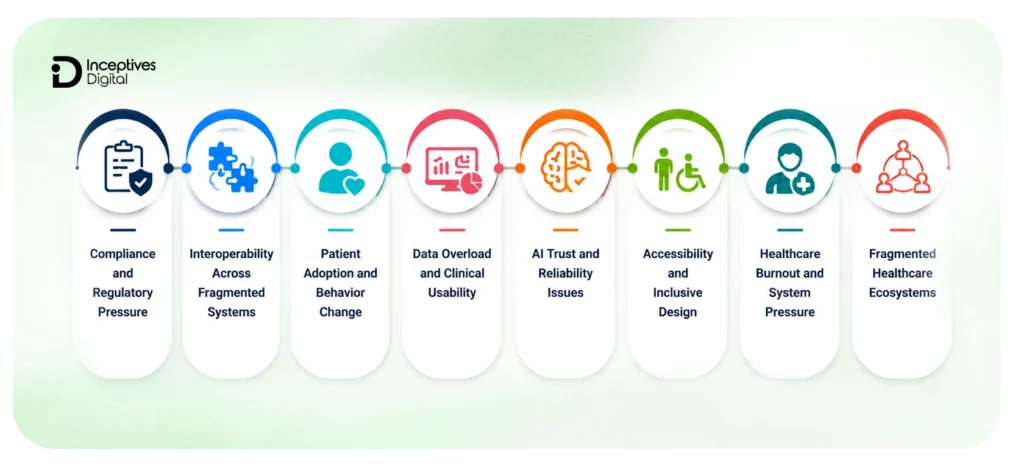
Despite rapid innovation in digital health, building successful healthcare apps is still complex. The industry operates under strict regulations, fragmented systems, and high expectations for accuracy and reliability. These challenges directly affect how healthcare app trends are implemented in real-world products.
1. Compliance and Regulatory Pressure
Healthcare apps must meet strict regulatory standards such as HIPAA and GDPR, depending on the region. Compliance is not just a legal requirement but a core design constraint that influences architecture, data storage, and third-party integrations. Any gap in compliance can lead to serious legal and financial risks.
2. Interoperability Across Fragmented Systems
Healthcare data is often spread across multiple hospitals, labs, and legacy systems. Achieving seamless interoperability between EHR/EMR systems, APIs, and third-party platforms remains one of the biggest technical barriers. Without proper integration, even advanced apps struggle to deliver complete patient insights.
3. Patient Adoption and Behavior Change
Even well-designed healthcare apps fail if patients do not consistently use them. Adoption challenges often come from:
- Low digital literacy among elderly users
- Resistance to changing traditional healthcare habits
- Lack of trust in digital-only care models
- Poor onboarding and user experience
Sustained engagement is still one of the hardest problems to solve in digital health.
4. Data Overload and Clinical Usability
Modern healthcare apps generate massive volumes of data from wearables, sensors, and patient records. However, too much data without proper filtering creates information overload for clinicians. The challenge is turning raw data into actionable insights that actually support decision-making.
5. AI Trust and Reliability Issues
While AI is widely used in healthcare apps, trust remains a key concern. Clinicians and patients often question:
- Accuracy of AI predictions
- Transparency of machine learning models
- Risk of biased outputs
- Dependence on automated decision-making
This makes explainability and validation critical for AI-driven healthcare systems.
6. Accessibility and Inclusive Design
Healthcare apps must work for a wide range of users, including elderly patients and people with disabilities. Poor accessibility design can limit adoption and reduce the overall effectiveness of digital health solutions.
7. Healthcare Burnout and System Pressure
Healthcare professionals are already under heavy workload pressure. If digital tools are not designed properly, they can add to the administrative burden instead of reducing it. Successful apps must actively reduce burnout through automation, better workflows, and simplified interfaces.
8. Fragmented Healthcare Ecosystems
Healthcare systems remain highly fragmented across providers, insurers, and technology platforms. This fragmentation slows down innovation and makes it difficult to create unified, patient-centered healthcare experiences.
These challenges highlight why successful healthcare apps require more than just advanced technology. They need strong compliance foundations, thoughtful UX design, and deep integration with real-world healthcare workflows.
How Businesses Can Prepare for Emerging Healthcare App Development Trends?
As healthcare app development trends evolve, businesses need to focus on building solutions that are scalable, secure, and compliant from the start. Strong planning around architecture, user experience, and AI integration plays a major role in long-term success.
1. Choosing the Right Tech Stack
Your mobile app tech stack should support scalability, real-time data handling, and healthcare integrations like APIs and FHIR standards.
Key points:
- Support for AI and machine learning features
- Secure backend architecture for sensitive data
- Cross-platform capability for faster deployment
2. Scalability and Cloud Infrastructure
Healthcare apps deal with growing data from wearables, RPM systems, and continuous monitoring tools, making cloud infrastructure essential.
Key elements include:
- Cloud-based storage and processing
- Scalable architecture for growing users
- High availability and system reliability
3. Compliance Planning from Day One
Compliance with HIPAA, GDPR, and healthcare regulations must be built into the product from the beginning.
This includes:
- Encrypted data handling
- Role-based access control
- Audit-ready data tracking
4. UX Strategy for Healthcare Users
The UI/UX design of a healthcare app must balance simplicity for patients with functionality for providers.
Focus areas:
- Easy onboarding and navigation
- Accessibility for all user groups
- Fast access to key actions like booking or reporting
5. AI Implementation Strategy
AI should be applied where it creates real value, not just as a feature.
Common use cases:
- Predictive analytics
- Symptom checking
- Workflow automation
- Personalized recommendations
6. Cross-Platform Development Approach
Cross-platform app development helps businesses reach more users while reducing app development cost and time.
Benefits include:
- Faster time to market
- Consistent user experience
- Lower maintenance effort
Businesses working with a healthcare app development services provider that understands both compliance and modern architecture are better positioned to succeed in this evolving digital health landscape.
The Future of Healthcare App Development
Healthcare apps are moving toward a more autonomous and connected future where they will actively support clinical decisions, not just record data. The next phase of healthcare app trends is being shaped by AI-driven systems, real-time data fusion, and deeper integration between digital and physical care environments.
1. AI Agents and Autonomous Workflows
AI agents will handle routine healthcare operations such as triage, scheduling, follow-ups, and documentation. These autonomous workflows will reduce administrative load and improve care efficiency across healthcare systems.
Key areas include:
- Automated patient triage and routing
- AI-generated clinical summaries
- Smart scheduling and follow-up management
- Continuous patient communication through AI assistants
2. Digital Twins in Healthcare
Digital twins will allow healthcare providers to create virtual models of patients using real-time and historical data. These models can help simulate treatment outcomes and predict disease progression more accurately.
3. Virtual Nursing and Remote Care
Virtual nursing will expand as healthcare systems combine human care with AI-assisted support. This model will help monitor patients remotely, especially in post-treatment and chronic care scenarios.
4. Multimodal Diagnostics
Future healthcare apps will combine data from wearables, labs, imaging, and patient inputs to improve diagnostic accuracy. This multimodal approach will help clinicians make faster and more informed decisions.
5. Smart Hospitals and Decentralized Care
Healthcare delivery will continue shifting toward decentralized models supported by smart hospitals and connected systems. Care will increasingly extend beyond hospital walls through continuous monitoring and digital health platforms.
The future of healthcare apps will focus on intelligence, automation, and connected care ecosystems that bridge patients, providers, and data in real time.
Key Takeaways on Healthcare App Trends
Healthcare app trends are clearly moving toward smarter, more connected, and preventive care models powered by AI, wearables, telemedicine, and interoperable systems. The focus is shifting from isolated digital tools to fully integrated healthcare ecosystems that improve outcomes, efficiency, and patient experience across every stage of care.
For businesses looking to act on these changes, partnering with a reliable mobile app development company can help turn these trends into practical, scalable healthcare solutions that are secure, compliant, and built for real-world use.
CTA SECTION START
cta title: Ready to Build a Healthcare App That Actually Stands Out?
cta des: From RPM to AI-powered care platforms, turn your healthcare app idea into a secure and scalable digital product.
cta button: Let’s Build Your Solution
CTA SECTION END
FAQs Regarding Healthcare App Development Trends
1. How much does healthcare app development cost?
Healthcare app development cost depends on features, complexity, and compliance requirements. A basic healthcare app may start from a lower budget range, while advanced solutions with AI, telemedicine, or EHR integration require significantly higher investment due to security and regulatory needs.
2. What are the must-have features in a healthcare app?
Must-have features in healthcare apps include appointment scheduling, telemedicine support, e-prescriptions, secure messaging, wearable integration, AI-based symptom checking, patient dashboards, and EHR/EMR integration for connected healthcare systems.
3. How is IoT used in healthcare apps?
IoT in healthcare enables real-time data collection from devices like wearables, glucose monitors, and ECG sensors. These devices help track patient vitals continuously, improve remote patient monitoring, and support early detection of health risks.
4. How can businesses build a successful healthcare app?
To build a successful healthcare app, businesses need to focus on scalability, compliance, user experience, and AI integration. Choosing the right tech stack and working with an experienced healthcare development team is also critical.
5. What are some healthcare app startup ideas?
Some of the best healthcare startup ideas are AI symptom checkers, remote chronic care platforms, mental health apps, telemedicine solutions, wearable-based health tracking apps, and digital therapeutic platforms.
6. How do healthcare apps make money?
Healthcare apps use monetization strategies like subscription plans, pay-per-consultation, freemium models, insurance partnerships, and enterprise licensing for hospitals and healthcare providers.
7. How to choose the right healthcare app development company?
Choosing the right partner for healthcare app development depends on their experience in compliance, AI integration, EHR/EMR systems, scalability, and proven expertise in building secure and user-friendly healthcare solutions.
SIDEBAR LIST START
- Top Healthcare App Trends Shaping Digital Health in 2026
- Why Healthcare Apps Are Transforming Modern Healthcare?
- Key Healthcare App Trends at a Glance
- 1. AI-Powered Healthcare Apps & Predictive Analytics
- 2. Telemedicine Platforms Are Becoming Full Digital Care Ecosystems
- 3. Remote Patient Monitoring (RPM) Is Becoming Standard Care
- 4. Wearable Healthcare Technology & IoMT Expansion
- 5. Hyper-Personalized Healthcare Experiences
- 6. Interoperability, FHIR & EHR/EMR Integration
- 7. Healthcare Cybersecurity & HIPAA-Compliant App Architecture
- 8. Voice AI & Conversational Healthcare Interfaces
- 9. AR/VR in Healthcare Apps
- 10. Preventive Healthcare & Continuous Monitoring
- Biggest Challenges in Healthcare App Development
- How Businesses Can Prepare for Emerging Healthcare App Trends?
- The Future of Healthcare Apps
- Key Takeaways
- Frequently Asked Questions (FAQs)
SIDEBAR LIST END