The iOS app development costs anywhere from $15,000 to $500,000 in 2026.
- Simple utility app: $15,000–$40,000
- Mid-level business app: $40,000–$120,000
- Feature-rich consumer app: $120,000–$300,000
- Enterprise AI app: $300,000–$500,000+
And this range is not a cop out. It reflects reality.
The market makes the stakes clear. Over 800,000 publishers are active on the Apple App Store, and if you are targeting American users, then iOS is where the money is.
Here’s what this guide covers:
- Real cost ranges for every app type, from a simple MVP to an enterprise platform
- The 8 factors that determine your final iOS app development pricing
- How native iOS, React Native, and Flutter compare on price and performance
- What hidden and ongoing costs do most agencies never mention in their quotes
- How iOS and Android development costs actually differ in 2026
- 8 practical ways to reduce your iOS app development budget without sacrificing quality
- How Inceptives Digital Approaches iOS App Cost Planning
How Much Does It Cost to Build an iOS App Based on Complexity?
The cost to build an iOS app depends almost entirely on what you are building and who you hire to build it. A simple utility app and an AI-powered enterprise platform are both iOS applications. But they share almost nothing in terms of development effort and price.
The table below reflects real-world 2026 market rates across four common app types.
| App Type | Complexity | Estimated Cost | Avg. Timeline |
| Simple utility / MVP | Low | $15,000-$40,000 | 2-4 months |
| Mid-level business app | Medium | $40,000-$120,000 | 4-8 months |
| Feature-rich consumer app | High | $120,000-$300,000 | 8-14 months |
| Enterprise / AI-powered app | Very High | $300,000-$500,000+ | 14-18+ months |
iOS development costs fall in a completely different range than mobile app development costs in 2026 for Android and cross-platform builds. It happens mainly because of how Apple’s controlled hardware ecosystem affects testing scope and developer specialization.
The Formula Behind Every iOS App Cost Estimate
Before breaking down individual factors, it helps to understand how agencies actually arrive at a number. The formula behind every iOS app cost breakdown is simpler than most people expect.
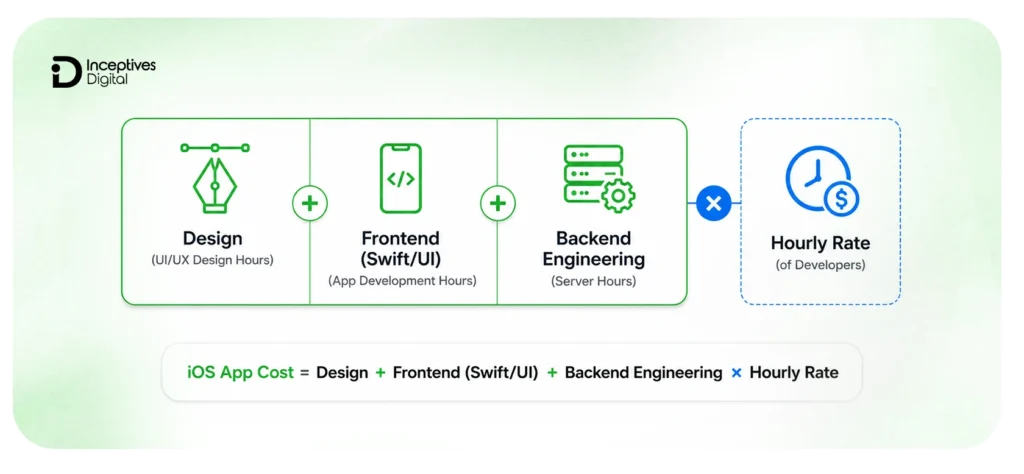
- What drives hours up? Scope, features, and complexity.
- What drives rates up? The team’s location, seniority, and agency model.
Everything else in this guide is an explanation of those two variables.
What Factors Affect the Cost of iOS App Development?
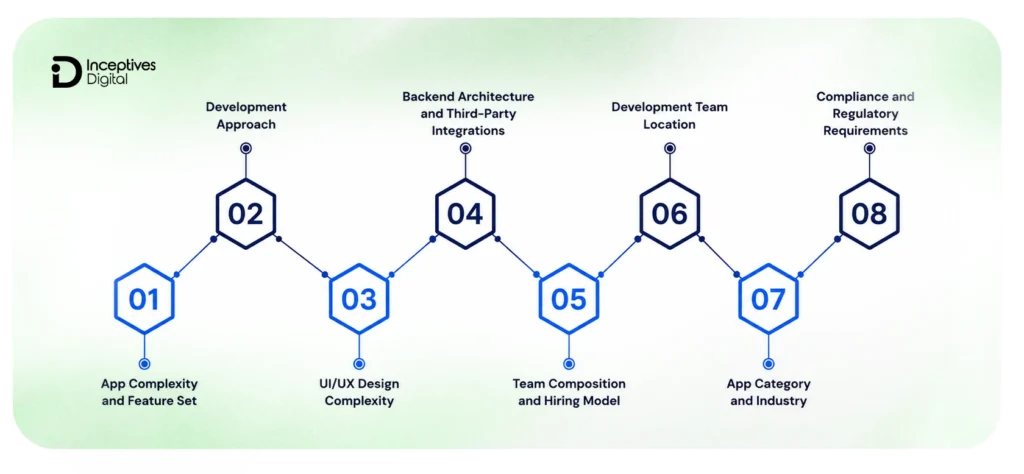
Not all apps cost the same. Here are the eight variables our team at Inceptives Digital assesses on every project before quoting.
Factor 1: App Complexity
The complexity of your app determines more of your final iOS developer costs than any other single variable.
If your app requires many features, screens, and backend logic, it will demand more development hours.
Here is how complexity tiers map to real cost ranges.
| Complexity | Feature Examples | Estimated Cost |
| Basic | Static UI, login/signup, 3–5 screens, no backend | $10,000-$25,000 |
| Medium | REST API, user profiles, push notifications, payments | $25,000-$100,000 |
| High | Real-time data, custom backend, admin panel, multi-role access | $100,000-$250,000 |
| Enterprise / AI | ML models, analytics dashboards, compliance, third-party integrations | $250,000-$500,000+ |
Factor 2: Native iOS vs. Cross-Platform
Your choice of technology stack is one of the important decisions you will have to make before writing a single line of code.
It directly shapes your app development cost estimate and determines what your app can and cannot do.
Here is how each approach compares.
| Approach | Technology | Relative Cost | Best For |
| Native Swift | Swift / SwiftUI | Higher | Complex UX, AR, performance-critical apps |
| React Native | JavaScript | Medium | Startups needing iOS + Android from one build |
| Flutter | Dart | Medium | MVPs and budget-conscious builds |
| No-Code (Bubble, Adalo) | Visual builder | Lowest ($5K–$15K) | Simple prototypes and non-technical founders |
A few rules of thumb help here:
- SwiftUI is one of the best frameworks for iOS app development. Pick this if your app uses Apple-specific APIs such as HealthKit, ARKit, or Face ID. Those require deep platform access that cross-platform frameworks can’t replicate fully.
- React Native or Flutter is perfect if you need both iOS and Android without any doubling cost, as both platforms account for over 80% of the cross-platform market.
- The no-code tools are suitable when you are just validating a concept before committing to the real development budget.
Factor 3: UI/UX Design
Design plays a very important role in the aesthetics of your app, but it is not the only reason. It directly affects the development time because the complex animations and custom interactions can take longer to build than standard components.
The three tiers below reflect what each design level includes and what it costs.
| Design Level | What It Includes | Cost Range |
| Template UI | Pre-built components, minimal custom work | $2,000-$8,000 |
| Custom UI | Brand-specific screens, custom icon sets, tailored flows | $10,000-$40,000 |
| Premium / Motion | Micro-interactions, 3D elements, fluid animations | $40,000-$80,000+ |
Factor 4: Backend Architecture and Third-Party Integrations
The backend is where most clients underestimate iOS app development pricing. Every integration. A payment gateway, a map, or a chat feature adds development time that doesn’t show up on a feature list but absolutely shows up in the final quote.
Here is a breakdown of what the common integrations cost to add.
| Integration Type | Estimated Cost Addition |
| Custom backend (built from scratch) | $15,000-$50,000+ |
| BaaS setup (Firebase / AWS Amplify) | $3,000-$10,000 |
| Payment gateway (Stripe, Apple Pay) | $2,000-$5,000 |
| Social login (Apple ID, Google) | $500-$1,500 |
| Maps / GPS (MapKit) | $1,000-$3,000 |
| Push notifications | $500-$2,000 |
| Analytics SDK | $500-$2,000 |
| Real-time chat/video (WebSocket) | $5,000-$20,000 |
Factor 5: Team Composition and Hiring Model
A project’s total iPhone app development cost depends heavily on who is building it and how they are engaged. Both the roles involved and the model you hire through can affect the final quote significantly.
Role-Based Hourly Rates
| Role | Global Avg. Rate (USD/hr) |
| iOS Developer (Mid-level) | $40-$100 |
| iOS Developer (Senior) | $80-$150 |
| UI/UX Designer | $30-$80 |
| Backend Developer | $40-$100 |
| QA Engineer | $25-$70 |
| Project Manager | $35-$90 |
| Business Analyst | $40-$100 |
Hiring Model Comparison
| Model | Cost | Control | Risk Level |
| In-house team | Highest | Full | Low (long-term) |
| Freelancers | Medium-Low | Low | High |
| Boutique agency | Medium | Medium | Medium |
| Offshore partner | Lowest | Medium | Low (if vetted) |
You can work with an offshore iOS application development company. It can mean you get senior-level communication accountability without paying US hourly rates for every development hour.
The offshore company can cost you 40%-70% lower and deliver the US quality output.
Factor 6: Where Your Team Is Located Changes Everything
Location is the most straightforward iOS app development budget variable. A senior iOS developer in New York and one in Eastern Europe may have comparable skills, but their billing rates are not comparable at all.
Here are the current 2026 market rates by region.
| Region | Avg. iOS Dev Rate (USD/hr) | Notes |
| USA / Canada | $100-$200 | Enterprise-grade, strong for regulated industries |
| UK / Western Europe | $80-$150 | Strong for EU-market apps |
| Eastern Europe | $40-$80 | High-quality, strong technical talent pool |
| India | $20-$50 | Cost-effective, large talent base |
| Southeast Asia | $20-$45 | MVPs and early-stage builds |
| Latin America | $35-$70 | US timezone alignment is a real advantage |
| Pakistan | $20-$45 | Growing tech hub, strong English proficiency |
Factor 7: Your App’s Industry Directly Affects Cost
The industry you want to build your app for determines the regulatory burden, feature complexity, and integration requirements.
For example, a fitness tracker and a HIPAA-compliant health records app both fall under healthcare, but they are not remotely similar in build.
Here is the real-world app-building cost in 2026 across multiple industries.
| App Category | Time Estimate | Cost Range |
| Gaming | 4–20 months | $30,000–$300,000 |
| eCommerce | 3–8 months | $25,000–$100,000 |
| Healthcare / MedTech | 3–12 months | $50,000–$250,000 |
| FinTech / Banking | 4–14 months | $60,000–$300,000 |
| On-Demand / Marketplace | 4–10 months | $40,000–$150,000 |
| EdTech | 2–10 months | $20,000–$120,000 |
| Social Networking | 5–10 months | $30,000–$150,000 |
| AI-Powered | 6–18 months | $100,000–$500,000+ |
| Fitness and Wellness | 2–8 months | $20,000–$100,000 |
Factor 8: Compliance and Regulatory Requirements
Compliance is the cost that most quotes leave out entirely. If your app operates in healthcare, finance, or any jurisdiction with data protection laws, you are not choosing whether to address compliance. You’re choosing whether to address it upfront or pay far more to fix it later.
Here is what common regulatory requirements add to a project.
| Compliance Standard | Typical Additional Cost | What Drives the Cost |
| HIPAA (Healthcare Apps) | $15,000-$50,000+ | Secure data storage, audit logs, access controls, encryption, compliance testing, and legal requirements. |
| PCI DSS (Payments & FinTech Apps) | $20,000-$80,000+ | Secure payment processing, tokenization, fraud prevention, certified infrastructure, and security audits. |
| GDPR (Apps Serving EU Users) | $5,000-$20,000 | Privacy-by-design architecture, consent management, user data controls, and compliant data handling processes. |
| COPPA (Children’s Apps) | $5,000-$15,000 | Age verification, parental consent mechanisms, child data protection, and regulatory compliance measures |
Apple App Store Guidelines: Non-compliance results in rejection. Factor in review cycles and potential resubmissions, especially for apps in health, finance, or children’s categories.
Apple rejected more than 2.09 million App Store submissions, the majority for spam, incomplete submissions, or guideline violations, not compliance failures by legitimate developers.
Ignoring compliance doesn’t save money. It creates liability that costs far more to address after your app is live.
Should You Build an MVP First? Here’s What the Numbers Say
The MVP question is one of the most important iOS app development budget decisions you will make.
Building a full product on an unvalidated idea is one of the most common and expensive mistakes in app development.
Here is a better look at the difference between the MVP and the final product.
| MVP (Minimum Viable Product) | Full Product | |
| Goal | Validate the idea with real users | Scale a proven concept |
| Features | 3–5 core features only | Complete feature set |
| Cost | $15,000-$60,000 | $80,000-$500,000+ |
| Timeline | 2-4 months | 6-18 months |
| Investment Risk | Low | Higher |
| Best For | Startups, new concepts, fundraising | Validated and funded products |
Many are surprised after finding out how much it really costs to build an MVP once the scope is properly defined. It happens because even a very simple first version needs a complete user flow with a working backend and enough polish to generate meaningful feedback from real users.
If you are building an MVP, it is suggested to keep the scope tight.
What should a well-scooped iOS MVP include? Here are the tips for you;
- The core flows from the signup through the primary action to a meaningful result.
- Basic, clear, and functional UI. Do not go just for a premium finish.
- One payment method is enough if monetization is central to the concept from day one.
- Analytics from launch to measure what the users are actually doing, not what you are expecting them to do.
- Crash report via TestFlight and Firebase Crashlytics, so the issues surface before they compound.
Hidden and Ongoing iOS App Costs You Must Budget For
Most mobile app development cost iOS guides stop at development. That is exactly where most budget surprises start.
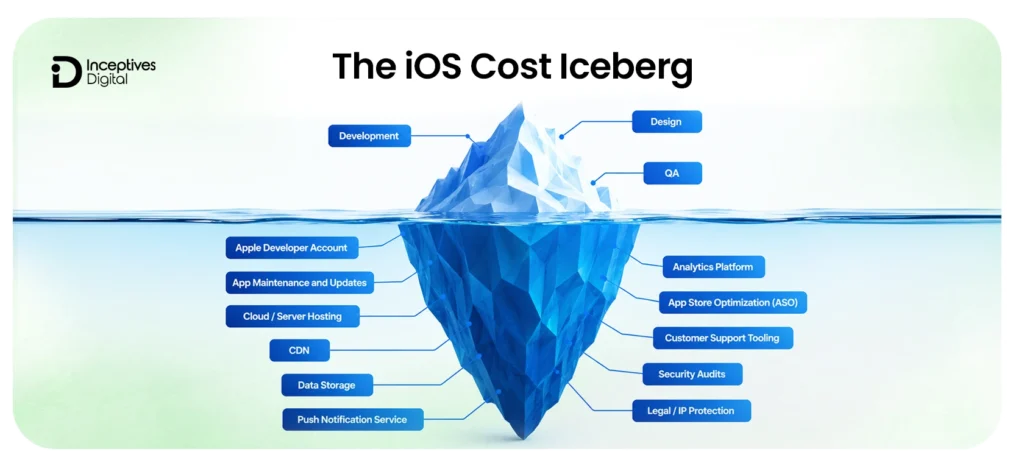
Here is a full breakdown of what it costs to keep an iOS app running after launch.
| Cost Category | What It Covers | Avg. Annual Cost |
| Apple Developer Account | Required to publish on the App Store | $99/year |
| App Maintenance and Updates | Bug fixes, OS updates, feature additions | $5,000-$20,000/year |
| Cloud / Server Hosting | AWS, GCP, Firebase | $1,200-$15,000/year |
| CDN | Media delivery for image or video-heavy apps | $150-$1,000/year |
| Data Storage | User data, logs, media files | $500-$5,000/year |
| Push Notification Service | OneSignal, Firebase Cloud Messaging | $0-$2,400/year |
| Analytics Platform | Mixpanel, Amplitude, Firebase Analytics | $0-$5,000/year |
| App Store Optimization (ASO) | Keywords, screenshots, A/B testing, ratings management | $1,000-$6,000/year |
| Customer Support Tooling | In-app helpdesk, Intercom, Zendesk | $600-$3,600/year |
| Security Audits | Penetration testing, vulnerability scans | $3,000-$15,000/year |
| Legal / IP Protection | Terms of service, privacy policy, and IP filing | $1,500-$10,000 one-time |
You must know the cost of mobile app maintenance prior to the launch. What many founders do is skip the maintenance budgeting, which can create problems afterwards.
You should plan for 15–20% of your original development cost per year for ongoing maintenance and operations.
For example, you gave a $100,000 app, then you must reserve $15,000-$20,000 per year just to keep it healthy and current.
Why the Higher Cost Often Pays Off
There is a misconception that higher upfront costs mean lower returns. If you have the right product targeting the right market, then iOS consistently delivers stronger revenue per user than any other mobile platform.
Alone in the USA, the average per-user annual spending is about $140.
This is the main reason the cost to build an iOS app is worth examining seriously, rather than defaulting to whichever platform feels cheaper.
8 Ways to Reduce Your iOS Development Budget
Reducing cost does not mean compromising on quality. It requires making smarter decisions before development starts.
Most apps that come in over budget do so because of avoidable decisions made in the early stages, not because iOS app development pricing is inherently out of reach.
- Start with an MVP.
- Choose Flutter or React Native if you need both iOS and Android
- Use a backend-as-a-service solution early on.
- Build on pre-existing UI component libraries.
- Work with an offshore agency that has US-facing project management.
- Define your scope before writing a single line of code.
- Finalize your Figma designs before development begins.
- Negotiate phased delivery.
How Inceptives Digital Approaches iOS App Cost Planning
At Inceptives Digital, we have seen what happens when clients receive vague quotes. A number without a scope is not an estimate. It is a guess that sets up both sides for a difficult conversation later. Our discovery-first model is built specifically to prevent that.
Here is how we approach every project from the first conversation to launch.
- Product Discovery. Before any quote, we define scope, features, and the appropriate tech stack in detail. This is the step most agencies skip, and it is where budget surprises are created or prevented.
- Transparent Estimation. We offer both fixed-price and time-and-materials models, explained clearly before anything is signed. You know what you are committing to and why.
- UI/UX Design Sprint. Design is validated and approved before a single line of production code is written. Changes at the design stage cost hours. Changes at the development stage cost weeks.
- Agile Development. We work in fortnightly sprints with client-facing demos after each one. You see progress in real time and can adjust direction early, not at the end when changes are expensive.
- QA and Testing. Device-specific testing across the current iPhone range before any App Store submission. No launch-day surprises from untested edge cases.
- App Store Submission. We handle the full submission process, including guidelines compliance and any rejection responses. Apple’s review process has specific requirements. We know them.
- Post-Launch Support. Maintenance plans are available from Month 1. An app that goes unsupported after launch degrades quickly as iOS updates ship.
Real-World Example: DPS Airem: Real-Time Workforce Management Platform
Inceptives Digital developed DPS Airem, an enterprise security management app for iOS and Android platforms featuring GPS attendance, shift scheduling, incident reporting, real-time tracking, and workforce communication.
Developing a similar application typically costs between $20,000 and $120,000, depending on features, integrations, scalability, and customization requirements.
Choosing an iOS App Development Firm: What to Look For
Get a quote from the shortlisted companies. But you don’t hire all of them. To pick the right one, here is a checklist designed. It separates the credible partners from the risky ones.
| Green Flags ✅ | Red Flags 🚩 |
| Live apps available on the App Store or Google Play | Quote provided without discovery or scoping |
| Proven experience in your industry | No breakdown of hours, milestones, or deliverables |
| Transparent pricing with detailed scope | Unrealistically low pricing without justification |
| Clear post-launch support and maintenance plan | No dedicated project manager for offshore teams |
| NDA and IP ownership are included in the contract | Vague answers about technologies and architecture |
| Client references available upon request | No maintenance or support after launch |
| Verified reviews on Clutch, Trustpilot, or DesignRush | Poor communication or an unclear development process |
The app market rewarded quality over volume, with revenue growing 10.6% while downloads grew just 0.8%, which is why understanding mobile app monetization strategies that actually work matters just as much as getting the development cost right.
Ready to Build Your iOS App? Let’s Talk Numbers.
Cost is a function of scope, team, location, and the ongoing reality of running a live product. The most expensive mistake in app development is building too much, too fast, without first validating whether users want what you’ve built.
Whether you’re a startup scoping your first MVP or an enterprise replacing a legacy system, the right starting point is a transparent discovery conversation, not a ballpark quote.
At Inceptives Digital, we start every project with a free discovery call. No obligations. Just honest scoping and a realistic number you can actually plan around.
Frequently Asked Questions About iOS App Development Cost
A simple iOS app with basic features typically costs between $15,000 and $40,000. If you want a proper enterprise-grade iOS app, then it can cost you around $300,000 to $500,000.
No. You cannot build an iOS app under $10,000 with professional developers. It is only possible with no-code tools like Bubble or Adalo. Those platforms are good for prototypes and concept validation. But they are not suitable for production-grade apps with real user traffic and complex logic.
You should reserve 15–20% of your original development budget annually. Such as for a $50,000 app, that translates to $7,500-$10,000 per year, covering OS updates, bug fixes, server costs, and incremental feature additions to stay competitive.
iOS developers typically charge 10–15%, but simpler device testing helps balance overall project costs, making total development expenses surprisingly comparable.
An MVP typically takes 2–4 months. A mid-level business app takes 4–8 months. An enterprise-grade product with complex integrations, compliance requirements, and AI features can take 12–18 months or longer.
$99 per anno. This fee is required to publish any app on the App Store, regardless of the app’s complexity or commercial model.
If your audience is primarily in the US, UK, or Australia, then build the iOS first. And if your monetization model depends on subscriptions or in-app purchases, then iOS users are a good target audience for this.
SIDEBAR LIST START
- How Much Does It Cost to Build an iOS App?
- The Formula Behind Every iOS App Cost Estimate
- What Factors Affect the Cost of iOS App Development?
- Should You Build an MVP First?
- Hidden and Ongoing iOS App Costs
- Why the Higher Cost Often Pays Off
- 8 Ways to Reduce Your iOS Development Budget
- How Inceptives Digital Approaches iOS App Cost Planning
- Choosing an iOS App Development Firm
- Ready to Build Your iOS App? Let’s Talk Numbers.
- Frequently Asked Questions
SIDEBAR LIST END