What Does It Mean to Validate a Game Idea?
Game idea validation is the process of testing whether a game concept has a viable market, a defined target player, a functional core mechanic, and a sustainable monetization model, before initiating the mobile game development process.
Most people arrive at the mobile game development company with one of two stories: they are at the start of an idea and want to know where to begin, or they have already spent months building something the market never asked for.
Both situations are fixable. Only one is avoidable.
This guide gives you the exact framework we use before starting the mobile game development process.
What you will learn:
- Why most game ideas fail and what the data says
- How to read the 2026 market with real tools and numbers
- How to define your target player the right way
- The Inceptives Digital 5-Gate Validation Framework
- Low-cost tactics that actually work in 2026
- The metrics that separate viable ideas from expensive mistakes
- When to kill, pivot, or go all in
Why Most Game Ideas Fail in 2026
Before diving into the framework, here is the reality of the market you are entering.
Nearly 19,000 video games were released on Steam in 2024 alone, the highest number in the platform’s history, yet around 80% of them went largely unplayed according to publicly available data.
On mobile, the average day 30 retention rate sits at just 3.21%, meaning 96.79% players abandon a game within a month.
This is not a quality problem. Many failed games are well-made. It is a validation problem.
The 3 Failure Patterns We See Every Time
| Failure Type | What It Means | The Root Cause |
| Wrong Market | Genre is saturated or has no spending audience | The developer assumed demand instead of measuring it |
| Wrong Mechanic | Core loop fails to create habitual play | Early prototype testing was skipped |
| Wrong Moment | Right idea, wrong timing in the trend cycle | Timing is treated as luck, not a validatable variable |
What Changed in 2026 That Makes This More Critical
Three forces have shifted the landscape, and all three make validation harder to skip:
1. AI lowered the barrier to entry. Tools like Midjourney, Suno, and Meshy allow developers to produce professional-looking assets in hours. More developers can build faster, which means more competition at launch than ever before.
2. User acquisition costs keep climbing. Average CPI for mobile games increased 22% year-over-year in 2024. For mid-core games, Meta CPI now regularly exceeds $4.00. If your LTV does not materially exceed CPI, the business model does not work.
3. Organic app store discovery has declined. Both the App Store and Google Play now prioritize paid placement. Launching cold into a store without pre-existing audience signals is increasingly unreliable. Community building and pre-launch validation are now structural requirements, not optional extras.
Understanding the 2026 Game Market
Making a sound decision about any game idea requires understanding the game market first. Here is the current landscape from the most reliable public sources available.
Global Market at a Glance
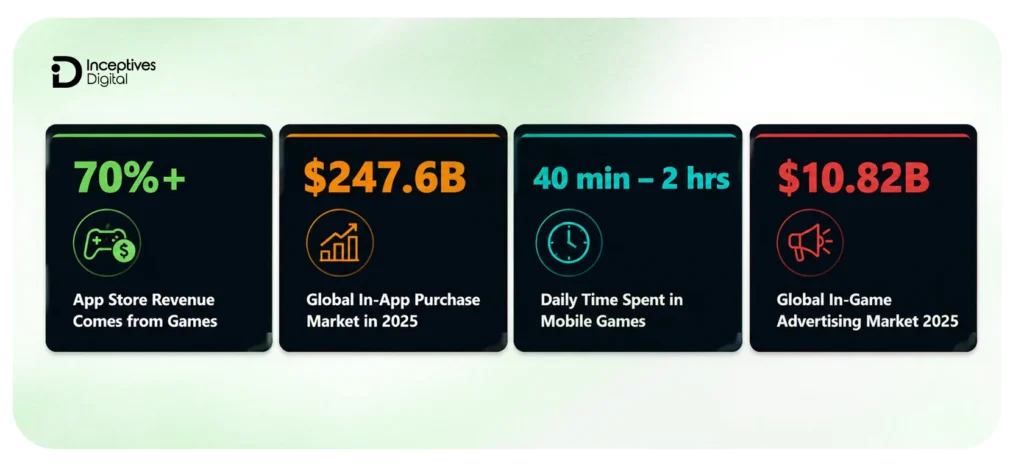
The global mobile gaming market is projected to reach $158.50 billion in 2026, growing at a CAGR of 9.95% through 2030. Mobile accounts for roughly 52% of total gaming revenue, making it the largest single segment of the industry.
| Platform | Revenue Share | Competition Level | Best For |
| Mobile (iOS + Android) | 49% | Very High | Volume, reach, IAP/ad models |
| PC (Steam, Epic) | 28% | High | Niche communities, premium pricing |
| Console | 23% | Capital-Intensive | Established studios with publisher support |
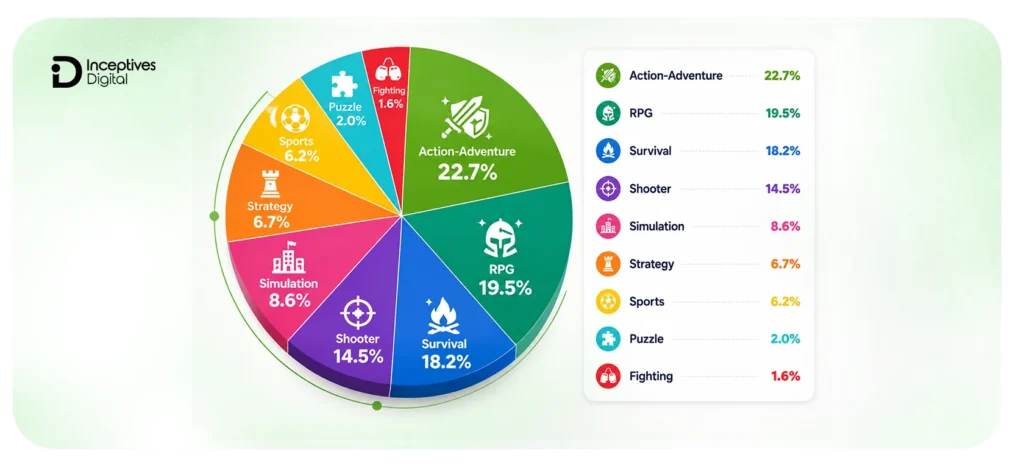
2026 Genre Opportunity Breakdown
You do not need to spend money to conduct professional-grade market research. Here is the toolkit the industry actually uses:
| Tool | What It Does | Best For |
| Sensor Tower | App store downloads, revenue, keyword rankings | Competitor analysis, ASO |
| data.ai | Active user data, category trends | Market sizing |
| Newzoo | Global market forecasts, platform segmentation | Strategic planning |
| GameRefinery | Feature benchmarking, mechanical analysis | Genre gap research |
| VGInsights | Steam revenue data, wishlists | PC/indie validation |
| AppFollow | Review analysis, ASO research | Competitor review mining |
| SteamSpy | Steam player counts and engagement | PC launch planning |
All offer free tiers with sufficient data for early-stage validation.
Who Is Your Player? Building a Player Persona That Actually Works
One of the most common mistakes we see is developers defining their audience too broadly.
“Everyone who likes games” is not a target. “Mobile strategy players, 25–34, who spend 15+ minutes per session and have made at least one IAP in the past 90 days” is a target.
The difference determines your acquisition channels, monetization model, App Store copy, and core loop depth.
The Bartle Taxonomy — Still the Most Useful Framework in 2026
Richard Bartle’s four player archetypes map directly to mechanics and monetization behavior.
| Archetype | What They Want | Responds To | Commercial Signal |
| Achievers | Progress, completion, mastery | Battle passes, progress bars, milestone rewards | High IAP potential |
| Explorers | Discovery, hidden systems, lore | Procedural generation, secrets, world depth | High retention potential |
| Socializers | Player interaction, community | Guilds, co-op modes, leaderboards | High viral potential |
| Killers | Competition, dominance, status | PvP, ranked modes, ego mechanics | High session frequency |
The 6 Data Points Every Player Persona Needs
- Platform and device behavior: iOS or Android? Phone or tablet? Affects control design, screen layout, and monetization model selection.
- Session length and frequency: Commuter player (5-min sessions, 4x daily) or dedicated player (30+ min, once daily)? This shapes your entire game loop.
- Genre history: What are they already playing? If you cannot name three games in their library right now, your persona is not defined enough.
- Discovery channel: TikTok, YouTube, App Store browse, or word of mouth? This determines your entire pre-launch strategy.
- Spending behavior: Have they made an IAP in the past 90 days? At what price point?
- Competitive stack: What else are they playing right now? Your game competes for time and attention from a specific set of players, not the whole store.
The Inceptives Digital 5-Gate Validation Framework
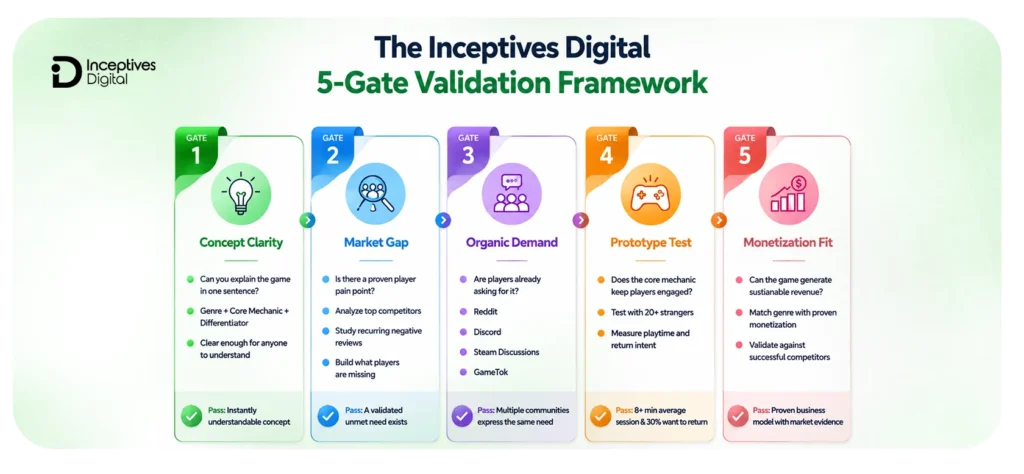
After years of experience across mobile, PC, and AR/VR, we have refined game idea validation into five sequential gates. An idea must pass each gate before resources are committed to the next stage.
Gate 1 — The One-Line Concept Stress Test
The question: Can you describe your game in one sentence that includes the genre, core mechanic, and a clear differentiator?
Why this matters: If you cannot describe your game in one sentence, you do not yet have a clear enough vision to build it. Every development decision, scope, art direction, monetization, UA creative, flows from the clarity of your core concept.
The formula: [Target Player] + [Core Mechanic] + [Genre Context] + [Differentiator]
| Version | Example | Result |
| ✅ Strong | “A mobile tower defense game for strategy players that uses real-time weather mechanics to change enemy behavior every session.” | Clear player, mechanic, genre, and differentiator |
| ❌ Weak | “A fun game where you build things and fight enemies — like Clash of Clans but with more depth.” | Aspiration, not a concept |
Pass condition: A stranger (not a friend or colleague) immediately understands the genre and the differentiator from your one sentence.
Gate 2 — Competitive Landscape Mapping
The question: Is there a validated, unmet player need in your genre that no top competitor is solving?
Why this matters: Player complaints are your product brief. The 1-star reviews on top games in your genre tell you exactly what the market wishes existed.
How to execute:
- Search your primary genre on App Store and Steam
- Identify the top 10 games by download volume
- For each competitor: record average rating, read all 1–2 star reviews, note recurring complaints
The three market conditions and what they mean:
| Condition | What It Means | What to Do |
| Crowded market + clear complaint patterns | Opportunity exists. Pain is proven. | Build to solve the gap |
| Empty market + no comparable games | Likely no demand, not a gap | Reconsider the concept |
| Crowded market + satisfied players | Differentiation is possible but expensive | Needs a very distinct angle |
Pass condition: You can identify at least one consistent, validated pain point in your genre that no top-10 competitor adequately solves.
Gate 3 — Organic Audience Signal Research
The question: Are players already asking for something like your game without being prompted?
Why this matters: The difference between real validation and false validation is whether the signal comes from strangers or people who know you. Organic research shows what players want in their own words.
Where to look in 2026:
- Reddit: r/indiegaming, r/patientgamers, r/gamedev, r/androidgaming
- Discord: Suggestions and feedback channels in genre-specific servers
- TikTok GameTok: Genre hashtags; measure saves-to-views ratio (saves = intent)
- Steam Discussions: Competitor game boards for PC-targeted concepts
Signal strength scoring:
| Signal Level | What It Looks Like |
| Strong | Multiple communities, unprompted, describing your game’s value in similar language |
| Moderate | One community actively discussing the need |
| Weak | Minimal organic discussion found |
| None | The concept exists in a vacuum. Red flag |
Pass condition: At least three unprompted, organic discussions across different communities describe wanting what your game delivers.
Gate 4 — The 2-Week Prototype Validation Test
The question: Does your core mechanic create genuine engagement when real strangers play it?
Why this matters: A concept can sound compelling and still produce a mechanic that fails. The only way to know is to watch strangers play it, not your team, not your friends.
What to build: The minimum necessary implementation of your single-core mechanic. No story, no progression, no polished art. One action. That is all.
How to run the playtest:
- Recruit 20+ strangers (post in relevant subreddits or Discord with a small incentive)
- Observe without narrating, do not explain or help, just watch
- Measure only three things:
| Metric | What It Tells You | Target |
| Session time | Whether the mechanic creates an engagement loop | 8+ minutes without prompting |
| Return intent | Whether the mechanic created curiosity or desire for more | 30%+ express unprompted return intent |
| Unsolicited sharing | Whether the concept has viral potential | Any unprompted share is a strong signal |
Pass condition: Average session time exceeds 8 minutes, and at least 30% of playtesters express unprompted return intent.
Gate 5 — Monetization Fit Verification
The question: Does a proven monetization model exist for your game type, and is your design compatible with it?
Why this matters: A game players love but cannot monetize is a hobby project. Monetization must be designed from day one,e not added after launch.
The three models and when they work:
| Model | How It Works | Best Genre Fit | Avg LTV / eCPM |
| In-App Purchases (IAP) | Players pay for currency, cosmetics, or progression | Mid-core, RPG, strategy | $8–$18 per paying user |
| Rewarded Ads | Players watch ads for in-game rewards | Casual, hybrid-casual | $12–$22 eCPM in the USA |
| Premium / Paid | Players pay upfront | PC, console, established IP | Depends on audience size |
The mismatch problem — avoid these combinations:
- Casual game (2–3 min sessions) + deep IAP monetization → Players never build enough investment to spend
- Deep RPG + pure ad monetization → Not enough volume to justify ad revenue model
Pass condition: You can name two top-10 games in your genre using the same monetization model, with LTV data (via Sensor Tower or GameRefinery) that supports the business case.
Low-Cost Validation Tactics for 2026
Once your idea passes the five gates, these tactics gather additional signals before full game development cost. All under $500.
| Tactic | Cost | What to Measure | Success Signal |
| Landing page + waitlist | $0–$20/month | Email conversion rate | 15–25% visitor-to-signup conversion |
| TikTok / Meta concept ad | $50–$100 | Click-through rate | CTR above 3% on TikTok |
| Game jam submission | Time only | Plays + comment patterns | 200+ plays, “want more” comments |
| Reddit/Discord concept post | Free | Community language and response | Unsolicited shares and follow-up questions |
| AI-assisted market research | Free–$20/month | Competitor patterns, trending mechanics | Used for research acceleration only |
One important caveat on paid ads: Paid signal tests produce false positives when the creative is strong, but the concept is weak. Always pair with Gate 3 organic research to cross-reference.
On AI validation tools in 2026: They are genuinely useful for compressing the research phase, synthesizing competitor reviews, identifying trending mechanics, and building persona hypotheses.
They are not a substitute for Gate 4 prototype testing. AI can analyze what players have said about games that exist. It cannot tell you how players will respond to a mechanic that does not yet exist.
When to Kill, Pivot, or Go All In
This is the most judgment-intensive part of the process, and where experience matters most.
Red Flags — Stop and Reassess
Kill or fundamentally rethink the concept if:
- The idea fails two or more gates, and the core mechanic is inseparable from the problem
- Your genre has declining CPI trends with no LTV recovery data in the past 12 months
- No comparable games exist, and you cannot explain why the market has not been served
- Prototype sessions consistently end before 5 minutes with no return intent
- Your monetization model is structurally incompatible with your genre’s player behavior
Green Flags — Build Deeper
Proceed to full development planning and timeline if:
- A consistent, unmet player need appears across Gate 2 reviews and Gate 3 communities in similar language across different platforms
- Prototype sessions average 10+ minutes with unsolicited return intent and sharing
- Your LT V: CPI projection shows above 3:1 at conservative estimates
- A proven monetization analog exists in your genre with publicly available performance data
- Your one-line concept generates unprompted follow-up questions from strangers
The Pivot Decision
When an idea passes some gates but fails others, the answer is usually not to abandon it — it is to change the right variable.
| Variable | Protect or Change? | Why |
| Core mechanic | Protect | If strangers respond to it in Gate 4, it has value |
| Genre framing | Change | A mechanic can live in multiple genres |
| Platform | Change | A strategy mechanic too complex for mobile may thrive on PC |
| Target player segment | Change | A different audience may already be waiting for this |
| Monetization model | Change | The most fixable variable at the early stage |
Validate First. Build Second. Launch With Confidence.
The 2026 game market is not short on games. It is short on games that were built because the market asked for them.
At Inceptives Digital, we have seen what happens when development skips validation: real budget, real talent, and real time invested into products that a 4–8 week process would have flagged early.
We have also seen what happens when it is done right with pre-built audience signals, cleaner unit economics, and teams who know exactly what they are building and why.
Frequently Asked Questions
For a mobile game, the full 5-gate process takes 4–8 weeks. Gates 1 and 2: a few days. Gate 3: 1–2 weeks. Gate 4: 2 weeks to build and test. Gate 5: 3–5 days of monetization research. Rushing this is how developers spend 12 months building something the market never wanted.
Yes, for the mechanic specifically. Market demand, competitive gaps, and monetization fit can be validated without one. But whether your core loop creates engagement can only be proven by watching real people play it. Gate 4 is non-negotiable.
Gate 3 (Reddit/Discord research) costs nothing. A landing page on Card costs under $10/month. A game jam prototype on itch.io costs time, not money. You can complete Gates 1–3 and a version of Gate 4 for under $100.
Market research tells you what already exists and how it performs. Validation tests whether your specific concept will work with your specific mechanic, player, and monetization model. Market research is an input to validation. It does not replace it.
Data from VGInsights and Newzoo consistently shows fewer than 10% of Steam releases recoup development costs. On mobile, the top 1% of games generate roughly 80% of category revenue. These numbers are not reasons to avoid game development; they are reasons to validate rigorously before building.
No. AI accelerates research significantly, but cannot replace human playtesting. Tools like Perplexity and ChatGPT tell you what players said about games that exist. They cannot measure how players respond to a mechanic that does not yet exist.
SIDEBAR LIST START
- What Does It Mean to Validate a Game Idea?
- Why Most Game Ideas Fail in 2026
- Understanding the 2026 Game Market
- Who Is Your Player? Building a Player Persona That Actually Works
- The Inceptives Digital 5-Gate Validation Framework
- When to Kill, Pivot, or Go All In
- Validate First. Build Second. Launch With Confidence.
- Frequently Asked Questions
SIDEBAR LIST END