Introduction to Blockchain Technology Trends Shaping the Next Phase of Digital Infrastructure
Blockchain isn’t really sitting in the “new tech” box anymore. It’s already being used in payments, identity checks, supply chains, and even in how ownership gets recorded digitally.
What’s interesting is how quickly companies are moving from testing it to actually relying on it. A recent industry survey shows that around 60% of Fortune 500 companies are already working with blockchain in some form. That’s not early adoption anymore. That’s integration.
This shift clearly indicates that businesses are now willing to invest in blockchain technology, mostly through collaborating with an experienced blockchain app development company to integrate it into their existing systems. The shift is not just due to the buzz, but to handling data more efficiently and improving traceability rather than relying on manual verifications.
And that’s really where things start to change. It’s no longer about “will blockchain work?” That part is already settled in most industries. The real curiosity now is around what actually sticks and what quietly fades out after all the hype cycles settle.
This blog breaks down the blockchain technology trends that are actually gaining ground, not just being talked about, and where they seem to be heading in real-world use.
Why Blockchain Technology Trends Are Shifting Toward Real-World Adoption?
Blockchain has stopped behaving like a “separate” technology category. It’s slowly getting absorbed into systems that already exist, especially where data integrity and automation matter more than experimentation.
From Speculation to Enterprise-Grade Systems
A few years ago, blockchain mostly showed up in conversations around crypto trading and market cycles. That phase hasn’t disappeared, but it’s no longer where most enterprise focus sits.
The shift now is more practical. Instead of developing independent blockchain solutions, companies now implement blockchain technology through their existing operational systems, which include payment processing, internal auditing, logistics tracking, and identity verification systems.
There is something hidden in the background that operates at a less visible level. The development of blockchain requires strict regulations to build its systems from the first day, with compliance requirements as its fundamental design principle.
Key Drivers Behind Modern Blockchain Adoption
A few practical pressures are pushing blockchain deeper into real-world systems:
- Enterprise digital transformation programs need cleaner data coordination
- Cross-border transactions that still feel slow and expensive
- AI systems that depend on verifiable data sources
- Rising demand for audit-ready transparency in operations
- Growing interest in tokenized real-world assets
It’s not a single breakthrough pushing adoption. It’s a mix of operational gaps that traditional systems struggle to solve cleanly.
Industries Leading Blockchain Adoption
Some sectors are moving faster than others simply because the problems are more visible or expensive to ignore.
| Industry | Blockchain Use Case | Why It Matters |
| Finance | Payments & settlement | Faster transactions and reduced intermediaries |
| Supply Chain | Traceability | Better fraud control and product tracking |
| Healthcare | Secure records | Improves data integrity and access control |
| Real Estate | Asset tokenization | Enables fractional ownership and liquidity |
| Government | Digital identity | Stronger and more reliable verification systems |
Each of these areas is less about “trying blockchain” and more about replacing or upgrading parts of systems that already exist but don’t scale well anymore.
Trend #1: AI Integration is Redefining Blockchain Technology
Why AI and Blockchain Are Becoming Interconnected
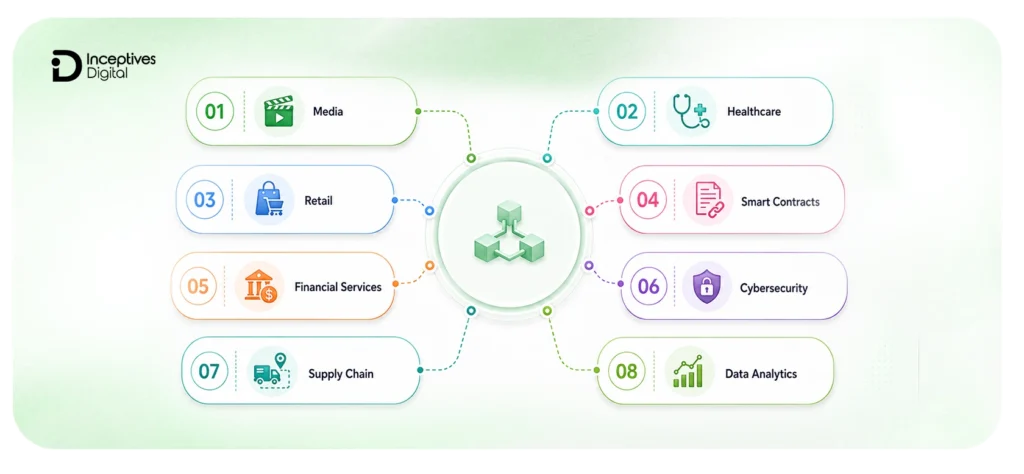
AI systems are only as reliable as the data they learn from, and that’s where things start to break down in real-world environments. Data gets messy, duplicated, or altered as it moves across systems.
Blockchain steps in with a different role. It doesn’t try to make data smarter. It makes it harder to tamper with. Once information is recorded, it stays traceable and unchanged, which is exactly what AI models need when accuracy matters.
Put simply, AI brings intelligence, blockchain brings trust. And the overlap between the two is getting more practical as automation starts showing up in decentralized environments.
Blockchain and AI Use Cases Emerging in the Market
- Automated smart contract execution without manual triggers
- Fraud detection systems in financial platforms using verified transaction history
- Decentralized AI training datasets with traceable data sources
- Predictive analytics built on blockchain-verified inputs
- Autonomous decision systems inside enterprise workflows
Impact on Enterprise Blockchain Solutions
The combination of AI and blockchain is slowly changing how enterprise systems are structured.
- Less reliance on manual data verification steps
- Clearer visibility across transactions and system logs
- Smoother automation across operational workflows
Trend #2: Real-World Asset Tokenization is Expanding Beyond Crypto Markets
Asset tokenization is basically the process of turning real-world assets into digital units on a blockchain. Instead of owning an entire asset in a traditional sense, ownership can be split into smaller, tradable parts.
That’s where fractional ownership comes in. A single property, for example, can be divided into multiple digital shares, allowing more people to invest without needing large capital upfront.
Assets Being Tokenized Across Industries
- Real estate properties
- Bonds and securities
- Commodities
- Intellectual property
- Carbon credits
- Luxury goods
Why Tokenization Is Becoming a Major Blockchain Technology Trend
There’s a simple reason this is gaining traction: it makes traditionally slow and restricted markets more flexible.
- Improved liquidity in previously illiquid assets
- Global access for investors without location barriers
- Fewer steps between buying and selling
- Faster settlement compared to traditional systems
Key Challenges Slowing Down Adoption
Even with momentum building, adoption isn’t friction-free.
- Unclear regulatory frameworks across regions
- Complex legal definitions of ownership
- Hesitation from institutional investors
Traditional Assets vs Tokenized Assets
| Traditional Assets | Tokenized Assets |
| High entry cost | Fractional access |
| Slow transfers | Near-instant settlement |
| Limited liquidity | Global trading access |
| Heavy paperwork | Smart contract automation |
Trend #3: Blockchain Interoperability Is Becoming a Core Requirement
Most blockchain networks still operate like separate systems that don’t naturally communicate with each other. That gap becomes obvious when businesses try to scale across multiple platforms.
The issue usually shows up in a few simple ways: fragmented ecosystems, limited chain-to-chain communication, and added complexity when enterprises try to connect everything into one workflow.
Solutions Driving Blockchain Interoperability
- Cross-chain communication protocols
- Layer-2 scaling solutions
- Blockchain bridges
- Zero-knowledge proof systems
- Multi-chain architecture
Business Impact of Interoperability
When blockchain networks start interacting instead of staying isolated, it changes how systems actually perform in production environments.
- Smoother data exchange across platforms
- Reduced operational complexity in enterprise setups
- Better scalability for larger applications
- Support for multi-network blockchain applications
Trend #4: Decentralized Identity Systems Are Replacing Traditional Verification Models
Digital identity systems today are starting to show their age. Data breaches are more frequent, and once information is stored in centralized databases, it becomes an easy target. On top of that, users often go through the same KYC checks again and again across different platforms, which feels repetitive and inefficient.
How Decentralized Identity Works in Blockchain Systems
Decentralized identity changes who controls the data in the first place. Instead of companies storing and managing all user information, individuals hold their own credentials.
- Self-sovereign identity model
- User-controlled credentials
- Blockchain-based verification
Industries Driving Adoption of Decentralized Identity
- Banking and financial services
- Healthcare systems
- Education verification
- Government identity programs
- Travel and immigration systems
Benefits of Blockchain-Based Identity Systems
| Feature | Benefit |
| User-owned identity | Better privacy control |
| Secure verification | Reduced fraud risk |
| Faster onboarding | Less friction during signup |
| Portable credentials | Works across multiple platforms |
Trend #5: Sustainable and Energy-Efficient Blockchain Systems Are Gaining Priority
Energy use has become a real talking point in blockchain, not just a technical one. Older consensus models brought attention to environmental concerns, especially when networks scaled.
At the same time, companies are under pressure from ESG commitments, and regulators are paying closer attention to how much energy digital infrastructure consumes. That combination is pushing blockchain design in a more efficient direction. Interest in blockchain in sustainable business practices is also growing as businesses look for better ways to improve transparency around emissions, sourcing, and environmental reporting.
Evolution of Blockchain Consensus Mechanisms
- Proof-of-stake systems
- Hybrid consensus models
- Low-energy blockchain protocols
- Optimized validation networks
Real-World Use Cases for Green Blockchain Systems
- Carbon credit tracking systems
- Renewable energy trading platforms
- Sustainable supply chain monitoring
- ESG compliance reporting tools
Consensus Models Compared
| Consensus Type | Energy Use | Scalability | Enterprise Suitability |
| Proof-of-Work | High | Moderate | Low |
| Proof-of-Stake | Low | High | High |
| Hybrid Models | Optimized | High | High |
High-Impact Blockchain Technology Trends Driving Enterprise Adoption
Trends With Immediate Commercial Value
Some blockchain technology trends are already moving past discussion and into active deployment inside enterprise systems.
- AI-powered blockchain systems that automate verification and decision workflows
- Interoperability solutions improving how different blockchain networks communicate
- Decentralized identity frameworks are replacing repetitive verification processes
These are the areas where companies are seeing quicker operational impact rather than long experimentation cycles.
Trends Gaining Strong Institutional Interest
A second layer of adoption is building more steadily, especially in finance-heavy and infrastructure-driven industries.
- Real-world asset tokenization, opening up fractional investment models.
- Enterprise blockchain automation reduces manual coordination across systems.
- Digital asset infrastructure supporting broader token-based economies
These trends are less about experimentation now and more about how large institutions plan long-term digital systems.
Trends Still Developing but Gaining Momentum
Some areas are still early, but the direction is clear enough that development activity is increasing.
- Autonomous decentralized systems with minimal human control
- Blockchain governance models for distributed decision-making
- AI-driven decentralized ecosystems combining intelligence with trust layers
These ideas are not fully mature yet, but they are shaping research and pilot projects across multiple sectors.
Blockchain Trends Adoption Snapshot
| Trend Category | Adoption Level | Business Value |
| AI + Blockchain | High | Strong |
| Interoperability | High | Strong |
| Tokenization | Medium | Growing |
| Decentralized Identity | High | Strong |
| Sustainable Blockchain | High | Stable Growth |
Challenges Affecting Blockchain Technology Trends
1. Regulatory Complexity Across Regions
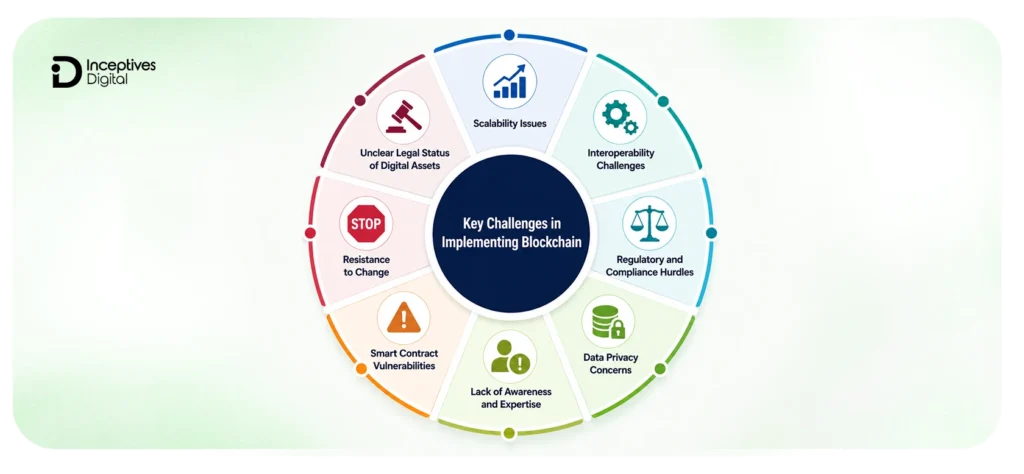
An initial obstacle that prevents people from adopting blockchain technology originates from government regulations. This inconsistent treatment of blockchain technology by different countries creates challenges for organizations that want to use blockchain technology in global operations.
- Lack of unified global regulations
- Compliance challenges for enterprises operating across regions
2. Scalability and Performance Limitations
The performance bottleneck is experienced as real use volumes increase, in spite of improved performance of the blockchain network.
- Network congestion during high transaction loads
- Transaction speed constraints compared to traditional systems
3. Security Risks in Smart Contract Systems
Smart contracts eliminate the requirement for intermediaries. However, they create a new type of risk through their dependence on code development.
- Code vulnerabilities that attackers can use to exploit
- The complex nature of contract logic limits auditors in reviewing contractual agreements
- Protocol-level risks across interconnected systems
4. Skills Gap in Blockchain Development
The demand for talent in the blockchain sector is growing faster than its supply, especially with its utilization at the enterprise level.
- The shortage of experienced blockchain developers
- Challenges in integrating blockchain into existing enterprise systems
How Businesses Are Adapting to Blockchain Technology Trends?
Strategic Questions Enterprises Are Asking
Before building anything with blockchain, most teams slow down and rethink the basics. The focus is less on the technology itself and more on whether it actually fits the problem they are trying to solve.
- Does blockchain solve a real operational problem?
Companies are starting to question whether blockchain is necessary or just an optional layer. - What level of decentralization is needed?
Not every system needs full decentralization, so businesses are trying to balance control and transparency. - How scalable will the system need to be in real usage?
Early design decisions often depend on whether the system will handle small pilots or enterprise-scale traffic. - What compliance risks could come up later?
Regulatory alignment is now part of the planning stage, not something added at the end.
Practical Areas Businesses Are Investing In
Instead of experimenting broadly, companies are narrowing down to use cases that connect directly with operations or cost efficiency.
- Blockchain infrastructure planning
Businesses are designing long-term architecture to avoid rebuilding systems later as adoption grows. - AI-integrated blockchain solutions
AI is being paired with blockchain for automation, fraud detection, and smarter decision workflows. - Tokenization pilots
Companies are testing how real-world assets can be digitized and divided into tradable units. - Identity verification systems
Blockchain is being used to reduce repeated KYC processes and improve secure onboarding. - Supply chain transparency tools
Tracking systems are being upgraded to improve visibility and reduce fraud across logistics networks.
Common Mistakes in Blockchain Implementation
Even with growing maturity in the space, a few mistakes keep repeating across projects.
- Adopting blockchain without a clear use case
Some projects still start from hype instead of a real operational need, which leads to weak results. - Ignoring compliance requirements early in development
Regulatory issues often appear late, causing redesigns that slow down delivery. - Overengineering solutions
Systems sometimes become unnecessarily complex when simpler architectures would work better. - Lack of interoperability planning
Many solutions are still built in isolation, making it harder to integrate later with other systems or networks.
Conclusion: The Direction Blockchain Technology Trends Are Moving Toward
Blockchain technology trends are becoming more practical, enterprise-focused, and deeply connected to real business systems. From AI integration and asset tokenization to decentralized identity and interoperability, the industry is clearly moving toward solutions that improve transparency, automation, and scalability instead of just generating hype.For businesses exploring these changes, the real challenge is knowing which trends are worth investing in and how to implement them properly. That’s why many companies looking to build future-ready systems are now exploring blockchain app development services that align with real operational needs rather than short-term experimentation.
CTA SECTION START
cta title: Ready to Build the Next Generation of Blockchain Solutions?
cta des: From AI-powered systems to tokenization platforms, turn emerging blockchain trends into scalable products with the right development strategy.
cta button: Start Your Blockchain Project
CTA SECTION END
FAQs on Blockchain Technology Trends
Blockchain app development cost usually depends on the complexity of the platform, smart contract functionality, security requirements, integrations, and the type of blockchain network being used. Features like tokenization, cross-chain support, and AI integration can also increase development time and overall cost.
The blockchain app development process typically starts with strategy and use case planning, followed by architecture design, smart contract development, UI/UX creation, testing, deployment, and ongoing maintenance. Most enterprise projects also include compliance checks and security audits before launch.
The benefits of blockchain technology are improved transparency, security, traceability, and automation across digital systems. It also reduces dependency on intermediaries, supports faster transactions, and makes data harder to alter or manipulate.
The four main types of blockchain technology are public blockchains, private blockchains, consortium blockchains, and hybrid blockchains. Each model offers different levels of decentralization, privacy, scalability, and control depending on the business use case.
Finance, healthcare, supply chain, real estate, and government sectors are currently among the fastest adopters of blockchain technology. Most of the adoption is focused on secure transactions, digital identity, automation, and transparent data management.
SIDEBAR LIST START
- 5 New Blockchain Technology Trends for 2026-2030 That Will Reshape Digital Business
- Introduction to Blockchain Technology Trends Shaping the Next Phase of Digital Infrastructure
- Why Blockchain Technology Trends Are Shifting Toward Real-World Adoption?
- Trend #1: AI Integration is Redefining Blockchain Technology
- Trend #2: Real-World Asset Tokenization is Expanding Beyond Crypto Markets
- Trend #3: Blockchain Interoperability Is Becoming a Core Requirement
- Trend #4: Decentralized Identity Systems Are Replacing Traditional Verification Models
- Trend #5: Sustainable and Energy-Efficient Blockchain Systems Are Gaining Priority
- High-Impact Blockchain Technology Trends Driving Enterprise Adoption
- Challenges Affecting Blockchain Technology Trends
- How Businesses Are Adapting to Blockchain Technology Trends?
- Conclusion: The Direction Blockchain Technology Trends Are Moving Toward
- FAQs on Blockchain Technology Trends
SIDEBAR LIST END