Why iOS App Development Frameworks Matter More Than Ever?
Before building an application, businesses usually inquire about cost and time. But ignore a very important decision of choosing the iOS app framework, which not only disturbs the app’s performance but also the overall cost and time as well. The best thing about frameworks is pre-built components that speed up development and simplify maintenance.
Some iOS app frameworks help teams launch faster. Others offer better performance but require more development effort. The challenge is figuring out which iOS app framework is the right one for your app. You should select the option that best fits your existing budget, essential features, and future business requirements.
According to Apple’s own data, there are more than 1.96 million apps on the App Store. The platform receives more than 747 million users every week from different parts of the world. This highly competitive market requires businesses to focus on performance and user experience because these factors create an operational advantage against their competitors.
Most companies choose to work with an iOS app development company because they want to ensure their development team follows correct operational methods. Your application performance and user experience design depend on all the choices you make, which include selecting your iOS application framework.
Read this extensive guide for insights about the best custom iOS app development frameworks, their pros and cons, and tips on selecting the right iOS app frameworks for your app idea.
Understanding iOS App Development Frameworks
Look, nobody actually builds an iOS app from a totally blank page anymore. That’s just a recipe for burnout. Developers lean on an iOS app development framework because it’s basically a high-speed toolkit. You get all the prebuilt “LEGO bricks”—the UI buttons, the data pipelines, and the hardware hooks. It means you aren’t stuck coding the basics for weeks. Instead, you just grab what you need and go.
Mobile app development requires programmers to write their code using either Swift or Objective-C, while iOS app frameworks like SwiftUI and UIKit deliver essential resources that enable them to create mobile applications with greater productivity.
What does an iOS Framework Actually Include?
A contemporary iOS framework exists as more than one application because it combines multiple native components that function together as a single entity:
- User Interface (UI) components
Buttons, screens, navigation, animations, layouts - System APIs
Access to camera, GPS, notifications, storage, and sensors - Data management tools
Local storage, cloud syncing, caching - Networking capabilities
API calls, backend communication, real-time data exchange - Development utilities
Debugging tools, testing support, and performance optimization
This is why frameworks like Apple’s native ecosystem feel so smooth compared to basic hybrid solutions. They are deeply integrated into iOS itself.
How Frameworks Differ from Programming Languages?
People mistakenly believe that Swift and Objective-C function as the framework. That’s not correct.
- Swift / Objective-C = programming languages (how you write logic)
- iOS frameworks = tools and structures (what you use to build features faster)
Think of it like this:
- Swift is the language you speak
- Frameworks act as fundamental components and time-saving elements that enable you to build your complete application.
Even if two Swift apps are involved, the feel of them can be worlds apart according to their utilization of SwiftUI and UIKit or a cross-platform Google-sourced framework like Flutter.
Why Developers Depend on Frameworks Today?
Modern iOS apps are no longer simple utility tools. They now include:
- Real-time chat systems
- AI-based recommendations
- High-performance animations
- Secure payment systems
- Cloud synchronization across devices
Developers need to use an advanced mobile app tech stack, including frameworks, because manual development requires multiple years to complete all tasks.
Experienced teams use iOS app frameworks to simplify their work while achieving Apple’s performance standards, which saves them time during their development process.
Why This Matters for Your Decision
Choosing the wrong framework doesn’t just slow development. It can directly affect:
- App performance on older iPhones
- Long-term maintenance costs
- Scalability when the user base grows
- Compatibility with future iOS updates
People need to understand both native and cross-platform iOS frameworks because they need to learn essential details about these two technologies.
Native vs Cross-Platform Frameworks: What Should You Choose First?
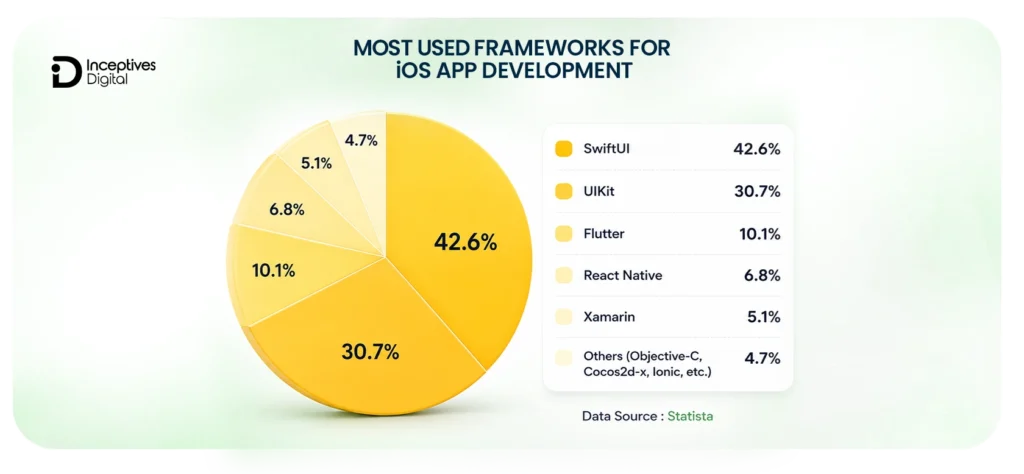
Before developers select their particular iOS app development framework, they must first know the difference between native and cross-platform development. This choice affects different areas, including performance, app development costs, and the capacity to grow in the future.
Native iOS Development
Native app development enables developers to create applications that run exclusively on Apple devices by using Apple’s proprietary development tools.
- Built specifically for the Apple ecosystem
- Delivers the best performance and smoothest user experience
- Offers tight integration with Apple hardware like Face ID, ARKit, and Apple Pay
Native apps provide users with better responsiveness because developers create them specifically for iOS without using additional system components.
Cross-Platform Development
Cross-platform frameworks enable developers to create applications that operate on both iOS and Android through a single codebase.
- Single codebase for iOS and Android
- Faster development cycles and quicker releases
- Slight performance trade-offs compared to native apps
Cross-platform app development becomes ideal when organizations prioritize rapid execution and cost savings above achieving thorough optimization of system components.
Native vs Cross-Platform Comparison
| Feature | Native (Swift/Apple) | Cross-Platform |
| Performance | Highest | Moderate |
| Cost | Higher | Lower |
| Development Speed | Slower | Faster |
| Maintenance | Easier in the long term | Unified codebase |
| UI Experience | Best-in-class | Good but limited |
When to Choose What
The right choice depends on your product goals, not just technology trends.
- Startups vs Enterprise Apps
Startups often prefer cross-platform for faster launch, while enterprises lean toward native for stability and performance. - High-Performance Apps vs MVPs
Apps like gaming, fintech, or AR-heavy products need native. MVPs and early-stage products can benefit from cross-platform speed. - Long-Term Scaling Considerations
Native frameworks usually scale better when your app grows in complexity, while cross-platform frameworks can become harder to optimize at scale.
The choice between native and cross-platform development establishes all subsequent decisions because it determines your available iOS app framework selections.
Best Native iOS Development Frameworks
Apple develops and maintains native iOS frameworks that deliver optimal performance and stability, together with complete system integration. Professional applications establish their user experience and reliability requirements through dependence on these particular tools.
1. SwiftUI (Apple’s Modern UI Framework)
SwiftUI is now one of the latest iOS app development trends for building user interfaces using a declarative style.
- Declarative UI approach that simplifies screen design
- Apple is actively pushing SwiftUI as the future of iOS development
Pros:
- Faster UI building with less effort
- Real-time preview while coding
- Less boilerplate code compared to UIKit
Cons:
- Still evolving and not fully mature for all edge cases
Best for:
- Modern iOS applications
- UI-heavy apps with dynamic layouts
2. UIKit (The Foundation of iOS Apps)
UIKit is the traditional framework behind most existing iOS apps and remains widely used in production.
- Mature and highly stable framework
- Powers many long-standing iOS applications
Pros:
- Extremely powerful and flexible
- Full control over UI behavior and customization
Cons:
- More verbose and complex code structure
Best for:
- Large-scale enterprise applications
- Apps with legacy system integration
3. Core Data (Data Management Framework)
Core Data is Apple’s framework for managing and storing app data locally.
- Handles local data storage and persistence
- Supports complex data relationships efficiently
Pros:
- Works offline without internet dependency
- High performance for structured data handling
Best for:
- Finance and banking apps
- Productivity and task management apps
4. Combine Framework (Reactive Programming)
Combine is used for handling asynchronous events and data streams in a clean, structured way.
- Manages asynchronous and event-driven workflows
- Integrates smoothly with SwiftUI
Use cases:
- Real-time updates in apps
- Data streaming and live content applications
For apps that want deep integration with Apple’s exclusive ecosystem, there is no other option than these native iOS app development frameworks.
Best Cross-Platform iOS Development Frameworks
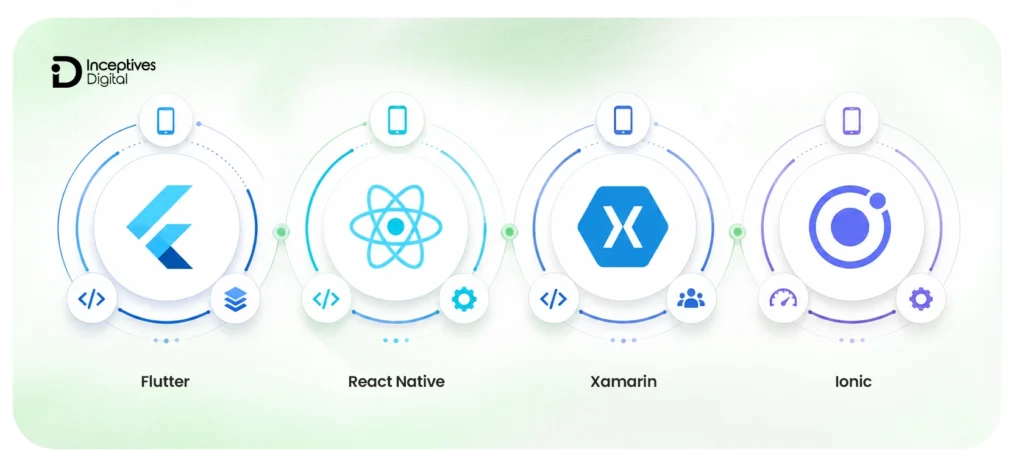
Cross-platform frameworks use a single codebase for both iOS and Android means there is no need to develop separate applications for both. They save both development cost and time, but are inferior in performance compared to native iOS frameworks. Here are the top cross-platform frameworks for iOS app development.
1. Flutter (Google’s UI Toolkit)
Flutter app development has become one of the most widely adopted methods, especially among U.S. startups.
- Single codebase for iOS and Android
- Uses the Dart programming language
- Strong adoption in fast-scaling startup ecosystems
Pros:
- Fast development cycles
- Consistent and visually rich UI rendering
- Strong community and ecosystem support
Cons:
- Larger app size compared to native apps
Best for:
- MVPs and early-stage products
- E-commerce applications
- UI-rich mobile apps
2. React Native (Meta’s Framework)
React Native app development is one of the most established cross-platform frameworks, powered by JavaScript and backed by a large developer community.
- Uses JavaScript for development
- Huge ecosystem and third-party library support
Pros:
- Faster iteration and updates
- High code reusability across platforms
Cons:
- Requires native modules for advanced device features
Best for:
- Social media applications
- Content-driven apps and platforms
3. Xamarin (Microsoft Framework)
Xamarin is a C#-based framework designed with strong enterprise integration in mind.
- Built on C# and the .NET ecosystem
- Strong integration with Microsoft Azure
Pros:
- Seamless Azure and enterprise tool integration
- Access to native APIs
Cons:
- Declining popularity compared to Flutter and React Native
Best for:
- Enterprise-grade mobile applications
- Internal business apps
4. Ionic (Hybrid Framework)
Ionic uses standard web technologies to build mobile applications, making it accessible for web developers.
- Built using HTML, CSS, and JavaScript
- Works through a hybrid app approach
Pros:
- Fast prototyping and development
- Easy learning curve for web development
Cons:
- Lower performance compared to native and modern cross-platform tools
Best for:
- Simple mobile applications
- Internal business tools and dashboards
Cross-platform frameworks are best when speed, cost efficiency, and shared development effort are the top priorities. However, performance trade-offs should always be considered before choosing one.
Supporting iOS Frameworks That Improve App Performance
Beyond core development frameworks, Apple provides specialized frameworks that extend what iOS apps can do. These are not used to build the entire app, but they significantly enhance functionality, performance, and user experience.
1. ARKit (Augmented Reality)
ARKit is Apple’s framework for AR app development directly on iOS devices.
- Used for immersive AR-based interactions
- Combines camera, motion sensors, and advanced tracking
Applications:
- Mobile game development with real-world interaction
- Retail apps for virtual product try-before-you-buy features
2. Core ML (Machine Learning on iOS)
Core ML enables machine learning models to run directly on the device without relying heavily on cloud processing.
- Supports on-device AI processing
- Improves speed and privacy by reducing server dependency
Use cases:
- Image and object recognition
- Predictive recommendations and smart features
3. MapKit (Location-Based Services)
MapKit is Apple’s native mapping framework used to integrate location-based features into apps.
- Provides maps, navigation, and geolocation services
- Seamlessly integrates with iOS system features
Used in:
- Delivery and logistics apps
- Travel and ride-sharing platforms
4. HealthKit (Health Data Integration)
HealthKit is used in healthcare app development to securely access and manage health and fitness data from Apple devices.
- Centralized and secure health data management
- Designed with strong user privacy controls
Used in:
- Fitness tracking applications
- Health and wellness app development
Modern iOS development needs these supporting frameworks, which help developers create apps that require advanced features beyond standard UI implementation and need to use AR, AI, location intelligence, and health tracking capabilities.
Comparison of Top iOS Frameworks (At a Glance)
This side-by-side comparison demonstrates the most commonly used iOS development frameworks
| Framework | Type | Best For | Learning Curve | Performance |
| SwiftUI | Native | Modern UI apps | Easy | High |
| UIKit | Native | Enterprise apps | Hard | Very High |
| Flutter | Cross-platform | MVPs, startups | Medium | High |
| React Native | Cross-platform | Social apps | Medium | Medium |
| Xamarin | Cross-platform | Enterprise solutions | Medium | High |
| Ionic | Hybrid | Simple apps | Easy | Low |
This comparison highlights an important aspect that none of the frameworks can be considered the best one, because each one has its own advantages and disadvantages. Although the best one depends on your specific requirements.
The next step is to establish the appropriate framework selection method based on your application’s requirements and your organization’s current development stage.
How to Choose the Right iOS Framework (Decision Guide)
Choosing the right framework depends on what you are building, how fast you want to launch, and how much performance your app needs. Instead of following mobile app trends, it’s better to match the framework to your actual product goals.
1. Based on App Type
Different app categories have different technical requirements.
- E-commerce apps → Flutter or SwiftUI
Great for smooth UI, fast performance, and scalable shopping experiences. - Enterprise apps → UIKit or Xamarin
Better suited for stability, security, and complex integrations. - Social apps → React Native
Ideal for rapid updates and content-driven interfaces. - AI-driven apps → Core ML with Swift
Best for machine learning, personalization, and predictive features.
2. Based on the Budget
Mobile app development cost often plays a major role in framework selection.
- Low budget → Cross-platform frameworks
One codebase reduces development and maintenance costs. - Higher budget → Native development
Better long-term performance and user experience.
3. Based on Performance Needs
Not every app needs the same level of performance optimization.
- High-performance apps → Native frameworks
Best for gaming, AR, fintech, and heavy animations. - Moderate performance apps → Cross-platform
Suitable for standard business, social, and content apps.
4. Based on Timeline
Your launch timeline can also influence the decision.
- Fast launch → Flutter or React Native
Reduce app development timeline with shared codebase support. - Long-term scalable products → SwiftUI and UIKit
Better for apps expected to grow in complexity over time.
The best framework is the one that aligns with your app’s goals, budget, and future roadmap, not simply the most popular option in the market.
Common Mistakes Developers Make When Choosing iOS Frameworks
Choosing the wrong framework can create performance issues, increase maintenance costs, and slow down future development. Here are some of the most common mistakes developers and businesses make when selecting an iOS framework.
1. Choosing a Framework Based on Hype Instead of Use Case
A framework may be popular, but that does not mean it fits every project. Many teams choose trending technologies without considering their app’s actual requirements, which often leads to scalability and performance issues later.
2. Ignoring Long-Term Maintenance Costs
Some frameworks may speed up initial development but become harder and more expensive to maintain over time. Regular updates, third-party dependencies, and compatibility issues can increase long-term development costs.
3. Overusing Cross-Platform Frameworks for Heavy Apps
Cross-platform development works well for many applications, but it is not ideal for every use case. Apps with complex animations, AR features, gaming elements, or intensive real-time processing often perform better with native frameworks.
4. Not Considering Apple Ecosystem Updates
Apple frequently introduces new iOS updates, APIs, and hardware features. Choosing a framework that struggles to keep up with Apple’s ecosystem can create compatibility problems and delay feature adoption.
5. Underestimating UI/UX Limitations
User experience is a major part of iOS app success. Some frameworks make it harder to achieve the smooth animations and native feel that iPhone users expect, especially in highly interactive apps.
Avoiding common UI/UX mistakes early can save significant development time, reduce future costs, and help create a more stable and scalable iOS application.
Future of iOS App Development Frameworks
iOS development is evolving quickly, and iOS app frameworks are changing alongside it. As Apple continues to expand its ecosystem, developers are focusing more on performance, automation, and immersive user experiences.
1. Shift Toward SwiftUI Dominance
SwiftUI is steadily becoming Apple’s preferred UI framework. Its simpler development approach, live previews, and tighter integration with modern iOS features are pushing more developers away from traditional UIKit-based workflows.
2. Increasing Adoption of AI-Powered Development Tools
AI is starting to influence how iOS apps are designed, tested, and optimized. Developers are increasingly integrating AI-driven features like personalized recommendations, automation, and predictive user experiences directly into apps.
3. Growth of Cross-Platform Frameworks
Frameworks like Flutter and React Native continue to grow because businesses want faster development and reduced app development costs. Cross-platform development is becoming more capable, especially for startups and MVP-focused products.
4. Apple’s Continued Ecosystem Tightening
Apple continues to prioritize privacy, hardware optimization, and ecosystem control. This means frameworks that align closely with Apple’s technologies will likely perform better and receive faster support for new iOS features.
5. Rise of AR and ML-Driven Apps
Technologies like ARKit and Core ML are pushing iOS apps beyond traditional mobile experiences. From augmented reality shopping to AI-powered automation, advanced frameworks are becoming a bigger part of modern app development.
As these technologies evolve, choosing a future-ready framework will become just as important as choosing the right one for current development needs.
Final Takeaway: Which iOS Framework Should You Actually Use?
Choosing the right framework is one of the most important decisions in iOS app development. Whether you prioritize performance, scalability, faster development, or cross-platform compatibility, the best framework ultimately depends on your app’s goals and long-term vision. Native frameworks like SwiftUI and UIKit offer deeper Apple ecosystem integration, while tools like Flutter and React Native help accelerate development for modern multi-platform apps.
As iOS apps continue to evolve with AI, AR, and advanced user experiences, selecting the right technology stack early can save significant time and development costs later. If you’re planning to build a scalable iOS application, working with an experienced company providing iOS app development services can help you choose the right framework based on your product requirements, budget, and future growth plans.
CTA SECTION START
cta title: Choose the Right iOS Framework and Start Building Today
cta des: Get expert help to pick the best iOS framework and build a scalable, high-performance app for Apple users
cta button: Get Expert Guidance
CTA SECTION END
Frequently Asked Questions (FAQs)
The best framework depends on your app requirements. SwiftUI is ideal for modern native iOS apps, while Flutter and React Native are popular for cross-platform development.
Native frameworks are built specifically for iOS and offer better performance and deeper Apple integration. Cross-platform frameworks use a single codebase for both iOS and Android, reducing development time and cost.
Yes, Flutter is widely used for iOS app development because it offers fast development, attractive UI design, and strong cross-platform support. It is especially popular for startups and MVPs.
UIKit is still heavily used because it is mature, stable, and offers greater customization for complex enterprise applications and legacy iOS projects.
Native frameworks like SwiftUI and UIKit are generally better for high-performance apps, especially those involving gaming, AR, real-time processing, or complex animations.
SIDEBAR LIST START
- Best Frameworks for iOS App Development (Guide for Developers & Businesses)
- Why iOS App Development Frameworks Matter More Than Ever?
- Understanding iOS App Development Frameworks
- Native vs Cross-Platform Frameworks: What Should You Choose First?
- Best Native iOS Development Frameworks
- Best Cross-Platform iOS Development Frameworks
- Supporting iOS Frameworks That Improve App Performance
- Comparison of Top iOS Frameworks (At a Glance)
- How to Choose the Right iOS Framework (Decision Guide)
- Common Mistakes Developers Make When Choosing iOS Frameworks
- Future of iOS App Development Frameworks
- Final Takeaway: Which iOS Framework Should You Actually Use?
- Frequently Asked Questions (FAQs)
SIDEBAR LIST END