Healthcare App Monetization in 2026
Healthcare app monetization strategies are methods for generating revenue from digital health applications through subscriptions, consultations, in-app purchases, and enterprise solutions.
Healthcare app monetization is shifting rapidly due to rising user expectations, strict regulations, and AI adoption. Monetization models have shifted away from app downloads and in-app advertising towards providing continued value, such as consultations and diagnoses.
According to Statista, the global digital health market is projected to surpass $220 billion in 2026, with over 1.5 billion users worldwide. The rapid adoption of telemedicine, AI-powered health applications, and mobile-first healthcare services is driving this growth. The growth of this industry is directly influencing changes within the healthcare app monetization strategy, prompting companies to adopt subscription, enterprise, and data-centric revenue models rather than one-time payment models.
The monetization plans would facilitate an important step in transforming the healthcare AI sector, enabling the implementation of artificial intelligence not only to attract customers due to the technology’s innovative nature, but also to generate revenue for the creators of such solutions.
Given the strict requirements for using software products in the health care sector, it is important to select an appropriate business model for developing health-oriented applications. The efficiency of the developed application would greatly depend on its effective selection, which a professional development team should handle at a specialized company.
Understanding Healthcare App Monetization Models
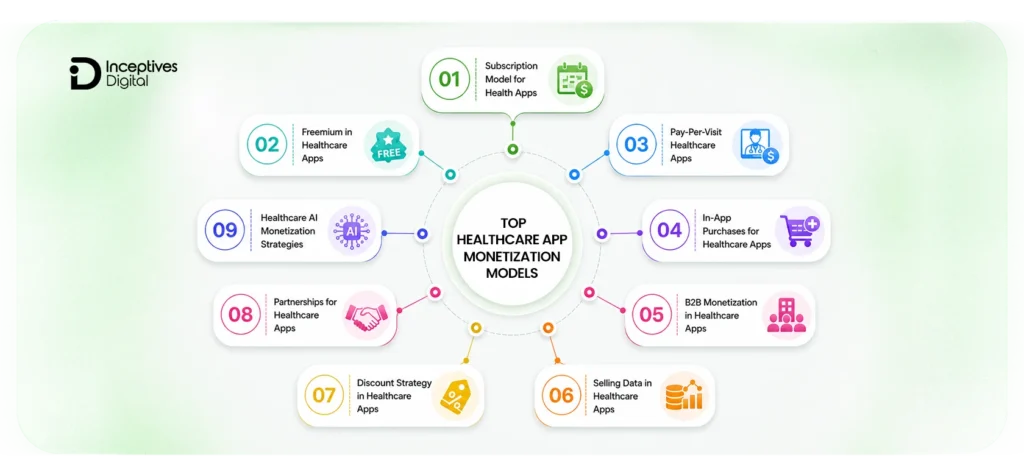
Monetizing health apps can no longer be approached with a single profit channel. Health applications need to be monetized in a way that creates a revenue system based on the value they create and the clinical use case. Health applications will have to monetize their users without negatively affecting their experience or affecting patient care and treatment delivery.
Some of the primary methods health applications use to generate revenue can be grouped into four categories:
- subscription-based
- pay-per-use
- freemium
- business-to-business contracts
In these revenue models, each is geared to the needs of the particular user: patients require flexibility and convenience, whereas hospitals seek scalability in their revenue streams.
Another essential element of monetizing a healthcare application is trust. While in other business scenarios people share their basic details, when dealing with a healthcare app, individuals share their medical issues in extreme detail, meaning that any service that can be monetized cannot come across as intrusive or exploitative. Any payment for additional services must be conducted ethically.
Here’s the importance of a healthcare app development company beyond software development services. It is vital to work with a professional development agency that can help design your business model at the earliest stage of product development, including defining which features will be paid and which will be free, and how HIPAA-style laws and GDPR-like policies are incorporated into the framework.
The success of healthcare application monetization will depend heavily on how well you select an appropriate concept and understand user requirements. Explore healthcare app ideas that will help you make money in this domain.
Top Healthcare App Monetization Strategies in 2026
The major monetization strategies for health apps include subscription, freemium, payment-per-visit, in-app purchases, B2B software-as-a-service, artificial intelligence, and ethical data monetization.
Subscription Model for Health Apps
The subscription approach is one of the most reliable methods of healthcare app monetization, providing consistent revenue through recurring payments while ensuring continuous benefits for users through health-related services.
The subscription-based monetization model for a health application allows people to pay monthly or annually for access to services such as teleconsultation, health monitoring, and artificial intelligence-powered insights.
Why Recurring Revenue Works Best?
The recurring revenue model is suitable for healthcare, as healthcare is naturally a process rather than an activity based on transactions. Patients with chronic illnesses, those who monitor their health for wellness, or those enrolled in preventive care plans require continuous access to healthcare services, creating a suitable opportunity for a subscription model.
Examples of Membership-based Health Apps:
- Telemedicine applications that charge a monthly fee for unlimited doctor appointments.
- Mental health applications that offer monthly therapeutic sessions.
- Health and wellness applications that offer monthly workout plans.
- Apps that help manage chronic conditions such as hypertension or diabetes.
- Applications that track women’s menstrual cycles and fertility and provide additional insights into health issues.
- Apps that provide preventive care by conducting health checkups and analyzing the risks through artificial intelligence.
- AI Health Assistants provide continuous, personalized health recommendations.
Also, before choosing a monetization method, you must know the cost of developing the application itself. Take a look at the detailed guide to healthcare app development cost.
Freemium in Healthcare Apps
Freemium business strategy works best for health apps because it lowers the cost of entry and builds user trust. This approach allows health app providers to attract many followers who will later become paying customers.
User Acquisition Through Freemium
The freemium model makes it easy for healthcare app users to use the app, as there are no initial costs. The user will familiarize themselves with the app’s main functions, such as symptom tracking and health reminders.
The user will get used to checking their symptoms and health status in the app. Thus, it will be easy for the user to migrate to the paid version, as they already know its functionality.
Converting Free Users to Paid
Conversions for health application monetization occur when the user reaches value limits, such as restricted consultations, reduced reporting, and insight caps. This form of conversion is presented after exposure to basic value points, meaning users will see conversions as a natural progression rather than an obligation to pay.
Custom prompts and appropriate conversion timing also determine the effectiveness of the conversion strategy. With custom AI prompts for premium features or professional guidance, the likelihood of upgrading from a free to a premium subscription is higher.
Balancing Free Paid Value
When balancing the use of freemium to monetize a healthcare application, users need to gain something from the free version. The idea is to offer enough benefits to keep users active and satisfied without requiring an upgrade before experiencing anything better.
Premium features, on the other hand, need to have added benefits over the free version. The benefits should be meaningful to users. The purpose is to create a sufficient difference that people will see the value of paying for it.
Linking Premium Healthcare Features
The correlation between freemium and premium features in healthcare apps will provide obvious distinctions for users. Basic functionality would be included in the core features, while premium features would include sophisticated capabilities, such as AI-assisted diagnosis and health analysis.
It is more interesting to include premium features, such as specialist consultation, health predictions, and more effective monitoring tools, to improve health outcomes. Users would consider premium features necessities rather than luxuries when they make significant contributions to improving users health.
Pay Per Visit Healthcare Apps
A pay-per-visit strategy can be considered quite a versatile model for healthcare apps, in which consumers are charged for specific consultations and services rendered. The strategy is particularly relevant in on-demand healthcare models, especially when consumers are not interested in subscription models.
Model Breakdown Pay Per Visit
Per-visit payment is one of the most fundamental revenue models in healthcare, charging users per consultation or medical procedure. In other words, it does not require any subscription plans and ensures that the patient has full control over accessing services as needed at any time.
This approach offers more flexible options for accessing healthcare services, particularly when occasional treatment is needed rather than constant monitoring. It can be used extensively within telemedicine applications, which have fluctuating demands.
Best Use Cases for Telemedicine
For instance, the pay-per-visit healthcare app business model is ideal for telemedicine platforms and applications that require fast, immediate patient consultation. This is because it suits conditions of uncertainty about demand for healthcare services, as it enables immediate booking of visits and payment for services rendered.
In cases involving urgent care services, specialist consultation, or any other situation requiring short-term medical advice, such a business model works effectively for patients because they do not need to pay for a subscription plan.
In-App Purchases for Healthcare Apps
Monetization through in-app purchases is essential for healthcare applications, enabling micro-payments for specific services within the app. This helps patients access healthcare according to their needs.
Micro Monetization in Healthcare Apps
In-app purchases facilitate micro-monetization in the telemedicine app monetization process by enabling payment for services such as reporting, consultation, and diagnosis.
With micro-monetization, there is no requirement for a subscription service; instead, multiple revenue streams can be generated through charges for specific services. Micro-monetization works best where there is no commitment to subscription services but instead an interest in using healthcare services as needed.
The strategy optimizes revenue without requiring subscriptions and enables patients to access necessary healthcare services.
Examples Healthcare In-App Purchases
Some of the most common instances include medical records, single doctor appointments, personal training plans, diet charts, and diagnostic information. These products offer instant satisfaction without recurring payment obligations.
- Comprehensive medical reports, payments made by users for in-depth analyses provided by artificial intelligence (AI), and detailed health diagnostics, which exceed free standard reports.
- Single-Time Consultation with a Doctor for immediate consultation services by a general doctor or specialist for emergency cases and quick health issues without a subscription.
- Customized physical exercise and nutritional guidelines, personalized physical activity and nutritional plans recommended by artificial intelligence technology.
B2B Monetization in Healthcare Apps
B2B monetization in healthcare apps involves marketing digital health applications to organizations such as hospitals, insurance companies, and enterprises. This monetization strategy involves generating sustainable income from long-term contracts, Software-as-a-Service models, and white-label applications designed to meet institutional medical requirements.
SaaS Healthcare App Models
SaaS healthcare apps provide users with access to crucial technological services, such as EMRs, telemedicine apps, and dashboard analytics. In the healthcare app revenue model, healthcare organizations can use advanced technologies without incurring high up-front costs. The SaaS healthcare revenue model guarantees recurring revenue streams for service providers and provides flexible healthcare software solutions.
White Label Healthcare Growth
White-labeling healthcare apps means turning an existing healthcare app into a brand, allowing organizations to use the already-developed application and claim ownership without developing one from scratch. This process is much easier and more cost-effective. White-labeling healthcare apps is common among clinics, hospitals, and startups seeking to deliver personalized, scalable healthcare services.
Selling Data in Healthcare Apps
Data selling on healthcare apps is an ethical practice with significant potential for monetizing healthcare applications. The primary objective of monetization will be the value-based sharing of anonymized data with pharmaceutical companies and research organizations.
Ethical Framework for Data Selling
Ethical monetization of data in health applications requires full transparency, user consent to use the data, and appropriate data management. This would foster a relationship of trust, whereby individuals feel safe that their data is being used properly.
In addition, the application must ensure that complete anonymity prevails when providing data to other third parties. The health application should never share any personal identification details of its clients. Anonymity is critical for protecting clients’ privacy and enabling organizations to use the data for their studies.
Demand for Patient Engagement Data
There is high demand for patient engagement data to monetize healthcare applications, as the need to understand how patients engage with apps is growing. Patient engagement data includes how often patients log in to the app and how they use its features.
Patient engagement data can be quite helpful in improving the delivery of healthcare services and performance. By using patient engagement data and analyzing treatment efficiency, doctors can create custom-made treatment programs.
Discount Strategy in Healthcare Apps
The healthcare app’s discount strategy, designed for monetization, aims to promote retention, improve conversion rates, and increase engagement among inactive customers. Used tactically, discounting increases lifetime value while maintaining user trust and perceptions of high-quality services.
Improving Retention Through Discounts
The following would be an efficient way to present discounts to customers in the healthcare application, thereby reducing customer attrition. It is essential to offer discounts when customers renew their subscriptions and when they appear to be inactive, to remind them of the importance of using the application.
A few discounts on services, upgrades, or subscription renewals can help ensure the customer remains interested in using the healthcare application.
Coupons and Referral Rewards
Discount vouchers and seasonal discounts are highly effective at generating revenue through the healthcare app because they offer immediate benefits to users. These discounts include consultations, healthcare app premium features, and bundles, encouraging users to buy during peak periods or during health initiatives.
Referral bonuses can be considered another growth tactic that leverages existing users to acquire more customers. Healthcare app developers will use discounts and referral credits to minimize the cost of affiliate marketing.
Balancing Discounts and Profit Margins
The discount strategy could significantly erode profit margins if widely adopted, requiring careful control of telemedicine app monetization. It is necessary to establish rules for maximum discount percentages, minimum prices, and period lengths. Personalized incentives should be provided based on triggers such as the expiration of the free trial period, customer churn likelihood, or the customer’s first purchase.
Segment customers into groups depending on their behavior and value, including new customers, active users, customers with high lifetime value, and those likely to churn. Develop unique incentives customized to them.
Discounts can be combined with certain conditions, such as bundling deals, extended subscription periods, or feature upgrades, to increase average order value. Track indicators such as customer acquisition cost, lifetime value, and contribution margin.
Partnerships for Healthcare Apps
Partnerships are key to helping healthcare applications generate revenue by enabling more services to be delivered, attracting new customers, and generating additional income. This is because partnerships can help create ecosystems that go beyond an application when working with healthcare organizations and other industries.
Expanding Revenue Through Partnerships
Healthcare application partnerships help increase income by incorporating other services, such as diagnostic centers, medicine delivery, and even insurance verification within the app itself. Such an approach makes life easier for users and allows them to earn money through commissions, referrals, and revenue sharing from every interaction.
Including services within an app creates many potential income streams for the app without requiring it to develop all features in-house. This helps save resources and increases the value from each customer, ultimately aiding in monetizing the healthcare app business model.
Collaboration with Healthcare Providers
Collaboration among laboratory facilities, pharmacies, and insurance agencies significantly contributes to monetizing healthcare applications by incorporating essential procedures directly into the app. The patient can schedule their laboratory tests, have their prescriptions filled, and confirm their health insurance, all from a single app interface.
In addition to providing users with all the necessary tools for managing their health, these integrations also help generate revenue through commission fees or collaboration agreements.
AI Healthcare Monetization Strategies
AI is changing the monetization strategy for healthcare apps by enabling more intelligent, predictive services. AI will not be just a component of the service; it will generate revenue on its own.
AI Monetization Strategies
Monetization strategies for AI in healthcare are quickly becoming a key source of revenue for digital health services, particularly when intelligence capabilities are more important than app capabilities.
- AI-as-a-Feature Monetization: Collecting fees from patients for smart AI applications such as predictive diagnostics, symptom analysis, and risk assessment as part of premium offerings.
- AI-Powered Personalization: Customizing health programs, workout regimens, and treatment protocols according to patient information and activity.
- Subscription-Based AI Health Insights: Offering real-time health tracking, notifications, and predictions through ongoing subscriptions.
- B2B AI Software Licensing: Licensing AI dashboards and analytics software to hospitals, insurers, and healthcare organizations for wide-scale use.
- Outcome-Based Pricing for AI in Healthcare: Setting prices based on health outcomes or AI-powered healthcare utilization.
- AI Clinical Decision Support Systems: Revenue generation from clinical decision support applications utilized by physicians for rapid diagnosis and prediction.
AI Diagnostics, Subscription Insights, and Future Monetization
AI diagnostics and personalized health care services improve healthcare outcomes by analyzing symptoms, personal medical records, and behavioral patterns to recommend appropriate actions and detect future risks. This type of service is monetized by leveraging its smart analysis processes as a product in healthcare app monetization.
Building on this, subscription-based health services powered by AI enable users to continuously monitor their health. Individuals subscribe to such services because they provide constant health insights.
How to Choose the Right Healthcare App Monetization Strategy?
Selecting appropriate monetization techniques for healthcare apps is vital for scaling and sustaining the app. The key to success in 2026 will be matching revenue streams to user requirements and app features.
Choosing an appropriate monetization model for a given app category is crucial to the success of monetization strategies in healthcare mobile apps. For example, telemedicine applications are best suited to models such as pay-per-visit or subscription. In contrast, fitness and wellness applications can use a freemium model to attract new customers and then monetize premium content.
Applications for managing chronic diseases and overall health require subscription models, as users need continuous tracking and consultation.
Matching Model With App Type
Various monetization models must be matched to the appropriate types of health apps to ensure they can earn money while remaining user-friendly. The telemedicine app type works best when adopting a pay-per-use or subscription-based model, depending on the user’s needs.
For fitness and wellness apps, freemium models work best, as the aim is to attract more customers and get them to pay for premium features. The healthcare applications category in the chronic illness space uses subscription-based models because long-term services are required.
Combining Revenue Streams Effectively
Using only one monetization model can limit opportunities to monetize health care apps. Successful apps combine subscription models, in-app payments, and B2B collaborations to create multiple income streams that enable them to serve both individuals and businesses.
This approach results in a more balanced revenue model by integrating consistent income with usage-based revenue. In addition, it improves the user experience with various billing options, thereby increasing engagement and retention.
Selecting an appropriate monetization strategy is also contingent upon finding a development partner that understands healthcare regulations and can build scalable applications.
Read more about how to choose the right healthcare app development company.
Common Healthcare App Monetization Mistakes
The following errors that people make when trying to make money from their healthcare applications may end up stifling the growth and earning potential of the app:
- Single-source income model: Dependence on a single source of income hinders earnings scalability and renders them unreliable in a shifting environment.
- Disregard for Compliance Issues/Data Privacy: Failure to comply with legal requirements undermines credibility within the industry and breeds distrust among the audience.
- Inefficient Pricing Model: An unclear, poorly designed pricing model makes it difficult to convert users and can confuse them about what they get from using the app.
- Lack of User Retention Focus: Focusing more on acquiring new users than retaining existing ones leads to high churn rates and stifles growth.
Future of Healthcare Monetization
The monetization models for healthcare applications are gradually shifting towards hybrid solutions that integrate subscriptions, payment for individual services, in-app purchases, and business-to-business collaboration. The advantage of such models is that applications can cater to different user groups, generating diverse sources of income that are not entirely reliant on one monetization strategy.
Another significant future healthcare market trend is the advent of AI-powered subscription models. Rather than paying only for access to healthcare services, customers receive ongoing benefits from AI algorithms, including predictive analytics, customized recommendations, and health monitoring.
Healthcare solutions for enterprises are growing rapidly, with hospitals, insurance companies, and other institutions adopting scalable IT infrastructure. The business-to-business model, software-as-a-service platforms, and the white-label solution will play an important role in generating revenue over the years to come.
Data-driven healthcare models are also making their way into the market. With appropriate data anonymization and compliance with legal guidelines, applications can leverage data collected from patient behavior and health outcomes.
Final Thoughts
Healthcare app monetization will leverage several revenue models to build an efficient, value-based monetization strategy. Rather than relying on a single income-generation strategy, efficient applications leverage subscription-based payments, the freemium model, B2B partnerships, and artificial intelligence to build a sustainable monetization strategy. Now, the primary goal of the application developer should be to deliver continuous healthcare value to patients while preserving their trust and complying with regulations.
While the digital healthcare sector is evolving rapidly, businesses must consider monetization as an integral part of product development. Cooperating with a trustworthy mobile app development company will ensure your healthcare app monetization framework operates effectively and meets your goals.
CTA SECTION START
cta title: Build a Profitable Healthcare App in 2026
cta des: Partner with a trusted healthcare app development company to implement the right monetization strategies, ensure compliance, and maximize long-term growth.
cta button: Get Monetization Strategy
CTA SECTION END
Frequently Asked Questions
In 2026, the most effective healthcare app monetization strategy is a hybrid model. It combines subscriptions, freemium access, pay-per-visit services, in-app purchases, and B2B partnerships. This approach ensures multiple revenue streams, improves user flexibility, and enables apps to scale sustainably while efficiently meeting the needs of patients and enterprises.
Telemedicine applications work best with subscription and pay-per-visit models. Subscriptions provide continuous access to doctors and health services, while pay-per-visit allows users to pay only when needed. This flexibility supports urgent consultations, long-term care management, and improves accessibility without forcing users into rigid payment structures.
A freemium healthcare app strategy offers basic features such as symptom tracking, reminders, and health logs for free, while advanced features are paid. These may include AI-based diagnostics, specialist consultations, and detailed health reports. This model helps attract users quickly and convert them gradually into paying customers by providing added value.
Yes, AI plays a major role in healthcare app monetization. Apps generate revenue through AI-powered diagnostics, predictive health analytics, personalized recommendations, and subscription-based insights. Additionally, AI tools can be licensed to hospitals and clinics, creating B2B revenue streams while improving clinical decision-making and patient care outcomes.
Yes, but only under strict conditions. Health data must be fully anonymized and user consent obtained. Compliance with regulations such as GDPR or HIPAA-style frameworks is essential. Ethical data monetization ensures privacy protection while enabling aggregated insights for research, pharmaceuticals, and improvements in the healthcare system.
SIDEBAR LIST START
- Healthcare App Monetization in 2026
- Understanding Healthcare App Monetization Models
- Top Healthcare App Monetization Strategies in 2026
- How to Choose the Right Healthcare App Monetization Strategy?
- Common Healthcare App Monetization Mistakes
- Future of Healthcare Monetization
- Final Thoughts
- Frequently Asked Questions
SIDEBAR LIST END