The price of the best mobile app marketing strategies will also become less predictable in 2026. However, to determine the reasons behind it and what can be done about it, it is necessary to understand the factors driving this development. Businesses wish to know the price of mobile app marketing.
Marketing expenses cannot be considered advertising expenses alone. It includes everything from customer acquisition and creative production up to app store optimization, influencer marketing, and retention marketing. All these steps complicate the process, leading to higher development and growth costs for mobile applications.
As noted by Statista, the worldwide mobile advertising market will exceed $2 trillion in 2030, indicating that fierce competition exists in mobile app marketing. Since almost all firms dedicate considerable resources to digital marketing campaigns, this raises the cost per install and cost per action.
Owing to this increasing competition, even applications designed by one of the best mobile app development companies have to invest substantially in their marketing budgets. Failure to do so will probably lead to such apps being overlooked in highly competitive markets, irrespective of how good they are.
What is Mobile App Marketing?
Marketing of mobile applications refers to the process through which an application becomes available among many others in a very competitive market. The marketing of mobile applications differs from mobile app development in that, whereas the latter focuses on developing an application’s features, the former focuses on marketing.
For example, when enterprises team up with a mobile application development company, they often do not fully realise the level of work required to scale a mobile app. Marketing does not involve one function but a series of systems for acquiring, making visible, and retaining clients.
When you invest in mobile app marketing, you will benefit from the strategy and service optimisation. The optimization may consist of ASO services, advertising campaigns, targeting the right audience, creative tests, and monitoring outcomes. All this is done to decrease the cost per install.
Aside from acquiring users, a substantial portion of the budget is spent on retention activities, such as push notifications, campaigns to win back old users, and data-driven optimization. Without this strategy, even a perfectly designed mobile app created by a professional mobile app development firm can fail to keep its users.
Average Cost of Mobile App Marketing in 2026
Knowing the cost of mobile app marketing services in 2026 depends to a large extent on the scale of your application and the marketing channels you select. There is no set pricing, and various factors would contribute to the overall cost of such services.
Early-Stage Startup App Marketing Costs
For startups in their early stages, app marketing costs can range from $2,000 to $10,000 per month. The reason for such high costs is that marketing focuses on testing rather than expansion.
Major aspects of emphasis:
- ASO basics.
- Limited advertising campaigns.
- Audience testing.
- Creative testing.
- Organic installs.
Growth-Stage Mobile App Marketing Costs
The money apps spend on their growth stage ranges from $10,000 to $50,000 per month, with the focus on acquiring new users. This company aims to maximise the impact of its marketing activities.
Primary areas of interest:
- Google Ads scaling.
- Meta Ads scaling.
- TikTok Ads scaling.
- Collaborations with influencers.
- Tracking and analytics improvements.
- A/B testing for creatives and landing pages.
- Retargeting and remarketing campaigns.
Enterprise-Level App Marketing Costs
For enterprise software or companies in sectors such as FinTech, games, or e-commerce, with stiff competition, the cost may range from $50,000 to $200,000 or more because of heavy marketing and high-cost advertising.
Focus areas for improvement:
- Global multi-channel customer acquisition.
- Expensive video production.
- Audience segmentation and automation.
- Influencer marketing and brand campaigns.
- Lifecycle and retention marketing systems.
| App Stage | Monthly Cost Range | Primary Goal | Key Marketing Activities |
| Early-stage (Startup) | $2,000 – $10,000 | Validation and initial traction. | ASO basics, limited paid ads, audience testing, creative testing, and organic installs. |
| Growth-Stage | $10,000 – $50,000 | Scalable user acquisition. | Google Ads, Meta Ads, TikTok Ads scaling, influencer collaborations, analytics optimization, A/B testing, retargeting. |
| Enterprise-Level / High Competition | $50,000 – $200,000+ | Market dominance and global scale. | Multi-channel acquisition, high-end video production, advanced audience targeting, influencer campaigns, lifecycle and retention marketing. |
Key Factors That Influence Mobile App Marketing Costs
When considering the cost of services offered by mobile app marketing companies, there is no straightforward answer, as various factors can affect pricing. To illustrate, two similar mobile applications developed by the same company can have significantly different marketing expenses.
1. App Category and Industry Competition
It is worth noting that the app’s nature will affect its marketing costs, given intense competition in industries such as FinTech, games, and online retail, which drives high CPI and fierce competition. This implies that, regardless of whether you have a competent company developing the app, you will need to increase the budget.
However, in less competitive markets and with functional apps, acquiring customers will be cheaper. Crowded markets will require greater advertising effort. In light of increased competition in the industry, the cost of mobile app marketing will grow in direct proportion.
2. Target Audience Location (Geography)
User acquisition costs in mobile applications vary by geographical location; therefore, costs depend on where one operates. For example, in Tier 1 locations like America, Great Britain, and Canada, the market is highly competitive, which implies that marketing costs will be high, even if you use a mobile application developer.
Nevertheless, customer acquisition costs in Tier 2 and Tier 3 locations will be low, as there will be no market competition. Nonetheless, users from Tier 2 and Tier 3 locations do not bring much profit.
3. Marketing Channels Used
This will definitely affect the price of the best mobile app marketing services, since different marketing channels use different pricing models. Services like Google Ads, Meta, TikTok ads, and other forms of paid advertising have monthly costs and are among the most expensive yet efficient tools for acquiring new clients for mobile apps.
At the same time, unlike paid services, ASO requires only an initial payment, after which organic growth can be expected, meaning that fewer paying users will be required. The price of influencers varies depending on the level of coverage and engagement rate, which can differ across industries and niches. In addition, the more channels used in the marketing process, the higher the price will be.
4. User Acquisition Strategy and Campaign Depth
The cost of a mobile app marketing campaign depends on the user acquisition approach and the depth of the campaign. The complexity of executing the campaign determines the cost. For example, an awareness campaign solely focused on app installs is a basic process that requires less budget.
However, full-funnel campaigns include acquisition, onboarding optimisation, retention, and remarketing. These campaigns are continuously monitored, tested creatively, and coordinated across channels, thus increasing the cost of mobile app marketing.
5. Creative Production and Content Quality
The creativity in production and the quality of the content play important roles in the cost of app marketing services, since engaging videos and visual content are crucial in contemporary user acquisition campaigns. The best results are achieved by using video, motion graphics, and user-generated content to catch the viewer’s eye.
Moreover, the ongoing A/B testing process requires constant content production, as numerous versions of the creatives must be produced to achieve the best result. Thus, higher content expenses translate into higher budget requirements, but the conversion rate improves.
6. Experience in Mobile App Development
The experience of the team involved in mobile app development or marketing significantly influences the cost of these app marketing services. For example, professional companies that have successfully helped their clients acquire new customers charge more money for their services.
Moreover, such experts can develop complex analytics systems that help minimise advertising expenses and increase campaign effectiveness. Although initial costs are rather high, they lead to improved return on investment and successful business scaling.
7. Competition Level and Market Saturation
Competition and market saturation significantly impact the pricing of marketing services for mobile applications, particularly in industries where multiple mobile applications compete to attract the same target market. In crowded markets with many players, CPCs and CPIs are relatively high due to stiff competition among rivals through ads posted on Google Ads, Meta, and TikTok.
Because of market saturation, companies must test creativity and targeting in addition to running marketing campaigns through a wide range of activities. As a result, companies incur higher marketing costs, which can even require complex strategies for mobile applications.
Cost Breakdown by Marketing Channels
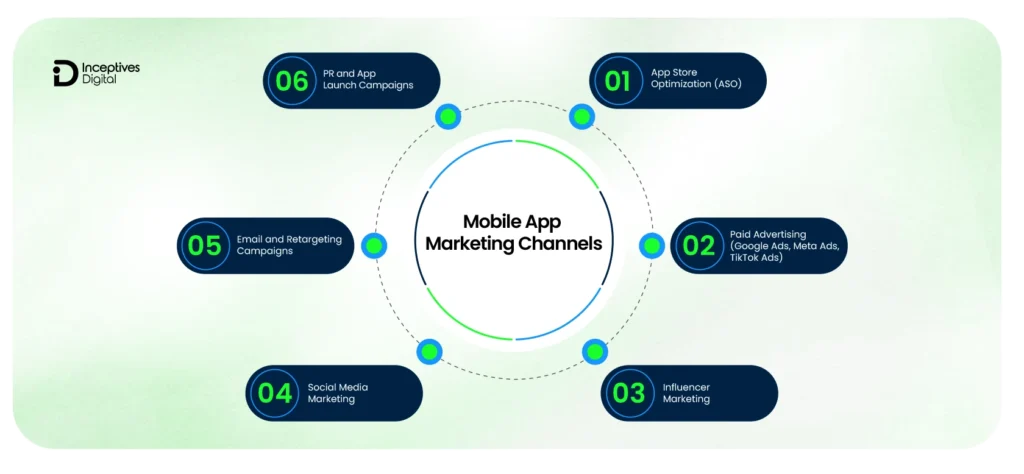
For pricing services offered through mobile app marketing channels, one of the most accurate methods is one-by-one pricing. Each channel performs a unique function related to consumer acquisition, promotion, and engagement, each at a different price depending on factors such as the tactics used, the competitive landscape, and even the mobile app developers implementing it.
App Store Optimization (ASO)
ASO stands for App Store Optimization and is the foundation for achieving organic traffic. It normally entails an investment that is neither too much nor too little, but should be sustained. ASO pricing ranges from $500 per month to $5,000 per month, depending on the competitive keywords, app types, and level of ASO optimization.
What you get:
- Keyword research and optimization.
- App name, description and metadata.
- A/B test icon and screenshots.
- Conversion rate optimization for your listing.
Paid Advertising (Google Ads, Meta Ads, TikTok Ads)
The most important cost factor in promoting mobile apps is paid advertising through platforms such as Google Ads, Meta Ads, and TikTok Ads. The cost of promoting an app via mobile application varies between $5,000 and $100,000+.
What is being charged:
- Campaign creation and targeting.
- Testing and optimization of creatives.
- Cost per install (CPI) or cost per acquisition (CPA).
- Performance analysis.
Influencer Marketing
Influencer marketing is an integral part of any mobile app’s growth; however, its pricing depends on the audience you reach through influencers, based on their interests and niches. This marketing method primarily builds trust with your target audience and attracts visitors to the influencer’s platform, such as Instagram, TikTok, or YouTube.
The pricing of this type of mobile app marketing varies depending on the degree of influence of the person. So-called micro-influencers cost $50 to $500 per post and are ideal for niche-focused campaigns. Mid-tier influencers cost from $500 to $5,000, whereas top-tier and celebrity influencers cost over $10,000. However, the exposure received is really incredible; yet, it is incredibly expensive compared to other mobile app marketing strategies.
What you’re paying for:
- Brand exposure and trust building.
- App installs through referral traffic.
- Content creation and promotion.
Social Media Marketing
Marketing mobile apps via social media involves both free and paid tactics to maintain awareness and engagement. This type of mobile app marketing is significant for covering the full cost of the service in question through promotion across social media channels such as Instagram, TikTok, Facebook, and X.
The price for the service may range from $1,000 to $15,000 per month, depending on how frequently and creatively content is shared, as well as the number of paid marketing campaigns run.
What you’re paying for:
- Content creation (posts, reels, videos).
- Community management.
- Engagement and brand positioning.
- Paid social campaigns.
Email and Retargeting Campaigns
Retargeting campaigns via email are designed to keep customers for as long as possible and increase their value throughout the entire installation period. It is important to ensure your mobile app marketing strategy delivers the right return on investment, rather than focusing solely on installations.
The cost of the service will depend on the automation system used, the target audience, and the type of campaign that needs to be run. It might range from $500 to $7,000 per month and include email campaign setup, push notifications, CRM integration, and email retargeting.
What you’re paying for:
- Push notification systems.
- Email automation setup.
- Retargeting ads for inactive users.
- CRM integration and optimization.
PR and App Launch Campaigns
It is within these PR and launch campaigns that traction, visibility, and credibility will be achieved once the market entry happens. The PR and launch campaigns are expected to ensure the application becomes popular through proper press coverage, press releases, product launch platforms, and advertising.
The budget is normally around $1,000 to $20,000 per campaign, depending on its scope. The activities include press distribution, journalist contact, launch planning, and positioning on Product Hunt and other technology blogs.
What you’re paying for:
- Press release distribution.
- Tech media outreach.
- Product launch strategy (Product Hunt, blogs, etc.)
- Brand positioning in the early market stage.
Paid User Acquisition Costs (Google Ads, Meta Ads, TikTok Ads Explained)
Attracting new users via paid channels is often considered the fastest approach; however, it is the most expensive aspect of app marketing services. Channels like Google Ads, Meta Ads, and TikTok Ads use bidding strategies, meaning the level of competition affects your prices.
Common cost structure:
- CPI: ~$0.20-$10+ (based on region and niche).
- Ad budget per month: $5,000-$100,000+ (depending on growth goals).
- Creative: Extra costs for videos, UGC and testing.
Google Ads (App Campaigns)
- Targets potential users within Google Search, YouTube and Display networks.
- Good channel for intent-rich traffic (users seeking solutions).
- More competition leads to higher CPI and better conversion quality.
Meta Ads (Facebook and Instagram)
- High-quality audience targeting, lookalikes.
- Best choice for scaling installs and running retargeting campaigns.
- Requires constant creative testing to achieve optimal performance.
TikTok Ads
- Perfect choice for virality and youth engagement.
- Lower CPI initially, yet heavily reliant on good video creatives.
- Best fit for app products that benefit from viral videos.
Freelancers vs Agency vs In-House Team: Cost Comparison
The selection of the most appropriate execution model significantly affects the cost of mobile app marketing services. The cost incurred will vary depending on whether one chooses to outsource the task by hiring freelance experts, create a specialized team in-house, or work with a mobile application development firm.
| Model | Monthly Cost | Best for | Limitations |
| Freelancers | $1,000 – $8,000 | Startups, small projects | Limited scalability, fragmented strategy. |
| Agency | $5,000 – $50,000+ | Growth-stage apps | Higher upfront cost. |
| In-House Team | $15,000 – $80,000+ | Large-scale apps | High overhead and management costs. |
Freelancers
The choice of freelancers is the most cost-effective and recommended for startup companies that need to test their application’s performance in the market. Freelancers offer flexibility in hiring for specific positions, such as ASO, PPC, or copywriting, at lower prices and with faster turnaround times. However, they rarely have a funnel marketing approach, cannot manage different freelancers, and lack software.
Agency
Agencies provide an all-round solution for marketing mobile apps, offering specialised teams and proven strategies for scaling. They provide full-cycle services from user acquisition to retention, leveraging the skills of professional marketers and the power of advanced marketing tools. Despite their many benefits, agencies can be more costly than freelance marketers and require long-term engagements to succeed.
In-House Team
The benefit of creating your own marketing team is that everything is under your control; hence, you are fully in charge of promoting your application, with a team fully committed to you. It is an expensive one due to costs incurred, such as staffing and equipment.
Pricing Models Used in Mobile App Marketing Services
Knowledge of pricing structures is important, since each development company has its own pricing model, and pricing can vary based on the campaign’s success.
Monthly Retainer Model
Most mobile app marketing agencies use a monthly retainer pricing model, in which companies pay a fixed monthly fee for services. These include strategy development, campaign management, optimization, and analysis of results. Their fees may range from $2,000 to $50,000+.
Performance-Based Pricing
The cost-per-performance strategy allows you to pay based on the result of your spending, either installs, leads, or actions, making it more performance-driven. You will pay on a per-install, per-acquisition, or per-action basis, which makes your marketing campaigns less costly but more dependent on their effectiveness.
Hybrid Pricing Model
The mix of flat fees and performance bonuses underpins the hybrid pricing strategy, and its adoption continues to grow among mobile app promotion services in 2026. Under this system, businesses will secure regular costs while simultaneously encouraging their advertising firms to work diligently to achieve measurable results, such as app installs, conversion rates, or revenue.
ROI of Mobile App Marketing
One critical factor to consider when determining the cost of marketing services for a mobile application is ROI. This is because money alone will not ensure success, but results will.
Key Metrics That Define ROI
For determining the efficacy of your marketing budget, these figures go beyond quantity; they help you gauge whether your investment in mobile application marketing services is worth it beyond increased downloads.
- CPI (cost per install) measures your efficiency at acquiring users. A low CPI indicates that it is inexpensive for you to acquire users, but it is not always indicative of user quality. Apps from Tier 1 countries, for instance, may cost more to acquire a user (high CPI) but be more lucrative.
- CAC (Customer Acquisition Cost) provides more insight by calculating the cost of acquiring a paying customer rather than just an installation. This metric is vital when the application uses a subscription or pay-per-use model.
- Another critical metric to consider when developing mobile apps is LTV, or Lifetime Value. This measure indicates how much revenue you will earn from users over their lifetimes with your application. The moment your LTV exceeds your CAC, you are profitable.
- The Return on Ad Spend (ROAS) is an indicator that shows how much revenue one earns from their ad investment. If ROAS is 3x, then one makes $3 for each invested dollar. It will allow you to understand what works well and where you should allocate more funds.
What Should You Actually Budget for Mobile App Marketing?
The correct budget allocation for promoting a mobile application is not based on an arbitrary number but on correlating the budget you set aside for promotion with the app’s current development phase, future objectives, and expected ROI. Your growth rate, competitive edge, and conversion efficiency will determine the expenditure.
Budget Based on App Stage
A simple way to determine the right marketing budget for your mobile application is to tie it to the current growth stage. Different stages require different amounts of investment and measures.
- Starting Up: $2,000-$10,000 per month
- Focus on validating your app and optimizing for downloads.
- Growing Phase: $10,000-$50,000 per month
- Focus on increasing your user base and optimizing conversions.
- Enterprise/Scale Phase: >$50,000 per month
- Focus on global growth and user retention.
How to Choose the Right Mobile App Marketing Company?
Choosing the best mobile app marketing company is critical to scaling growth and generating a high ROI. The business should focus on firms that have the necessary experience, rely on data-driven approaches, use multi-channel methods, and provide transparent pricing. The chosen partner should be able to optimise and scale across the various stages of growth in a creative way.
Inceptives Digital offers comprehensive solutions to market mobile applications, helping companies scale effectively. The techniques used include ASO, PPC, influencer marketing, and user retention techniques. With their expertise in performance-driven marketing, their campaigns are optimized to lower the cost of acquiring new users without compromising KPIs such as CPI, CAC, and ROAS.
CTA SECTION START
cta title: Ready to scale your app with the right strategy?
cta des: Partner with Inceptives Digital, a trusted mobile app development company, to combine powerful mobile app development services.
cta button: Contact Us Now
CTA SECTION END
Final Thoughts
The expenses involved in marketing an app will depend primarily on app development, the competitive environment, and the strategies put in place to grow the business. Regardless of whether firms use SEO or paid advertising, the money spent should align with ROI and value creation for the company. The most important aspect to remember is that even when an app is created by the best mobile app development company in the USA, effective marketing is key to success.
Marketing your mobile app is no longer optional; it’s a fundamental need for your app’s development. As market competition is stiff and the cost of acquiring users is increasing, you need to upgrade your analytics-driven practices and optimize your marketing across multiple channels. It all boils down to striking a balance between cost, creativity, and key performance indicators such as CPI, CAC, and ROI.
Mobile App Marketing Cost FAQs
Mobile app marketing services cost in 2026 typically range from $2,000 to $10,000 per month for startups, $10,000 to $50,000 for growth-stage apps, and $50,000 to $200,000+ for enterprise-level apps, depending on competition, strategy, and marketing channels used.
The cost depends on several factors, such as app category, target audience location, marketing channels, campaign depth, creative production quality, competition level, and the experience of the mobile application development company.
Mobile app marketing services usually include App Store Optimization (ASO), paid advertising campaigns, influencer marketing, social media marketing, email and retargeting campaigns, analytics tracking, and user acquisition strategies focused on installs and retention.
You can estimate your budget by aligning it with your app’s growth stage. Early-stage apps focus on testing and validation, growth-stage apps scale user acquisition, and enterprise apps invest heavily in multi-channel campaigns and retention strategies.
Hiring a mobile app company is better for full-scale growth because they provide complete strategy, execution, and optimization. Freelancers are cheaper and good for minor tasks, but agencies usually deliver stronger long-term ROI through structured and data-driven campaigns.
SIDEBAR LIST START
- Introduction: Why Mobile App Marketing Costs Vary So Much
- What is Mobile App Marketing?
- Average Cost of Mobile App Marketing in 2026 (Full Breakdown)
- Key Factors That Influence Mobile App Marketing Costs
- Cost Breakdown by Marketing Channels (ASO, Ads, Influencers and More)
- Paid User Acquisition Costs (Google Ads, Meta Ads, TikTok Ads Explained)
- Agency vs Freelancers vs In-House Team: Cost Comparison
- Pricing Models Used in Mobile App Marketing Services
- ROI of Mobile App Marketing: What You Should Expect From Your Budget
- What Should You Actually Budget for Mobile App Marketing?
- Final Thoughts
- FAQs
SIDEBAR LIST END