Startups do not fail because they have no promising ideas, but rather because they cannot cope with growth. This is where building a tailored solution becomes necessary. When creating custom solutions, entrepreneurs can benefit from greater flexibility, scalability, and control, all of which are crucial as a business grows rapidly.
Preset parameters do not constrain custom solutions, which can be tailored to a startup’s specific needs, enabling rapid innovation and improvements.
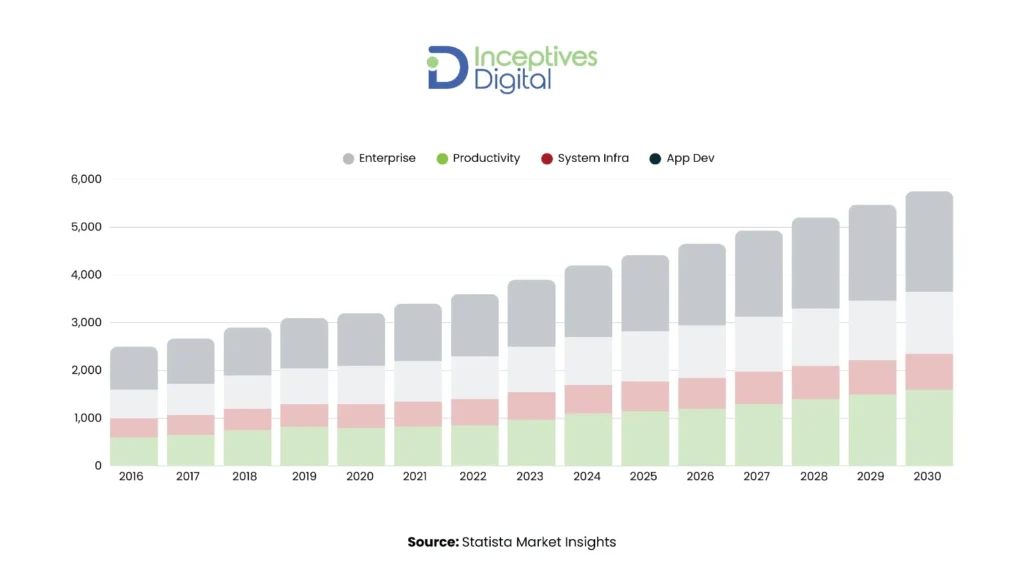
Statista’s forecast for the global software industry highlights tremendous growth in overall software revenues, up 4.67% from 2026 to 2030, driven by enterprise and digital software, indicating increasing demand for digital solutions from startups and companies.
A development partner enables founders to build software applications customized to the business. Instead of trying to fit the business into generic software, founders can develop startup-specific software solutions customized to the idea and market.
This is not only about software creation but also about the adaptability and scalability it enables. With it, companies can modify their solutions, integrate with other applications, and build new features without the constraints of standardized software.
The other significant advantage is scalability. Startups require scalable software, and this is one area where fully customized software is particularly beneficial. With custom-developed software, startups can scale and improve performance without difficulty.
Custom software development services are critical to digital transformation, where innovation and competition require customized software applications. Though off-the-shelf software would do fine for startups, as the business expands, it becomes insufficient, necessitating custom software solutions.
Benefits of Custom Software Development for Startups
Going the custom route offers startups the chance to develop software that aligns with their business model, rather than the other way around, as is often the case with generic software. This is a chance for startups to grow, become more efficient, and develop products that are unique and competitive in the market, rather than relying on software that offers no real value.
The following are the advantages associated with custom software development:
Customized to Your Business Processes: Built around how your business actually operates.
Easy Scalability: A solution built for you scales with you as your startup grows, saving the cost of migrating platforms later.
Unique Competitive Edge: Unique capabilities not readily available from mainstream providers can be incorporated into your startup, providing you with a competitive edge and establishing distinctive brand identities.
Value Over Time: Although custom software may seem expensive initially, it ultimately provides value in the long run by helping you to avoid expensive licensing fees.
Flawless Integration: It becomes easy for you to integrate with the rest of the solutions your startup uses.
Security: As you own your software solution, you can tailor it to your security standards.
Data-Driven Decisions: Custom software solutions help you incorporate analytics capabilities within the application.
When Should Startups Go Custom?
Choosing the timing for software development is critical and will determine your company’s efficiency. The right time to develop startup software is when your firm is ready to benefit from it. Getting the timing right matters, and mistakes here can waste resources.
Major signs your startup should follow to go custom:
- You have achieved product-market fit, but the tools available can no longer handle the increased user requests.
- Your team is facing operational efficiency issues because the available tools are insufficient.
- You are facing increased scaling challenges, and the tools need to be flexible enough to accommodate them.
- Your business model is unique and requires workflows that are not available in the tools.
- You are looking to make the build vs. buy decision, and you need control over the features.
- Your MVP stage decisions have confirmed the idea, and the product is expected to perform better.
- You are moving from the early stage to the growth stage of startup technology and need more infrastructure.
Custom vs. Off-the-Shelf Solutions
While evaluating whether the start-up should develop its own software or buy an existing one, it is important to assess whether the choice aligns with the organizational vision. While developing a software program will cater to the requirements of start-ups, buying a software program will suit a wider audience.
When comparing off-the-shelf and custom software, cost and time matter.
The flexibility/cost factor is an important factor in decision-making. Although the cost of using SaaS tools is lower, the total cost will add up over time. Custom software, on the other hand, requires a greater investment, but startups will have greater control and efficiency.
A comparison of software scalability clearly indicates that custom software is more appropriate for startups. Although scaling the user base will be necessary over time, it is more scalable than SaaS tools. Therefore, this approach suits startups that are likely to scale rapidly.
To fully appreciate the advantages and disadvantages of custom software, one must consider the licensing and ownership issues. Whereas ready-to-use software is licensed, a custom build gives total ownership. Nevertheless, ready-to-use software is the best choice for start-up firms because it is easy to implement.
| Factor | Custom Software | Off-the-Shelf Software |
| Definition | Built specifically for a business’s unique requirements | Pre-built, ready-made software solutions for a wide audience. |
| Flexibility | Highly flexible with full software customization benefits | Limited customization options. |
| Cost | Higher upfront cost but better long-term value | Lower initial cost but recurring subscription fees. |
| Deployment Time | Takes longer to develop and launch | Quick implementation, especially in SaaS vs custom development. |
| Scalability | Designed for growth | May struggle to scale as the business grows. |
| Ownership | Full ownership | License-based access, no ownership. |
| Maintenance | Controlled internally or by a development partner | Managed by the software provider. |
| Use Case | Ideal for startups with complex models | Suitable for early-stage or simple business needs. |
| Long-term Value | High ROI with customized features and scalability | It can become costly and restrictive over time. |
Software Development Planning for Startups
Software development planning is necessary for successful startups because it ensures the product developed meets the company’s and its customers’ needs. The right strategy for product development by startups will guide the process, ensure alignment among team members, and facilitate successful product development.
The main steps in planning your software development:
- Build a software project roadmap to define milestones, timelines, and deliverables.
- Clarify your product vision to define the purpose of your software.
- Map the user journey to understand how people interact with your product.
- Prioritize features so the most critical ones get built first.
- Set a tech strategy aligned with where the technology needs to take you.
Defining Core Features and Requirements
Having set up your software development planning for startups, the next step is to identify the basic features and requirements that will serve as the foundation for the development process.
A good startup product development plan is crucial, as it ensures that every feature included in the product is relevant to the business’s success and helpful to the end user.
It is vital to define the must-haves and nice-to-haves for a startup product and ensure the most important ones receive top priority.
- Create a lean Product Requirements Document (PRD) to document features, technical details, and workflows.
- Use user journey mapping to ensure features address actual user needs.
- Adopt a feature prioritization approach to manage feature development.
- Map features to the product vision to sustain focus.
- Map features to software project road mapping for timely tracking.
- Consider your startup’s technology strategy for scalability and feature enhancements.
- Avoid feature creep by evaluating feature requests strictly based on business and user needs.
Choosing the Right Tech Stack
Choosing an appropriate tech stack is essential when building a software product that can be scaled to meet certain goals. It is important to know which tech stack will suit the company and make the right decision in this regard.
Key considerations when choosing a tech stack:
- Choose a frontend technology to create an intuitive interface.
- Select the backend technology most appropriate for your application’s needs.
- Choose a database that is most suitable for your application now and in the future.
- Ensure the technological stack is scalable to accommodate future growth.
- Take advantage of the infrastructure to be flexible, economical, and globally scalable.
- Use performance optimization software to speed up applications.
- Choose a technological stack that aligns with your startup’s software architecture and future business needs.
MVP Strategy for Faster Validation
MVP development for startups enables entrepreneurs to test their ideas quickly and effectively, ensuring products that are useful to users.
Custom MVP software development enables the creation of a working model of the product to gain insights into its improvement, aligning with the Lean Startup methodology’s principles of agility in product development.
- Focus on the features that address the fundamental problem.
- Use rapid prototyping to test functionality and design.
- Use a feedback loop to learn from users.
- Study successful MVP implementations for startups.
- Use real-world usage to validate assumptions and minimize costs.
- Use results from ongoing validation to make plans.
Development Process and Methodologies
Choosing the right software development methodology will help ensure your software is developed as efficiently as possible for your startup. By adopting an agile approach, startups can gain the flexibility they need.
Below are the steps that are part of the development process:
Agile vs Waterfall vs Lean
Understanding the distinctions among Agile, Waterfall, and Lean would help startups select the most suitable methodology for their operations. Agile is rooted in iteration and adaptability. In contrast, Waterfall is based on a sequential process. Lastly, Lean is about efficient production without waste.
Scrum Development Process
The Scrum development process is divided into sprints, usually 1 to 4 weeks long, allowing the team to set and achieve smaller goals. Scrum is best suited for startups because they need faster iterations and improvements based on end-user feedback.
Sprint Planning and Iteration Cycles
Sprint planning includes setting goals and tasks for each cycle in the backlog. Iterations help ensure incremental feature development and regular reviews. This approach helps mitigate risk, allows for course corrections, and provides a roadmap for the development team, keeping it aligned with business objectives.
Testing and Deployment Basics
Good testing and release practices are necessary to produce high-quality software products. The use of CI/CD pipelines to automate processes and DevOps to improve collaboration is important in achieving this objective.
In-House vs Outsourcing: Which Is Better for Startups?
Deciding whether to build in-house software or hire an outside team is crucial for startups, as it affects costs, timelines, and product quality.
Although keeping development in-house can help maintain control over the process, startups often outsource software development to quickly save money.
In-House Development
Start-up firms would have control over the entire development process as they build their own team within the company. It ensures effective cooperation, rapid communication, and a better understanding of the product’s idea.
However, recruitment of competent developers, designers, and managers is both time-consuming and expensive.
Outsourced Development
Going the outsourcing route for your startup allows you to tap into international talent pools without being committed to any lengthy processes. Outsourcing may be cheaper and faster than hiring developers within the organization. IT firms, such as IT staff augmentation providers, offer a range of development options for startups.
| Factor | In-House Development | Outsourced Development |
| Cost Efficiency | Higher costs due to salaries, infrastructure, and benefits. | More affordable with flexible pricing models. |
| Speed to Market | Slower due to hiring and onboarding processes. | Faster, start with ready-to-deploy teams. |
| Expertise Access | Limited to the skills of the hired team. | Access to global talent and diverse expertise. |
| Control and Communication | Full control with direct communication. | Requires structured communication and management. |
| Scalability | Difficult and time-consuming to scale the team. | Easily scalable based on project requirements. |
Which One Should You Choose?
Outsourcing is considered a more favorable choice for new enterprises, as it reduces costs and accelerates the process. It enables companies to operate immediately without incurring high upfront costs. Once an enterprise grows and matures, it moves towards adopting a combination of both models.
Cost Breakdown and Budget Planning
Understanding costs early helps startups plan effectively, use resources wisely, and avoid overspending.
Proper cost planning is essential for healthy growth.
Key considerations for cost and budget planning:
- Identify key cost drivers, such as feature set, team size, and technology stack.
- Estimate your development budget and costs based on scope and complexity.
- Analyze the mobile app development cost breakdown to identify areas where you spend the most.
- Compare the cost of outsourcing and in-house software development to determine the most efficient approach.
- Consider app developers’ hourly rates when hiring for your startup.
- Use cost optimization techniques to avoid wasteful expenses without compromising quality.
- Study software development pricing models to determine the best approach for your startup.
| Cost Component | Description | Estimated Range / Notes |
| Features & Functionality | Core features, must-have vs nice-to-have, integrations | 40–50% of the total budget. |
| Development Team | Developers, designers, QA engineers, project managers | Based on hourly rates, developers can cost more when outsourced than when in-house. |
| Technology Stack | Licenses, tools, frameworks, servers, cloud infrastructure | 15–25% of the total budget. |
| Design & UX/UI | Interface design, user experience enhancements | 10–15% of the total budget. |
| Testing & QA | Manual and automated testing, bug fixes | 10–15% of the total budget. |
| Deployment & Maintenance | Initial deployment, updates, and ongoing support | 5–10% of the total budget. |
| Contingency | Buffer for unexpected costs | 5–10% of the total budget. |
Common Challenges in Custom Software Development
While this approach can help deliver high-performing applications, startups may face challenges that could affect their timeframes and budgeting plans. It is essential to be informed about potential problems beforehand.
- Unclear Objectives: Failure to clearly define project objectives and requirements can result in inefficiency and complications during development.
- Excessive Costs: Budget overruns are common due to unplanned additions or inadequate budgeting.
- Feature Bloat: The continual addition of new features can delay the project and influence the final product’s quality.
- Poor Technology Selection: Inappropriate technology choices and a lack of skilled developers can negatively affect software performance.
- Communication Problems: Poor communication among project stakeholders can delay the project schedule.
- Time Pressure: Short time frames can adversely influence the development process and the quality of the outcome.
- Maintenance Issues: Software maintenance involves regular updates and other adjustments to ensure the software operates successfully.
Real-World Examples of Startups Using Custom Software
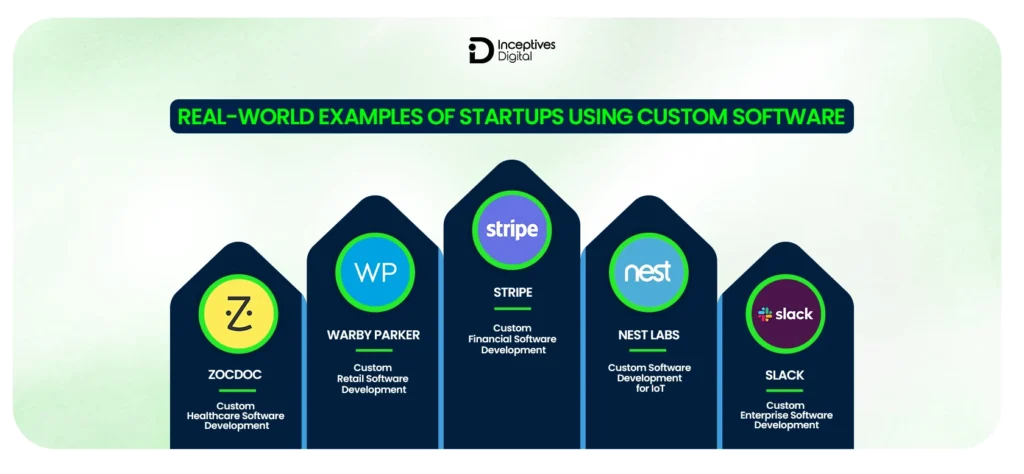
The use of tailored solutions has helped startups boost their efficiency, customer satisfaction, and scalability. They enable startups to address industry-specific needs that standard solutions cannot.
The following are some common examples of startups in various industries:
Custom Healthcare Software Development
Today, more and more healthcare startups use their own software to manage patient information, provide telehealth services, and comply with healthcare regulations. Cooperation between such startups and a custom healthcare software development company enables the creation of software products that are beneficial from a management and security perspective.
The software that startup companies like ZocDoc use enables them to monitor patient appointments, doctor schedules, and patient health information. This allows for a smooth telehealth process and compliance with healthcare legislation.
Custom Retail Software Development
New retail ventures leverage custom software to optimize inventory management, deliver personalized customer experiences, and integrate e-commerce solutions with POS systems. This approach lets companies develop software solutions to their specific requirements.
Warby Parker has developed a customized retail solution that will enable management of inventory, online orders, and try-on. The purpose is to make operations easier and help develop a distinct consumer experience.
Custom Financial Software Development
FinTech start-ups need platforms that are highly secure and regulatory compliant for processing transactions, conducting assessments, and reporting. FinTech app development lets fintech startups handle complex financial processes securely and at scale.
Stripe uses customized financial software to enable secure payments and billing. This customized system makes the payment process easier, more efficient, and scalable for startups and companies.
Custom Software Development for IoT
Custom software development for IoT is essential for startups running IoT technology, as it enables easy device management and the processing of real-time data, thereby increasing system efficiency.
Nest Labs has created IoT software that enables control of connected devices, such as thermostats and security systems. The software analyzes real-time data to increase device efficiency.
Custom Enterprise Software Development
B2B-focused startups require scalable, integrated solutions for human resources management, customer relationship management, or workflow automation. Working with a specialized development partner enables these startups to develop systems that align exactly with their processes and strategy.
Slack developed a solution for enterprise business communication and collaboration. This scalable software is compatible with many applications and allows enterprises to automate their processes.
Security and Compliance in Custom Software Development
Security and compliance must become integral parts of software development from the very beginning, rather than an afterthought. It will help businesses protect their critical information and ensure compliance with laws and regulatory frameworks such as GDPR, HIPAA, and SOC 2.
- Secure Development Lifecycle (SDLC): By conducting security tests in each phase, from planning and design through testing and implementation, security issues should be caught early, with weaknesses addressed before they reach production.
- Risk Analysis and Code Testing: Conducting risk analysis and code testing beforehand enables one to detect software weaknesses.
- Data Encryption: Encrypting data while it is transmitted and stored protects sensitive data from tampering.
- Identity and Access Management: Implementing effective identity authentication, such as MFA and RBAC, restricts access to critical systems and data.
Scaling and Optimizing Your Software
Once your startup product goes live, scaling your software applications becomes necessary to meet growing demand while ensuring a high-quality user experience. Therefore, implementing effective software optimization strategies helps your system scale smoothly without compromising quality or reliability.
Your software needs a scalable architecture that handles growing demand, new features, and shifting business needs. Cloud scaling and load balancing are core parts of that.
- Optimize app performance for faster, more responsive apps.
- Install performance-monitoring tools to identify performance bottlenecks and failures.
- Develop a software update and maintenance strategy to keep the app secure and up to date.
- Optimize database queries and backend performance to ensure scalability.
- Refine app features to ensure better performance.
- Utilize cloud computing for flexible resource allocation.
Future Trends in Custom Software Development for Startups
Many startups are adopting new methods and tools to remain competitive, grow their businesses effectively, and deliver a unique user experience. This knowledge will be useful to entrepreneurs who want to develop future-proof software.
Here are a few of the best future trends you should look for:
AI-Powered Software Solutions
AI is revolutionizing startup software through automation, predictive analysis, and personalization. Startups can leverage AI to improve processes, support decision-making, and deliver smart products to consumers.
Cloud-Native and Serverless Architectures
With cloud-native technology coupled with serverless computing, start-ups can scale quickly, reduce infrastructure costs, deploy faster, and remain flexible, all while growing efficiently without a significant initial capital outlay.
Low-Code and No-Code Platforms
Low-code/no-code development platforms enable startups to develop apps quickly with minimal code. These platforms can quickly launch an MVP, minimize development costs, and help nontechnical entrepreneurs make rapid improvements.
Increased Cybersecurity and Data Privacy
In the wake of rising cyberattacks, it becomes necessary to incorporate security capabilities. Startups will rely on technologies such as AI-enabled threat detection, encryption, and regulatory compliance mechanisms to secure user data.
Internet of Things (IoT) Integration
IoT-driven solutions enable startups to develop IoT devices and ecosystems. Custom-made software applications would be needed for real-time data analysis, device monitoring, and automation.
Blockchain and Decentralized Solutions
Blockchain technology is expected to revolutionize the transparency and security of startup software. Startups can use blockchain technology to enable secure transactions, support DeFi, and store immutable data, thereby establishing trustless platforms and business models.
Predictive Analytics and Big Data
Startups will become increasingly dependent on predictive analytics and big data to understand customer behavior, operations, and offerings. The use of custom software that incorporates these elements will assist in decision-making and increase efficiency.
CTA SECTION START
cta title: Ready to uplift your startup with solutions built just for you?
cta des: At Inceptives Digital, we help startups build scalable, secure, high-performing software tailored to your growth stage.
cta button: Let’s Connect
CTA SECTION END
Final Thoughts
Building tailored software has become not a luxury but a necessary step for startups. By leveraging scalable platforms, artificial intelligence, the Internet of Things, and advanced cybersecurity practices, businesses can develop smart products that give them a competitive advantage. If you decide to work with a reliable software development company, you will receive all the necessary support from professionals.
FAQs
Custom software development for startups involves developing unique software solutions that are scalable, flexible, and competitive.
The price may vary depending on factors such as the software’s features and complexity, the team members, and the technologies used. A custom software development company will help you build a detailed budget and plan.
If a startup is expected to grow in the coming years and has unique workflows, a customized software solution is probably a better option.
Here we can mention AI-driven software, cloud and serverless architecture, low-code/no-code options, integration with the Internet of Things (IoT), predictive analytics, and blockchain-based software solutions.
When looking for a company to collaborate with, it is important to focus not only on its skills but also on the scalability solutions and software development services it offers.
SIDEBAR LIST START
- Introduction
- Benefits of Custom Software Development for Startups
- When Should Startups Go Custom?
- Custom vs Off-the-Shelf Software Solutions
- Software Development Planning for Startups
- Defining Core Features and Requirements
- Choosing the Right Tech Stack
- MVP Strategy for Faster Validation
- Development Process and Methodologies
- In-House vs Outsourcing Software Development
- Cost Breakdown and Budget Planning
- Common Challenges in Custom Software Development
- Real-World Examples of Custom Software for Startups
- Security and Compliance in Custom Software Development
- Scaling and Optimizing Your Software
- Future Trends in Custom Software Development for Startups
- Final Thoughts
- FAQs
SIDEBAR LIST END