SaaS applications are popular among startups that need to be agile and efficient in the early phases of their operations. They allow startup teams to develop and implement processes and solutions effectively without making significant initial investments.
Custom software solutions enable you to create software that fully meets your company’s needs. It is possible to automate the entire software process to increase your productivity. Custom software development services guarantee better performance and integration within the software ecosystem.
The demand for customized software has become global. According to Statista, worldwide revenue from enterprise and digital transformation software spending will reach about $1.3 trillion in 2026. Around 70% of businesses will spend more money on customized software to increase scalability and effectiveness.
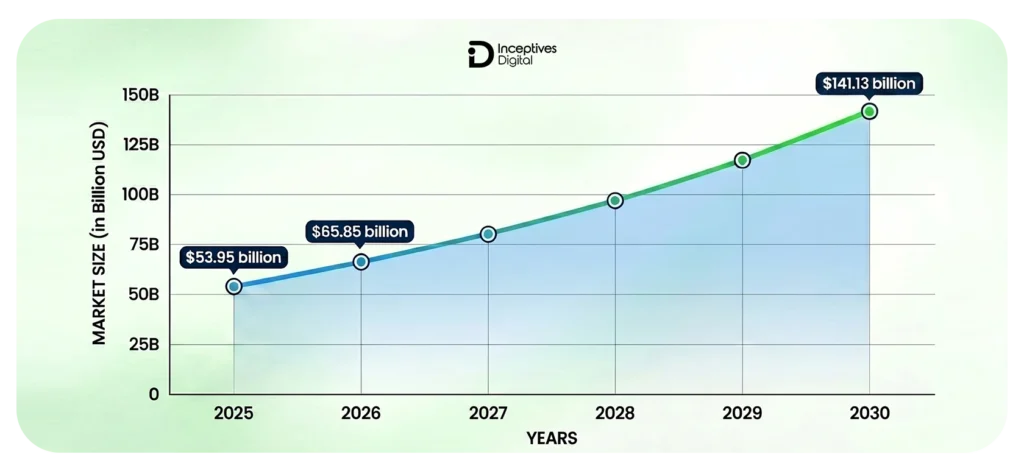
The SaaS market experiences significant and consistent growth from 2025 through 2027, driven by rapid digitalization and cloud adoption. The market begins with a valuation of $53.95 billion in 2025 and reaches $65.85 billion by 2026. In 2027, however, growth will continue to accelerate as demand for scalable subscription software solutions across sectors such as IT, healthcare, and finance drives further market development in the coming years.
Source: thebusinessresearchcompany.com
Beginning in 2028, the SaaS market will experience rapid growth, reaching $99.99 billion in valuation, followed by the market crossing the $115 billion mark in 2029. By 2030, the market will be worth $141.13 billion, more than doubling its 2025 valuation. This dramatic growth is attributed to AI integrations, remote work practices, automation, and the adoption of subscription models, all of which are imperative to modern-day business operations.
Why Startups Start with SaaS Tools?
Startups choose the SaaS option early in their development because it offers quick implementation and cost-effectiveness. In other words, instead of developing their own software, they can quickly install a CRM, project management, marketing, and analytics solution from the existing list of options offered by vendors.
Another key reason is cost efficiency and minimal risk. Startups in the initial phase do not seek services from software development firms due to the high capital outlay and lengthy development process. Software-as-a-service (SaaS) solutions offer flexible payment plans, making budgeting easier and more predictable. While SaaS solutions can scale to some extent, limitations emerge as startups grow.
7 Signs Your Startup Needs Custom Software
As the startup grows, the constraints imposed by pre-built software become more apparent in its day-to-day operations. This is often when company founders begin to realize that custom software may be necessary. The difference between a ready-made solution and a customized one lies in its specificity to a particular company’s business processes and goals.
The 7 key signs that you need to invest in custom software for your startup include process incompatibility, scalability issues, software overload, a need for a competitive advantage, and growing concerns about data security.
The following are the seven signs you need software development:
Sign #1: Business Processes Don’t Fit Your Software
One of the most obvious indicators that your startup needs custom software development is when your software solutions do not align with your business’s workflow. Out-of-the-box solutions are built for generic processes, while startups develop specific workflows that existing tools can’t cover.
Consequently, the majority of your operations become inefficient and require significant manual involvement. At some point, it may become clear that you have been adjusting to the tool rather than optimizing it to suit your needs.
Sign #2: Your Tools are Not Integrated or Scalable
Yet another clear sign that you need custom software for your business is when your tech stack stops working as smoothly as it should. Many startups start with having several SaaS services, ranging from CRM systems to analytical ones, from project management tools to marketing platforms.
The problem with all such software solutions is that they often lack proper integration, leading to poor data organization, duplication of effort, and poor collaboration.
In case you see that the inefficiency of your tech stack is only growing along with your company, custom software can be one of the best ways to make it right. When you outsource this task to professionals, they will help you create a system that will work effortlessly as the business grows and develops.
Sign #3: Startup is Paying Too Much for Multiple Software Tools
As your venture progresses, more and more SaaS applications are adopted for processes such as CRM, analytics, marketing, and project management. While these apps might seem affordable individually, together they add up to a significant monthly expense. This definitely points to the need for custom software development services for startups.
The key factor here is duplication of functions. Most often, there is significant functionality overlap among the applications you use; however, you still need to pay for additional options to integrate them into a single solution. This becomes quite costly and challenging. With custom software, these problems can be solved easily.
Sign #4: You Need Custom Features to Compete in the Market
As your company expands and starts competing against similar products, using standard tools and features will make things difficult for you. Commercial software is designed for mass consumption, which makes it difficult to incorporate innovations. Custom software lets startups build features tailored to their users and workflows
If you want to grow by offering something unique to your customers, standard features won’t deliver what you expect. Custom-built software solutions can help you build features personalized to your needs. These custom features can be beneficial in creating an innovative and scalable solution.
Sign #5: Data Security and Control are Becoming a Concern
However, as your startup grows and begins working with sensitive client and business information, depending solely on ready-made tools can become a disadvantage. Ready-made applications usually provide pre-configured security settings, access permissions, and common server infrastructure that may not meet all your specific data security needs. Hence, it may become necessary for your business to consider using custom-made software services designed for startups.
Security is much more than data protection. As you continue to develop your business and comply with new laws, you might need to create specialized security settings, select specific encryption types, or use other solutions. Custom software development will help you achieve better protection by enabling you to build a security system personalized to your needs.
Sign #6: Your Team Depends on Manual Workarounds
If your business team finds itself constantly using spreadsheets, copying data from one place to another, or changing applications for performing simple actions, it is evident that you are currently using inefficient software solutions. This problem often arises when existing tools are not flexible enough to fit your workflow. Such inefficiency may negatively affect your company’s performance and necessitate the development of custom software for startups.
In addition, a product experience that feels inconsistent when forming actions increases the likelihood of mistakes and creates extra trouble when scaling a team, since you will need more employees to fill the gaps. Instead of focusing on valuable actions, your business team ends up solving problems caused by inefficient processes.
Sign #7: Your Product Experience Feels Inconsistent for Users
If users notice unstable performance, disrupted processes, or inconsistent feature implementation, one should consider scalability now, as the existing configuration will hardly cope with it. Standard products are usually built in a standalone manner, leading to disconnected user experiences. That is why custom software development for startups is essential, as they help create a holistic platform that manages all components of the user experience.
The inconsistency of the user experience directly affects engagement. Inconsistent functionality or any other problems connected with it mean a user will be dissatisfied with your product and unlikely to use it anymore. With the help of custom software developers, one can create a holistic product that integrates backend processes, APIs, and interfaces into an inseparable chain.
SaaS vs Custom Software: What’s Better for Startups?
Startups mostly prefer SaaS software solutions because of their advantages, such as speed, cost-effectiveness, and ease of integration. This allows validating ideas quickly without having to build customized software for the startup’s needs.
Nevertheless, SaaS solutions lack flexibility. They are designed to meet a variety of different requirements; therefore, they cannot meet all your needs. As startup growth increases, you will notice these shortcomings as your workflow becomes constrained by the software.
Here comes the added value of software development companies. The best software can be customized to your processes, enabling more effortless integration and automation. Moreover, unlike cloud software, customized solutions adapt to your company’s needs and minimize reliance on multiple platforms.
SaaS is a faster way to get started, but software is a smarter way to scale up. It all comes down to your current stage, budget, and specific business needs.
Below is the comparison table of custom software vs SaaS:
| Factors | SaaS (Off-the-Shelf) | Custom Software Development |
| Setup Time | Very fast | Moderate |
| Cost Model | Subscription-based | One-time + maintenance |
| Flexibility | Limited customization | Fully customizable |
| Scalability | Restricted by the vendor | Built for growth |
| Integration | Partial, depends on APIs | Effortless system integration |
| Data Control | Vendor-managed | Complete ownership |
| Best For | Early-stage startups | Growing & scaling startups |
Cost and Timing: When to Invest in Custom Software Development?
Custom software development investment for new businesses is more dependent on their developmental stage rather than their budget. This occurs once SaaS systems become restrictive to business processes due to inefficiency or lack of scalability. A custom software development firm will help match your technology needs with the business processes.
When to Invest in Custom Software Development?
Custom software should be developed for your startup if you notice specific symptoms indicating that your company cannot function effectively and that existing solutions are no longer sufficient, as it has entered a new phase of development characterized by higher complexity and inefficiency. In particular, this symptom is linked to the growing number of issues stemming from disconnection across platforms and to low efficiency due to the high complexity of your startup.
The next symptom is quite obvious, too, since when your startup reaches stability, the next stage will be developing a solution that can grow along with it. Therefore, if you have decided on the next step and all processes in your startup are already stabilized, you should start collaborating with a software development firm.
Cost of Custom Software Development
It is generally implied that startups need to invest more in custom software development than in SaaS products. However, the price of customized software development is indicative of its real worth rather than just its development. Instead of paying monthly fees for multiple applications, startups choose to develop a single application customized to their needs.
In the end, startup-focused software solutions may be cheaper than a combination of SaaS products. The tools developed by custom software developers are highly scalable and incur no subscription, integration, or other costs.
Final Thoughts
A startup does not immediately outgrow SaaS products; it is a gradual process driven by growing workflows, increased complexity, and greater data volume. Software that was easy to use and efficient at first can become inefficient due to frequent integration fixes, higher costs, and manual workarounds to make everything work. This is the moment when off-the-shelf solutions no longer fuel but hinder growth.
That is why custom software development is becoming more popular among startups, as it enables you to build a system customized to your current workflows and growth objectives, rather than changing your processes to fit pre-designed solutions. Choosing the right custom software development company can give you an advantage in terms of integrations, automation, and user experience.
CTA SECTION START
cta title: Outgrowing SaaS? Build Software That Scales With You
cta des: Stop juggling multiple tools and paying rising SaaS costs. We design custom software tailored to your workflows, integrations, and growth goals.
cta button: Get a Software Strategy Call
CTA SECTION END
Custom Software Development FAQs
Signs that a startup business requires custom software include inefficiencies caused by SaaS platforms, integration issues, high costs, and workflows that fail to align with business processes.
Startups prefer SaaS products for their rapid implementation, affordability, and suitability for testing ideas before developing dedicated software.
For startups that plan to scale, custom software is more beneficial than SaaS tools. They provide greater scalability and flexibility.
It is time for startup companies to begin building their own software as operations become more complex and integration becomes more difficult.
Although the costs of custom software development can be high at first, custom solutions save money in the long term.
SIDEBAR LIST START
- Introduction
- Why Startups Start with SaaS Tools (and Outgrow Them)
- When Off-the-Shelf Software Stops Working for Startups?
- 7 Signs Your Startup Needs Custom Software
- SaaS vs Custom Software Development: What’s Better for Startups?
- Cost and Timing: When to Invest in Custom Software Development
- Final Thoughts
- FAQs
SIDEBAR LIST END