Mobile app maintenance costs typically range from 15% to 25% of the initial estimated app development costs. The monthly costs range between $500 and $4,000+, but the exact numbers will depend on the complexity, features, and size of your app.
These numbers move a lot in real situations. A simple utility app with limited features won’t need much ongoing work. But once you add things like user accounts, APIs, payments, or real-time data, maintenance becomes a regular expense rather than an occasional fix.
After launch, apps don’t really stay static. Operating system updates, security patches, third-party API changes, and performance issues keep showing up in different cycles. Maintenance is what keeps the app usable and stable through all of that.
In most cases, a mobile app development company also plans maintenance early in the project because ignoring it often leads to unexpected cost spikes and technical issues later in the product lifecycle.
This breakdown covers:
- Monthly and yearly mobile app maintenance cost ranges
- Cost differences based on app type and complexity
- Key factors that actually change pricing
- Hidden expenses that usually get ignored
- Practical ways to control ongoing maintenance spending
Quick Answer: How Much Does Mobile App Maintenance Cost?
Mobile app maintenance costs usually depend on how intricate and evolving in nature the application is after it is launched. The actual maintenance cost of different applications becomes more understandable when you measure them through specific cost ranges instead of using percentage values:
Mobile App Maintenance Cost Estimates
| App Type | Annual Maintenance Cost (USD) | Monthly Cost Estimate | What You’re Paying For |
| Basic App | $5,000 – $4,000+ | $500 – $1,500 | Bug fixes, minor updates, basic hosting |
| Mid-Level App | $4,000+ – $45,000 | $1,500 – $4,000 | API updates, scaling, performance improvements |
| Advanced App | $45,000 – $150,000+ | $4,000 – $15,000+ | Cloud infrastructure, security, and real-time features |
Why Mobile App Maintenance is Important?
Mobile app maintenance is important because it directly affects your overall app development costs to run after launch. Without regular updates, even a well-built app starts losing performance, security, stability, and compatibility with new operating system versions.
Every update, bug fix, or performance improvement adds to the ongoing mobile app maintenance cost, but skipping it usually leads to bigger and more expensive problems later.
Apps that are not maintained properly often face issues like crashes, broken features after OS updates, slow performance, and security risks. Fixing these problems in bulk later usually costs more than maintaining the app consistently.
Maintenance is what keeps the app functional in real-world conditions, and it is one of the main reasons why mobile app maintenance costs exist as a recurring expense rather than a one-time payment.
What is Technical Debt in Mobile App Development?
Technical debt is the cost of choosing a faster or simpler solution during the app development process that later requires more effort to maintain, fix, or upgrade.
When technical debt builds up, even small updates take more time because the code becomes harder to change safely. This directly increases mobile app maintenance costs over time.
Apps with high technical debt usually need more bug fixes, more refactoring, and more testing before every release, which raises the overall maintenance budget.
What Is Mobile App Maintenance? A Technical and Business Definition
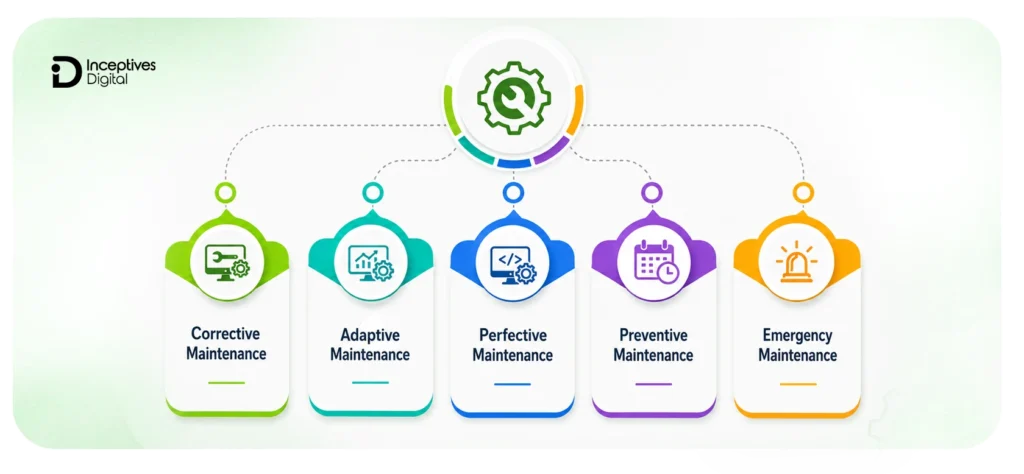
Mobile app maintenance is the ongoing work required to keep an application running smoothly after publishing on the app stores. It ensures the app stays functional, secure, and compatible with new operating system updates and user needs.
It is a continuous process, and most of the mobile app maintenance cost comes from keeping the app stable as technology, devices, and user expectations change.
Main types of mobile app maintenance:
1. Corrective Maintenance
Fixes bugs, crashes, and issues that appear after the app is live. These fixes are often unpredictable and directly add to recurring mobile app maintenance costs when user-facing problems increase.
2. Adaptive Maintenance
Updates the app to stay compatible with new iOS and Android versions. This becomes a regular cost driver as operating systems evolve every year.
3. Perfective Maintenance
Improves performance, speed, and user experience based on real user behavior. It usually grows as the app scales, and more optimization is needed.
4. Preventive Maintenance
Focuses on improving code quality to avoid future issues. This reduces long-term maintenance costs but requires upfront investment.
5. Emergency Maintenance
Handles critical failures like outages, security breaches, or broken integrations. It is unpredictable and often the most expensive type of maintenance.
How to Calculate Mobile App Maintenance Costs? (The 15-25% Rule)
A common way to estimate mobile app maintenance cost is to use a simple industry benchmark:
Mobile app maintenance typically costs 15% to 25% of the initial development cost per year.
This range is used because maintenance effort depends on how complex the app is, how many systems it connects to, and how frequently updates are required after launch.
Lower-complexity apps usually stay closer to the 15% range, while feature-heavy or high-traffic apps often move toward 25% or more due to increased infrastructure, security, and update requirements.
Example Calculation:
If an app costs $300,000 to develop:
- Low maintenance estimate (15%) → $45,000 per year
- High maintenance estimate (25%) → $75,000 per year
This means the monthly mobile app maintenance cost would roughly fall between $3,750 and $6,250, depending on how the app evolves after launch.
Why is This Rule Used?
The 15–25% model works because maintenance is not a fixed task. It changes based on user growth, system complexity, OS updates, and third-party integrations, all of which directly affect mobile app maintenance cost over time.
Maintenance Pricing Models and Service Level Agreements (SLAs)
Mobile app maintenance cost is also influenced by how the service is structured. Different pricing models determine how predictable your spending is and how much flexibility you get for updates and fixes.
Some models offer fixed monthly planning, while others charge based on actual work done. The right choice depends on how stable or dynamic your app is after launch.
| Model | Description | Cost Impact | Best Fit |
| Percentage Retainer | Fixed annual cost based on 15–25% of development cost with defined maintenance coverage | Predictable mobile app maintenance cost with stable budgeting | Long-term apps needing consistent updates |
| Monthly Hourly Block | Fixed monthly hours allocated for maintenance work, extra hours billed separately | Balanced cost control, but it varies with usage | Growing apps with ongoing feature updates |
| Pay-as-You-Go | Pay only when maintenance work is required | Low fixed cost, but unpredictable spikes in mobile app maintenance cost | Small apps with minimal updates |
Mobile App Maintenance Cost Breakdown by App Type
Mobile app maintenance costs vary based on the complexity of the application, backend structure, and how frequently it needs updates after launch. Different app types require different levels of ongoing effort, which directly affects yearly and monthly costs.
1. Simple Utility Apps
Examples: Calculator, Weather, Note-taking apps
These apps have low mobile app maintenance costs because they require minimal backend support and limited updates. Most maintenance work is related to OS compatibility and occasional bug fixes.
2. Mid-Market Apps
Examples: E-commerce, Social networking, Booking apps
These apps require regular updates due to APIs, user activity, and database scaling. As traffic increases, mobile app maintenance costs rise because performance optimization and integration updates become more frequent.
3. Enterprise / FinTech / Mobile Game Apps
Examples: Banking apps, Trading platforms, Multiplayer games
These apps have the highest mobile app maintenance cost because they rely on real-time systems, strict security, cloud infrastructure, and continuous updates, for example, complex mobile game development projects. Even small changes often require testing, monitoring, and compliance checks.
Quick Comparison of Maintenance Cost by App Type
| App Type | Examples | Cost Drivers | Complexity | Annual Maintenance Cost |
| Simple Utility | Calculator, Notes | OS updates, minor fixes | Low | $5,000 – $15,000 |
| Mid-Market | E-commerce, Social | APIs, scaling, databases | Moderate | $15,000 – $45,000 |
| Enterprise / FinTech / Games | Banking, Trading, Games | Security, cloud, real-time systems | High | $45,000 – $150,000+ |
Monthly vs Annual Mobile App Maintenance Cost
Mobile app maintenance cost is usually presented on an annual basis, but most businesses prefer to understand it in monthly terms for budgeting.
Both perspectives are important because maintenance is a recurring operational expense rather than a one-time cost.
Monthly vs Annual Breakdown
| App Type | Monthly Cost | Annual Cost |
| Simple Utility | $500 – $1,500 | $5,000 – $15,000 |
| Mid-Market Apps | $1,500 – $4,000 | $15,000 – $45,000 |
| Enterprise Apps | $4,000 – $15,000 | $45,000 – $150,000+ |
Why This Matters?
Monthly breakdowns help businesses plan cash flow, while an annual breakdown reflects the true long-term mobile app maintenance cost, including scaling, updates, and infrastructure changes.
How App Features Impact Mobile App Maintenance Cost?
Mobile app maintenance cost is not only driven by app type or platform. Individual features inside the app play a major role in how much ongoing effort is required after launch. Each feature adds its own dependency, update cycle, and potential failure points, which directly affect long-term maintenance spending.
Some apps look simple on the surface, but a few added features can significantly increase the monthly maintenance workload. The more connected and dynamic the feature set is, the higher the maintenance effort becomes.
Feature-Based Cost Impact Breakdown
| Feature | Maintenance Cost Impact | Why It Increases Cost |
| User Authentication (Login/Signup) | Low to Medium | Requires security updates, token handling, and periodic compliance fixes |
| Push Notifications | Medium | Depends on third-party services and platform-specific delivery rules |
| Payment Integration | High | Frequent API updates, security patches, and compliance requirements |
| Real-Time Chat | High | Requires constant server maintenance, scaling, and message syncing |
| GPS / Location Tracking | Medium to High | Battery optimization, API changes, and accuracy improvements |
| Admin Dashboard | Medium | Backend updates, analytics changes, and data handling adjustments |
| Media Upload (Images/Videos) | Medium | Storage scaling, compression optimization, and CDN dependency |
| AI / Recommendation Features | High | Model updates, API costs, and performance tuning over time |
| Third-Party API Integrations | High | External dependency updates often break functionality unexpectedly |
Why This Matters for Maintenance Planning?
The actual mobile app maintenance cost increases when multiple high-dependency features exist in the same application. For example, an app with payments, real-time chat, and location tracking will require significantly more ongoing updates compared to a simple utility app.
This is because each feature adds its own maintenance cycle:
- Security updates for sensitive data handling
- API updates from external services
- Performance optimization as user load increases
- Compatibility fixes after OS changes
Even small feature additions can compound over time, increasing both technical complexity and long-term maintenance cost.
Key Takeaway
It’s not just the size of the app that matters. The combination of features inside the app determines how expensive it will be to maintain after launch.
Apps with fewer integrations and simpler workflows naturally stay closer to the lower end of the mobile app maintenance cost range, while feature-heavy apps move toward the upper range due to continuous maintenance demand.
What Affects Mobile App Maintenance Cost?
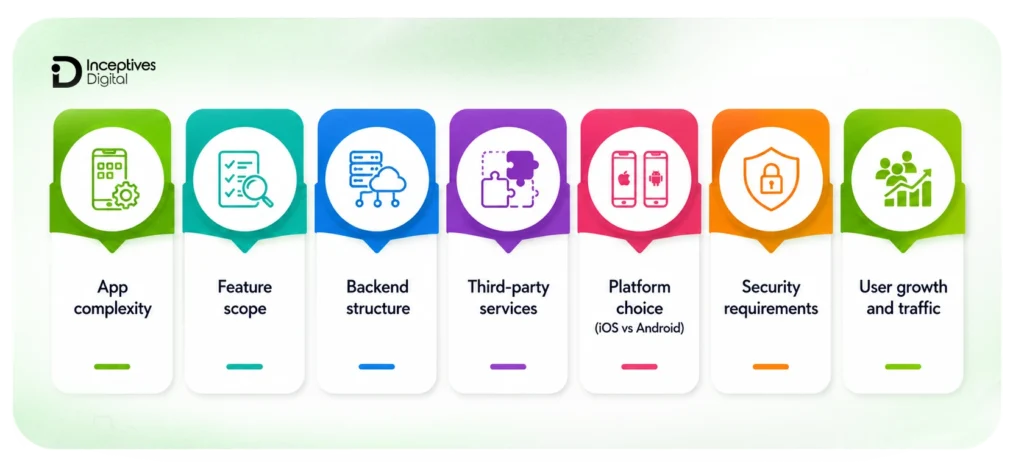
Mobile app maintenance cost depends on several practical factors that determine how much ongoing work is needed to keep an app stable, secure, and up to date after launch.
1. App complexity
The more complex the app, the higher the maintenance cost. Apps with advanced features like real-time updates, user dashboards, or dynamic content require more frequent fixes, testing, and updates.
2. Feature scope
Apps with more features naturally require more maintenance. Each additional feature increases the chances of bugs, compatibility issues, and update requirements.
3. Backend structure
Apps that rely on servers, databases, or cloud infrastructure need continuous monitoring and optimization. A heavier backend directly increases mobile app maintenance costs.
4. Third-party services
Integrations like payment gateways, maps, analytics tools, or authentication systems change over time. When these services update, the app must be adjusted, increasing ongoing maintenance effort.
5. Platform choice (iOS vs Android)
Maintaining apps across both platforms increases cost due to separate updates and testing requirements. Android fragmentation and frequent iOS updates both add to the maintenance workload. However, cross-platform app development is a much better option in terms of maintenance cost because it uses a single codebase for both iOS and Android.
6. Security requirements
Apps handling sensitive user data need regular security updates, vulnerability fixes, and compliance checks. Higher security standards lead to higher maintenance costs.
7. User growth and traffic
As user activity increases, apps require better performance optimization and scaling. More users typically mean higher infrastructure and maintenance expenses.
Mobile App Maintenance Cost: Android vs iOS
Mobile app maintenance costs differ between Android and iOS due to how each platform handles devices, updates, and release requirements.
Android maintenance cost
Android app development requires more testing and optimization because it must run across a wide range of devices and OS versions. This increases maintenance effort and cost over time.
iOS maintenance cost
iOS app development has fewer device variations, but Apple’s strict update cycles and compliance rules require fast and precise updates whenever new OS versions are released.
Key difference
Android increases cost through fragmentation, while iOS increases cost through strict release timelines.
Android vs iOS Maintenance Cost Comparison
| Factor | Android | iOS |
| Device variety | Very high (many manufacturers) | Low (limited Apple devices) |
| Testing effort | High | Moderate |
| Update frequency pressure | Moderate | High (yearly OS changes) |
| Maintenance cost impact | Higher due to fragmentation | Moderate but time-sensitive |
| Risk of compatibility issues | High | Low |
Detailed Breakdown: Where Your Mobile App Maintenance Costs Go
Mobile app maintenance cost is made up of several ongoing technical and operational expenses required to keep an app stable, secure, and up to date after launch. These costs vary depending on app complexity and usage scale.
1. Bug Fixes, QA, and Performance Optimization
A major part of mobile app maintenance costs goes into fixing bugs, improving stability, and optimizing performance. This includes crash monitoring, debugging, and ensuring the app runs smoothly across devices. Tools for error tracking and performance monitoring also add to recurring expenses.
2. OS Updates and Device Compatibility
Apps need regular updates to stay compatible with new iOS and Android versions. Each major OS release often requires testing, UI adjustments, and backend updates, which increases maintenance workload and cost.
3. Cloud Infrastructure and Hosting
Backend systems such as servers, databases, and storage generate ongoing costs. As user traffic increases, infrastructure needs to scale, which directly increases mobile app maintenance costs. This also includes load balancing, uptime monitoring, and data management.
4. Third-Party Tools and APIs
Apps often depend on external services like payment gateways, maps, analytics, and push notifications. These services frequently update their APIs, requiring ongoing adjustments and maintenance work. Each integration adds to the long-term maintenance cost.
5. Security and Compliance Updates
Security updates are a continuous part of maintenance. Apps must be protected against vulnerabilities, data leaks, and outdated dependencies. For apps handling sensitive data, compliance requirements further increase mobile app maintenance costs.
Hidden Mobile App Maintenance Costs Most Businesses Miss
Mobile app maintenance cost is not limited to bug fixes or updates. Several hidden expenses appear after launch that many businesses fail to account for during planning.
1. Technical Debt and Code Refactoring
Quick development decisions often lead to poorly structured code that becomes expensive to maintain later. Fixing or rewriting this legacy code increases long-term mobile app maintenance costs significantly.
2. Emergency Fixes and Security Incidents
Unexpected crashes, security breaches, or system failures require immediate developer attention. These urgent fixes often cost more due to higher priority work and unplanned resource allocation.
3. Developer Onboarding and Knowledge Transfer
When development teams change, hiring app developers again needs time to understand the existing codebase. This onboarding period adds hidden labor cost before any real maintenance work even begins.
4. Third-Party API Changes
External services like payment systems, maps, or authentication tools often change their APIs. These changes force sudden updates in your app, increasing maintenance effort and cost.
5. Compliance and Legal Updates
Regulations like data privacy laws or industry-specific compliance standards change over time. Updating the app to stay compliant adds ongoing, often overlooked maintenance expenses.
How to Reduce Mobile App Maintenance Costs Without Compromising Quality?
Mobile app maintenance costs can be controlled if the right decisions are made during development and post-launch operations. The goal is not to cut corners, but to reduce unnecessary maintenance workload that ultimately reduces the overall app development cost.
1. Use Cross-Platform Development Where Possible
Using frameworks like Flutter or React Native reduces duplicate work across iOS and Android. A single codebase means fewer updates and lower mobile app maintenance costs over time.
2. Automate Testing and Deployment
Automated mobile app testing reduces manual QA effort after every update. CI/CD pipelines help catch issues early, which lowers the cost of fixing bugs after release.
3. Keep Architecture Simple and Scalable
An overly complex system design increases long-term maintenance effort. A clean, modular structure makes updates easier and reduces ongoing maintenance workload.
4. Limit Unnecessary Third-Party Integrations
Every external API adds dependency risk. Fewer integrations mean fewer breakpoints, which directly reduces future maintenance costs.
5. Use Managed Cloud Services
Cloud providers handle scaling, backups, and infrastructure updates. This reduces the need for manual server management and lowers operational maintenance expenses.
6. Work With a Stable Maintenance Partner
Frequent vendor changes increase onboarding time and slow down updates. A consistent team reduces ramp-up time and improves long-term efficiency.
In-House vs Outsourced Mobile App Maintenance Cost
The choice between in-house and outsourced maintenance directly affects long-term mobile app maintenance cost, flexibility, and operational efficiency.
In-House Maintenance Team
An in-house team gives full control over development and updates, but comes with higher fixed monthly costs due to salaries, infrastructure, and ongoing training.
Outsourced Maintenance Team
Outsourcing reduces fixed overhead and converts maintenance into a flexible cost model based on actual work required.
In-House vs Outsourced Maintenance Cost Comparison
| Factor | In-House Team | Outsourced Team |
| Cost structure | Fixed monthly cost | Pay-per-work / flexible |
| Control over process | High | Medium |
| Scalability | Limited by hiring | Easy to scale |
| Expertise access | Limited to the team | Wide (specialized skills available) |
| Onboarding time | Low (internal team) | Medium (initial ramp-up) |
| Long-term cost impact | Higher fixed cost | Often lower overall cost |
Key takeaway
In-house teams offer stability and control, but increase fixed mobile app maintenance costs. Outsourcing provides flexibility and often reduces total long-term spending.
When Does Mobile App Maintenance Become New Development?
Mobile app maintenance cost does not stay linear forever. As apps grow, there is a point where maintaining the existing system becomes more expensive than rebuilding it.
This usually happens when the underlying structure is no longer efficient, stable, or scalable.
1. Outdated Technology Stack
When the app is built on outdated mobile app tech stacks, frameworks or unsupported technologies, maintenance becomes difficult and expensive. At this stage, fixing issues costs more than rebuilding the system.
2. Excessive Technical Debt
If too many quick fixes have been applied over time, the code becomes complex and unstable. Every new update increases mobile app maintenance cost and slows development significantly.
3. Scaling Limitations
When the app cannot handle increased users or features without major rewrites, maintenance turns into constant restructuring. This shifts costs closer to full redevelopment.
4. Frequent System Failures
If bugs, crashes, or performance issues become regular, maintenance stops being preventive and becomes reactive. This leads to higher long-term cost and unstable performance.
5. Major Product Expansion
When a business adds completely new functionality that does not fit the current architecture, rebuilding is often more efficient than patching existing systems.
Final Thoughts: Budgeting Mobile App Maintenance for Long-Term Success
Mobile app maintenance is not a one-time task but an ongoing cost that directly impacts performance, security, and scalability. Planning and allocating 15–25% of your mobile app development cost annually helps prevent technical debt, control long-term expenses, and keep your app compatible with evolving iOS and Android updates. A well-maintained app lasts longer, performs better, and delivers consistent value to users.
If you’re building a new app or reassessing your mobile app maintenance costs, partnering with an experienced mobile app development services provider can help you plan smarter and avoid unnecessary spending. A strategic maintenance approach ensures stable performance, predictable budgeting, and long-term growth. Contact us to get expert guidance now to create a maintenance plan that fits your product and business goals.
CTA SECTION START
cta title: Plan Your Mobile App Maintenance Cost With Clarity From Day One
cta des: Get a clear breakdown of your maintenance costs based on app type, features, and growth stage before you start spending more than expected.
cta button: Get Your Maintenance Cost Estimate
CTA SECTION END
FAQs Regarding Mobile App Maintenance Cost
Mobile app maintenance costs in the USA typically range from 15% to 25% of the initial development cost, annually. Due to high U.S. labor rates (up to $250/hour), a custom software development project costing $200,000 to build may require an annual budget of $30,000 to $50,000 for ongoing support and compliance.
No, it is not. The initial development cost covers the capital expense (CapEx) to build the app. Mobile app maintenance is a separate, recurring operational expense (OpEx). After the brief warranty period, a separate annual retainer agreement or SLA (Service Level Agreement) is required for long-term adaptive and corrective work.
Android app development often costs slightly more to maintain. While iOS app development requires intense effort for major OS updates, the overall cost for Android is driven up by mandatory fragmentation testing across numerous devices and OEM skins, requiring more continuous QA labor time.
Yes, and it is standard practice. Choosing the right mobile app development company for maintenance converts high fixed internal labor costs into a predictable OpEx. This also grants access to specialized talent (e.g., cloud engineers, blockchain app development experts) and ensures faster response times for critical issues.
App maintenance cannot be considered as a part of the mobile app development timeline. Because it lasts for the entire operational life of the product. As long as your app is live and used by customers, maintenance is mandatory. Continuous adaptation to new OS versions, security patching, and third-party API changes ensures the app remains stable and compliant.
SIDEBAR LIST START
- How Much Does Mobile App Maintenance Cost?
- Quick Answer: How Much Does Mobile App Maintenance Cost?
- Why Mobile App Maintenance is Important?
- What Is Mobile App Maintenance? A Technical and Business Definition
- How to Calculate Mobile App Maintenance Costs? (The 15-25% Rule)
- Mobile App Maintenance Cost Breakdown by App Type
- Monthly vs Annual Mobile App Maintenance Cost
- How App Features Impact Mobile App Maintenance Cost?
- What Affects Mobile App Maintenance Cost?
- Mobile App Maintenance Cost: Android vs iOS
- Detailed Breakdown: Where Your Mobile App Maintenance Costs Go
- Hidden Mobile App Maintenance Costs Most Businesses Miss
- How to Reduce Mobile App Maintenance Costs Without Compromising Quality?
- In-House vs Outsourced Mobile App Maintenance Cost
- When Does Mobile App Maintenance Become New Development?
- Final Thoughts: Budgeting Mobile App Maintenance for Long-Term Success
- FAQs Regarding Mobile App Maintenance Cost
SIDEBAR LIST END