A few years ago, doctors mostly worked with snapshots. A blood pressure reading during a visit. A lab report from last week. A patient is trying to remember symptoms from memory. Not ideal, honestly.
Now? A wearable patch can stream heart data every few seconds. Smart glucose monitors can warn patients before sugar levels become dangerous. ICU equipment talks to hospital systems in real time instead of sitting there like isolated machines.
That’s the shift IoT in healthcare is creating.
The Internet of Medical Things (IoMT) connects medical devices, healthcare applications, sensors, and hospital infrastructure into one connected ecosystem. Data moves constantly between patients, physicians, and healthcare systems, which changes how monitoring, diagnosis, and treatment happen day to day.
The momentum behind it is hard to ignore. According to Fortune Business Insights, the global IoT healthcare market is expected to hit USD 946.06 billion by 2034. Remote patient monitoring, telemedicine, connected medical devices, predictive analytics… all of it is pushing healthcare away from reactive treatment and toward continuous care.
You can see the industry adapting already. Almost every healthcare app development company working in digital health is now building around connected care systems instead of standalone healthcare platforms.
In this guide, we’ll break down how IoT in healthcare works, the types of connected medical devices being used today, real-world applications, major benefits, implementation challenges, and the trends shaping the future of IoT in healthcare.
What is IoT in Healthcare?
IoT in healthcare is basically a network of medical devices, sensors, and software systems that stay connected and share patient data in real time. Instead of relying on one-time readings during hospital visits, these systems keep collecting health data continuously and send it to doctors or healthcare platforms for monitoring and action.
It can be something as small as a smartwatch tracking heartbeat or as advanced as hospital equipment feeding live ICU data into a central system. The point is simple: health data doesn’t stay stuck in one place anymore.
IoT vs IoMT (Internet of Medical Things)
IoT is the broader idea of connected devices across industries. That includes smart homes, logistics systems, and even connected cars.
IoMT is more specific. It sits inside healthcare.
- IoT = general connected devices
- IoMT = medical and healthcare-focused connected devices
IoMT includes anything designed for clinical or health use:
wearables, remote monitoring devices, hospital machines, and even implantable tech.
So when we talk about healthcare applications, IoMT is usually the more accurate term, even if people casually say IoT.
Role of Connected Devices in Healthcare Ecosystems
Connected devices are what actually make this system work.
They collect real-time patient data and move it through apps, hospital systems, or cloud platforms. That data can be used to track conditions, trigger alerts, or support diagnosis.
A few examples:
- A heart monitor sending irregular rhythm alerts
- A glucose sensor updating readings every few minutes
- A hospital system tracks equipment location automatically
What used to sit in isolation is now part of a live ecosystem. That’s the real shift.
How IoT Works in Healthcare?
IoT in healthcare works as a connected system where devices, networks, and software constantly exchange patient data. Nothing sits in isolation. A reading captured by a device doesn’t stay there; it moves through a chain of systems that turn raw signals into usable medical insights.
At a simple level, the flow looks like this: a device collects data, sends it through a network, processes it in a cloud or platform, and finally delivers it to doctors or healthcare systems for action.
That constant loop is what keeps modern digital healthcare running.
Flow of Healthcare Data From Devices to Providers
The movement of data usually follows a clear path:
- A medical device captures patient data (like heart rate or glucose levels)
- The data is transmitted through wireless networks
- It reaches a cloud or healthcare platform
- Analytics tools process and interpret it
- Doctors or healthcare staff receive alerts or dashboards
What matters here is speed. Instead of waiting hours or days, decisions can be made almost instantly.
Key Components of IoT Healthcare Systems
1. Sensors and Medical Devices
These are the starting points of the entire system. They collect raw health data from patients.
Common examples include:
- Wearables like smartwatches and fitness bands
- Implantable devices such as pacemakers or insulin pumps
- Diagnostic equipment used in hospitals and labs
Each of these plays a different role, but all of them feed continuous data into the system.
2. Connectivity Technologies
Once data is collected, it needs to move somewhere.
That’s where connectivity comes in:
- Wi-Fi for hospital and home environments
- Bluetooth Low Energy (BLE) for short-range device communication
- 5G for fast, low-latency transmission
- LPWAN for long-range, low-power communication
The choice of network depends on how critical and frequent the data updates are.
3. Cloud Computing and Data Storage
After transmission, data is stored and processed in secure cloud systems.
This layer handles:
- Real-time data processing
- Long-term patient data storage
- Secure access for doctors and healthcare providers
It also ensures data can be accessed from different devices without delays.
4. AI and Data Analytics
Raw data alone is not useful. It needs interpretation.
AI systems analyze incoming health data to:
- Detect unusual patterns
- Predict potential health risks
- Trigger alerts for doctors or caregivers
This is where IoT starts moving from monitoring to prediction.
5. Integration With EHR and Hospital Systems
For IoT to actually work in real healthcare environments, it must connect with existing systems like Electronic Health Records (EHR).
This is done through interoperability standards such as:
- FHIR (Fast Healthcare Interoperability Resources)
- HL7 communication standards
These allow different healthcare systems to “talk” to each other without breaking data flow or structure.
Types of IoT Devices Used in Healthcare
Healthcare IoT isn’t one type of device. It’s a mix of different tools working at different levels of patient care, from daily tracking to critical hospital operations.
1. Wearable Healthcare Devices
These are the most familiar ones. Devices people use daily without even thinking of them as medical tools. They track basic but important health signals continuously.
Examples
- Smartwatches
- Fitness trackers
- ECG monitors
These devices help detect early changes in heart rate, activity levels, and sleep patterns. In many cases, they’re the first layer of continuous health monitoring outside hospitals.
2. Remote Patient Monitoring Devices
These devices are more clinically focused and often prescribed by doctors for home use.
They’re designed for ongoing monitoring of specific conditions.
Examples
- Blood pressure monitors
- Pulse oximeters
- Glucose monitoring systems
They are widely used for chronic conditions like hypertension, diabetes, and respiratory issues, where frequent tracking matters more than occasional checkups.
3. Implantable Medical Devices
These are placed inside the body and continuously monitor or regulate internal functions. They are more advanced and usually used in critical care cases.
Examples
- Pacemakers
- Smart insulin pumps
- Neurostimulators
Because they operate inside the body, they often send real-time data to external monitoring systems for clinical review.
4. Ingestible Sensors
This category is smaller but growing fast in clinical research and diagnostics. These devices are swallowed and transmit data as they move through the body.
Examples
- Smart pills
- Internal monitoring sensors
They are used to track internal conditions that are otherwise difficult to measure non-invasively.
5. Smart Hospital Equipment
These are devices used inside healthcare facilities to improve efficiency and patient care. They don’t just collect data; they also help hospitals manage operations.
Examples
- Connected ventilators
- Smart beds
- RFID-enabled medical assets
They help track equipment location, monitor patient status in wards, and reduce delays in critical care environments.
Applications of IoT in Healthcare
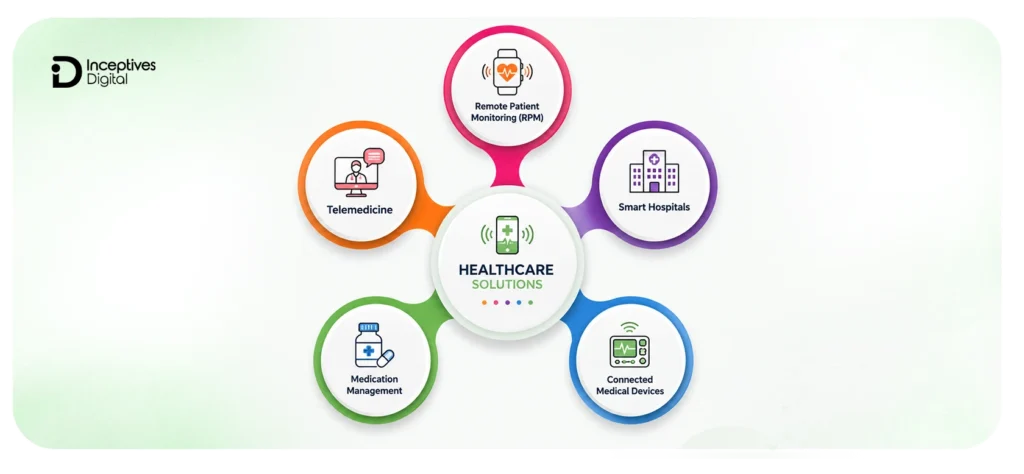
IoT has changed how day-to-day healthcare actually runs. Instead of isolated systems and manual updates, hospitals and clinics now rely on connected workflows where data moves automatically between devices, software, and medical staff.
Key Areas of Transformation
- Connected healthcare workflows are replacing manual coordination
- Automation is reducing administrative load in hospitals
- Faster decision-making using real-time patient data
It’s less about individual tools and more about how everything starts working together.
1. Remote Patient Monitoring (RPM)
Remote Patient Monitoring (RPM) refers to using connected devices to track a patient’s health outside traditional clinical settings. Data is collected continuously and shared with healthcare providers in real time.
How RPM Works?
- Patients use wearable or home-based medical devices
- Devices collect continuous health data
- Data is transmitted to healthcare platforms
- Doctors monitor and respond when needed
Benefits of RPM
- Early detection of health issues before they become severe
- Reduced hospital readmissions
- Better management of chronic conditions
Real-World Use Cases
- Cardiac monitoring for heart patients
- Blood sugar tracking for diabetes management
- Continuous monitoring for elderly care
2. Smart Hospitals
A smart hospital uses IoT systems to connect patients, staff, and medical infrastructure into a single digital ecosystem for improved efficiency and care quality.
IoT Applications in Smart Hospitals
1. Asset Tracking and RTLS
- RFID-based tracking of equipment
- Better utilization of medical assets
- Reduced time spent searching for critical tools
2. Smart Patient Monitoring
- ICU monitoring systems with real-time alerts
- Smart hospital rooms track patient vitals
3. Environmental Monitoring
- Temperature and air quality control
- Hygiene and infection control systems
4. Workflow Automation
- Staff coordination systems
- Automated alerts for emergencies or changes in patient status
3. Connected Medical Devices
These devices allow continuous communication between patients, hospital systems, and healthcare providers.
Examples of Connected Medical Devices
- Smart imaging systems
- Connected infusion pumps
- Surgical robotics
Benefits
- Faster diagnosis
- More accurate treatment decisions
- Improved patient safety and outcomes
4. Medication Management
IoT helps track medication usage automatically and reduces dependency on manual tracking.
Medication Adherence Solutions
- Smart pill dispensers
- Automated reminders for patients and caregivers
Reducing Medication Errors
- Automated dosage tracking
- Digital prescription management systems
5. Telemedicine
IoT strengthens telemedicine by adding real-time patient data into virtual consultations.
Remote Consultations With Live Data
- Wearables feed live vitals during virtual visits
- Continuous monitoring during treatment
Expanding Healthcare Access
- Remote care for rural areas
- Support for chronic disease patients
Benefits of IoT-Enabled Telemedicine
- Less need for physical visits
- Faster consultations
- Better continuity of care
Benefits of IoT in Healthcare
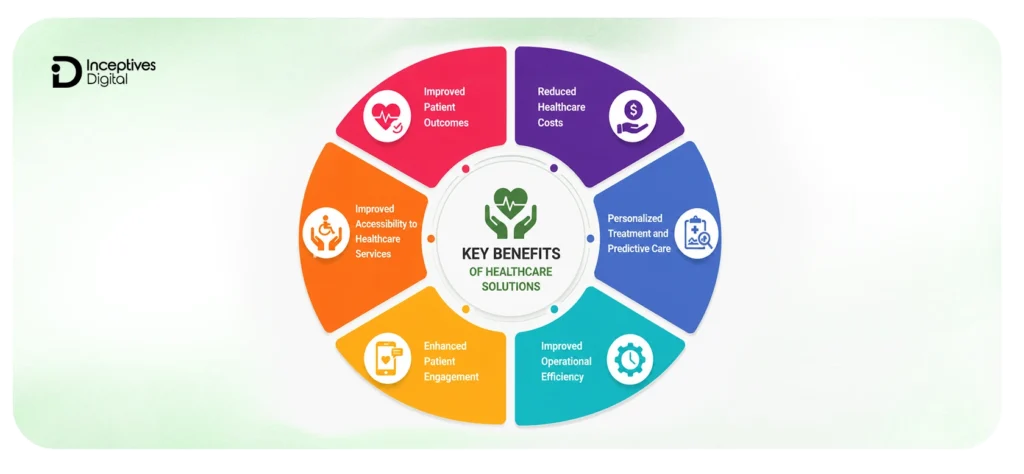
IoT is changing how healthcare systems operate at both the patient and hospital levels. The following are some of the key benefits that stand out in real-world use.
1. Improved Patient Outcomes
One of the biggest shifts IoT brings is how early health issues can be caught.
Instead of waiting for symptoms to worsen, connected devices keep tracking patient vitals continuously.
- Continuous monitoring helps detect changes early
- Preventive care becomes more realistic, not just theoretical
This is especially important for chronic conditions where small changes often signal bigger risks.
2. Personalized Treatment and Predictive Care
Healthcare is slowly moving away from “one-size-fits-all” treatment.
IoT systems generate continuous patient data, which can be analyzed to understand patterns that were previously invisible.
- AI-powered insights help identify risk trends
- Treatment plans can be adjusted based on real-time data
It’s not just reactive care anymore. It starts becoming predictive in nature.
3. Reduced Healthcare Costs
Hospitals spend heavily on avoidable admissions and emergency treatments.
IoT helps reduce that pressure by catching problems earlier and shifting care outside hospitals when possible.
- Fewer emergency visits
- Lower hospitalization rates
- Reduced long-term treatment costs
The financial impact shows up most clearly in chronic disease management.
4. Improved Operational Efficiency
Hospitals are complex systems, and a lot of inefficiency comes from manual processes.
IoT reduces that friction by automating routine tracking and updates.
- Administrative tasks become more automated
- Equipment and resource management improve
- Staff can focus more on patient care
Even simple things like locating equipment or updating patient status become faster.
5. Enhanced Patient Engagement
Patients are no longer passive recipients of care.
With connected devices, they can actually see and track their own health data.
- Self-monitoring through apps and wearables
- Better awareness of health patterns and habits
This often leads to better compliance and more informed lifestyle choices.
6. Improved Accessibility to Healthcare Services
Not everyone can regularly visit hospitals, especially in remote or underserved regions.
IoT helps bridge that gap by enabling care delivery outside traditional clinical settings.
- Remote monitoring for patients at home
- Better access to healthcare in rural areas
- Continuous support without physical visits
This is where IoT starts feeling less like technology and more like access itself.
Challenges of IoT in Healthcare
IoT brings a lot of progress to healthcare, but it also introduces problems that hospitals and providers can’t ignore. The following are the key challenges slowing down full-scale adoption.
1. Data Security and Patient Privacy Risks
Healthcare data is extremely sensitive, which makes it a major target for cyberattacks.
- Healthcare systems face increasing cyber threats and ransomware attacks
- Patient data needs strong protection across devices, networks, and cloud platforms
Even a small security gap in a connected device can expose critical medical information.
2. Regulatory Compliance Challenges
Healthcare is one of the most regulated industries, and IoT systems must comply with strict rules.
- HIPAA compliance in the US for patient data protection
- FDA regulations for approval of medical devices
- GDPR requirements for data privacy in Europe
Meeting these standards adds time and complexity to IoT implementation.
3. Interoperability Issues
Hospitals often run on a mix of old and new systems, which don’t always communicate well with each other.
- Difficulty integrating with legacy hospital systems
- Data silos that prevent a unified patient view
Without proper integration standards, IoT data loses much of its value.
4. High Implementation Costs
Setting up IoT infrastructure in healthcare is not cheap.
- Investment required for devices, sensors, and networks
- Ongoing maintenance and system upgrades
For smaller hospitals or clinics, cost becomes a major barrier.
5. Device Reliability and Connectivity Concerns
IoT systems depend heavily on stable connectivity and accurate device performance.
- Network failures can disrupt real-time monitoring
- Device malfunctions can lead to inaccurate readings
In healthcare, even small failures can have serious consequences.
6. Healthcare Staff Adoption Challenges
Technology alone doesn’t guarantee adoption.
- Staff need proper training to use IoT systems effectively
- Some resistance to digital transformation still exists in clinical environments
Without user acceptance, even advanced systems can remain underutilized.
Future Trends in IoT Healthcare
IoT in healthcare is still evolving. What we see today is only the early layer of a much larger shift toward connected, intelligent healthcare systems. The following are some of the key directions shaping its future.
1. AI-Powered Predictive Healthcare
Healthcare is moving from reacting to predicting. Instead of treating conditions after they appear, systems are starting to flag risks earlier using continuous data.
- Early disease detection through pattern recognition
- Automated diagnostics supported by real-time patient data
The focus is shifting toward identifying problems before they escalate.
2. 5G and Edge Computing in Healthcare
Connectivity is becoming just as important as the devices themselves.
- Ultra-low latency networks support faster medical response
- Edge computing processes critical data closer to the device
This is especially important in scenarios like ICU monitoring or emergency care where delays can’t be tolerated.
3. Expansion of Smart Hospitals
Hospitals are gradually turning into fully connected environments where systems communicate with each other without manual input.
- Integrated patient monitoring systems
- Connected medical equipment and hospital infrastructure
- Real-time coordination between departments
The goal is smoother operations and fewer delays in care delivery.
4. Growth of Digital Therapeutics (DTx)
Software is starting to play a role in treatment itself, not just support.
- App-based treatment programs
- Data-driven behavioral therapies
- Personalized recovery tracking
These solutions often rely heavily on IoT-generated health data.
5. Advanced Wearable Healthcare Technology
Wearables are becoming more advanced and medically accurate, moving beyond fitness tracking.
- Next-generation biosensors for deeper health insights
- Continuous monitoring of multiple health parameters
These devices are expected to become a standard part of preventive healthcare.
6. IoT in Mental Healthcare
IoT is also expanding into mental and behavioral health monitoring.
- Wearables track stress and sleep patterns
- Behavioral data used to detect early signs of mental health issues
This adds a new layer to how healthcare understands overall well-being.
7. Market Growth and Industry Forecast
The adoption of IoT in healthcare continues to grow rapidly as more hospitals and healthcare providers invest in digital infrastructure.
- Strong global market growth projections
- Increasing investment in connected healthcare systems
- Expanding use across hospitals, clinics, and home care setups
The trend clearly shows a shift toward long-term digital transformation in healthcare delivery.
Conclusion
IoT in healthcare is steadily shifting medical care from isolated checkups to continuous, connected monitoring. From remote patient tracking and smart hospital systems to AI-assisted diagnostics, it’s changing how doctors interact with data and how patients experience care. The real impact shows up in faster decisions, earlier detection of health issues, and a more coordinated healthcare system overall.
As healthcare continues to evolve, adopting connected solutions is becoming less of an option and more of a practical step forward for hospitals and digital health providers. Working with an experienced IoT app development company can help healthcare teams design systems that are secure, scalable, and aligned with real clinical needs, without adding unnecessary complexity to existing workflows.
CTA SECTION START
cta title: Let’s Build Smarter Healthcare Systems Together
cta des: Turn connected healthcare ideas into real-world solutions with secure, scalable IoT systems designed for modern medical needs.
cta button: Talk to an IoT Expert
CTA SECTION END
FAQs About IoT in Healthcare
1. What are the top healthcare app trends to watch?
Key healthcare app trends include IoT-based remote patient monitoring, AI-driven diagnostics, wearable health tracking, predictive healthcare, and smart hospital systems. Most of these trends are directly powered by connected healthcare technologies.
2. What are some of the best healthcare app startup ideas?
Strong healthcare startup ideas include IoT-enabled remote patient monitoring platforms, chronic disease tracking apps, smart elder care solutions, telehealth systems with wearable integration, and AI-assisted health monitoring apps.
3. How is IoT used in healthcare applications?
IoT is used in healthcare apps to collect real-time data from medical devices like wearables, glucose monitors, and heart trackers. This data helps doctors monitor patients remotely, detect risks early, and improve treatment decisions.
4. What are the must-have features in a healthcare app?
Modern healthcare app features often include IoT device integration, real-time patient monitoring, wearable connectivity, telemedicine support, AI-based alerts, and secure health data management systems.
5. What is telemedicine app development, and how does IoT support it?
Telemedicine app development allows doctors to consult patients remotely. IoT strengthens these platforms by providing live health data from connected devices, making virtual consultations more accurate and data-driven.
6. How much does healthcare app development cost?
The healthcare app development cost depends on complexity, features, and integrations. IoT-based healthcare apps generally cost more due to hardware connectivity, real-time data processing, and strict security and compliance requirements.
SIDEBAR LIST START
- IoT in Healthcare: Applications, Benefits, Challenges, and Future Trends
- What is IoT in Healthcare?
- How IoT Works in Healthcare?
- Types of IoT Devices Used in Healthcare
- Applications of IoT in Healthcare
- Benefits of IoT in Healthcare
- Challenges of IoT in Healthcare
- Future Trends in IoT Healthcare
- Conclusion
- FAQs About IoT in Healthcare
SIDEBAR LIST END