The cost of developing an AR app depends on factors such as app complexity, the nature of the AR experience, and the target platform. In the sections below, we outline the key cost ranges for various AR app types, providing a clear understanding of the development investment for each app.
Basic App: $5,000 – $50,000
Mid-Level App: $50,000 – $150,000
Complex App: $200,000 – $400,000+
AR app development is a growing field with applications in gaming, entertainment, and education, among other fields. According to Statista, the AR app market is projected to reach $198 billion by 2026. This shows tremendous interest and investment in AR solutions.
AR can combine the physical and virtual worlds, offering users a revolutionary experience through 3D graphics, haptic feedback, audio, and even scent, among other sensations. The combination of the physical and virtual worlds provides users with the power to interact with the physical world in unimaginable ways.
For businesses planning to use AR technology, hiring an AR app development company is a great strategic move. However, one of the major challenges faced by AR app development companies is determining the cost of development. Due to the complex nature of AR apps, integrating advanced technologies like 3D modeling, gesture recognition, and machine learning, understanding Augmented Reality (AR) app development pricing can be a complex process. Moreover, businesses can experience difficulties in understanding the scalability and platform requirements for their AR app (iOS, Android, and AR glasses).
AR app development companies play an important role in helping businesses overcome the challenges of building an AR app. The cost of AR app development varies depending on several factors. The factors include the app’s functionality, technologies, platforms, and complexity.
How Much Does AR App Development Cost in 2026?
For augmented reality app development, businesses may be required to spend between $10,000 and $50,000 in 2026, depending on the augmented reality app’s features.
For simple augmented reality apps like marker-based AR apps, also known as a minimum viable product (MVP), businesses are expected to spend anywhere between $5,000 and $50,000. These apps allow consumers to experience augmented reality simply by interacting with digital content using markers.
As the features of the Augmented Reality App become more complex, businesses may have to pay more to develop it. For intermediate Augmented Reality apps, such as those using cloud storage for data management, AI, and improved user interaction, businesses may have to pay between $50,000 and $200,000.
This type of augmented reality app includes more features and is more complex to develop. This is why it is more expensive. Businesses in the retail sector and education use these augmented reality apps to provide better services to their customers/users.
On the other end of the scale, AR app solutions such as multi-user experiences, real-time 3D modeling, and integration with AI can cost more than $250,000. These AR app solutions are primarily used in business sectors such as healthcare, manufacturing, and architecture, where the AR app is required to handle large volumes of data and integrate other business applications.
Key Factors That Affect AR App Development Cost
When finalising the cost of AR app development, a few key factors are important. The factors mentioned below not only affect the app’s cost but also determine its success, as measured by performance and user engagement. A well-developed AR app that incorporates these factors can provide an excellent user experience, scalability, and sustainability.
App Complexity (Basic vs Advanced AR)
App complexity in AR apps, even if it is basic or advanced, depends on the features and functionality used to develop them. Basic applications of AR focus more on operations, such as placing static 2D images, text, or objects on top of a live video feed from a camera.
However, more advanced applications of AR incorporate more complex operations, including real-time object recognition, environment mapping, multi-user interaction, and 3D modeling.
2D vs 3D AR Experiences
The experience that changes both 2D and 3D AR involves the role of images or text, which makes a major difference in the cost. 2D AR experiences usually consist of static elements, such as images or text, that are overlaid onto the real world. Such experiences require fewer resources and can be implemented at a lower cost.
In contrast, 3D AR experiences provide dynamic 3D models and environments that need to interact in real time with the user. Such experiences require high-end rendering, graphics, and resources. Hence, they can be implemented at a higher cost.
ARKit vs ARCore vs Cross-Platform AR
ARKit is considered the best option for developing AR-based applications for iOS devices. ARKit provides features for developing, such as motion tracking, environment mapping, and rendering. On the other hand, ARCore is considered the best option for developing AR-based applications for Android devices.
ARCore provides features for developing, such as motion tracking, environment mapping, and light estimation. ARKit and ARCore are considered powerful platforms for developing AR apps, and they require separate codebases, increasing the ARKit vs ARCore development cost.
Real-Time Rendering and 3D Modeling
Real-time rendering is an important aspect of AR apps that provide interactive experiences for users, such as gaming and virtual try-on. It involves the rendering of 3D models and environments in real time. The process requires a lot of computational resources and the use of optimally efficient graphics.
3D modeling, which involves the development of detailed models, textures, and animations, also adds to the cost of development. The development of complex 3D models requires the use of specialized software and skilled professionals, making the overall process more costly.
Backend Infrastructure and Cloud Integration
Backend infrastructure plays a significant role in managing content storage, data, and all the processing work of AR apps. Since AR applications may handle vast amounts of content, cloud integration is key to facilitating real-time synchronisation and updates. The cloud enables AR applications to store content, facilitate multi-user experiences, and achieve high scalability.
However, the integration with the cloud introduces another layer of complexity to the development process, which may pose challenges for managing servers, security, and APIs. This, in turn, increases the development time and cost, as optimal functionality must be achieved.
AI and Computer Vision Integration
AI integration in AR apps improves interactivity by enabling intelligent decision-making through advanced object and gesture recognition. It also allows the application to adjust to the real world. Even though AI upgrades functionality and usability, it also increases the application’s complexity and development costs due to the need for special algorithms and expertise.
With AI integration, computer vision integration is also important. While AI plays a critical role in intelligent decision-making, computer vision provides the tools to understand the physical environment. With the integration of these technologies, AR apps can now interact more easily with the real world. However, integrating these technologies into AR apps poses numerous challenges and costs, especially due to the complex algorithms and development skills required.
Device Compatibility and Performance Optimization
AR app device compatibility enables effortless use across multiple devices, including AR glasses and smartphones. Each device varies in its display resolution and processing capabilities, and these need to be optimized for a unified user experience for end-users. Thus, AR app development becomes more complicated and expensive.
Moreover, device performance optimization requires the adjustment of the AR app’s sensor data, graphics, and rendering to give the best operation services on all devices. This includes optimizing visual aspects, processing capabilities, and real-time interaction for low-end and high-end devices.
AR App Development Cost Breakdown by App Type
The cost of developing an AR application can vary from $5,000 to over $400,000. Below is the detailed breakdown of AR app development costs by app type:
| Category | App Cost | Complexity | Key Features |
| Simple AR App | $5,000 – $50,000 | Low | Basic object tracking, simple animations, and limited interactivity. |
| Medium AR App | $50,000 – $150,000 | Medium | Advanced object tracking, complex animations, interactive elements, and custom logic. |
| Complex AR App | $200,000 – $400,000+ | High | High-fidelity graphics, real-time data integration, AI-powered features, and custom devices. |
The more advanced features and integrations your AR app requires, the higher the development cost will be.
AR E-commerce Apps
AR e-commerce app development lets users see how a product will look in their environment. However, the development cost of an augmented reality app is determined by factors that include 3D modeling, real-time object tracking, and payment gateway integration.
Moreover, the use of refined visual rendering techniques is necessary to provide the best graphics experience to the users. In addition, developing this app requires backend integration to deliver a solid user experience.
AR Gaming Apps
AR/VR gaming apps are changing the face of gaming, and we’re making that reality. By using the best game engines, such as Unity and Unreal Engine, and ARKit and ARCore, we develop engaging, interactive experiences for users.
Our method for mobile game development ensures scalability, security, and performance across all devices. By focusing on these major areas, we develop engaging, dynamic games that take the AR/VR world by storm while ensuring a smooth, secure experience for users anywhere and everywhere.
AR Education and Training Apps
AR education and training applications use augmented reality to deliver interactive learning experiences. The cost of education app development varies based on factors such as interactive 3D models, simulations, and multi-user support. It is important to note that the applications must support real-time data updates, cloud storage of educational content, and provide a user-friendly interface.
Moreover, the inclusion of AI-based assessment and real-time feedback can increase development costs due to the use of smart technology. It requires significant investment in development and testing to function effectively and provide a full-scale learning experience for users.
AR Real Estate and Interior Visualization Apps
The use of AR real estate and interior visualization applications helps users to make better decisions in their process by allowing them to see real-time images of real estate and interior designs. However, the development cost of the applications is based on the requirement to incorporate real-time images with accurate 3D modeling, environment mapping, and virtual tours.
In order to develop an AR real estate app development and interior visualization application, developers have to incorporate accurate scale modeling, geospatial mapping, and textures in the application. Moreover, the applications require cloud integration to store large model files and enable interactivity, making the development process more complex and costly.
AR Healthcare Applications
AR healthcare apps are the best option for medical practices, training, and patient services with dynamic data visualization. Developing healthcare apps is more expensive due to the requirement for accurate 3D modeling, real-time tracking, and integration with medical information. Adding AI for diagnostic, predictive analysis, and customized treatments adds more complexity and cost.
Ensuring healthcare app compliance with healthcare regulations and security is an additional requirement. We incorporate AR and VR technologies into healthcare app development to support medical training, patient information, and remote consultations, improving learning, accessibility, and healthcare efficiency.
AR App Development Cost by Platform (iOS, Android, Cross-Platform)
In 2026, the cost of developing an AR app can vary widely depending on the application’s complexity. For instance, developing a simple AR application can cost as little as $30,000. Conversely, developing a feature-rich AR application can cost as much as $300,000. Developing a native AR application for iOS using ARKit or for Android using ARCore can cost between $50,000 and over $500,000.
The cost of developing a cross-platform AR application using engines like Unity or Flutter would range from $30,000 to $150,000, depending on the application’s complexity. Unity is best suited for 3D-based AR application development due to its advanced 3D rendering and object interaction features.
However, Flutter can be used to develop basic AR application functionality, but would require additional integration efforts for advanced features like 3D rendering or real-time object tracking.
AR App Development Cost by Region (USA vs Offshore Development)
The development cost of an AR app varies by geographical location. In the USA and other parts of North America, the hourly rate can range from $100 to $250+, while the development cost of a mid-complexity app can range from $60,000 to $120,000, and high-end apps can exceed $300,000.
In contrast, in Asia and other parts of India, the development cost is significantly lower, with hourly rates ranging between $15 and $50. In comparison, moderately complex app development can cost between $15,000 and $50,000.
Near-shore development in Eastern European countries, such as Ukraine and Poland, can offer a good balance between cost and high-level technical expertise, with hourly rates ranging from $30 to $70.
Hidden Costs in AR App Development
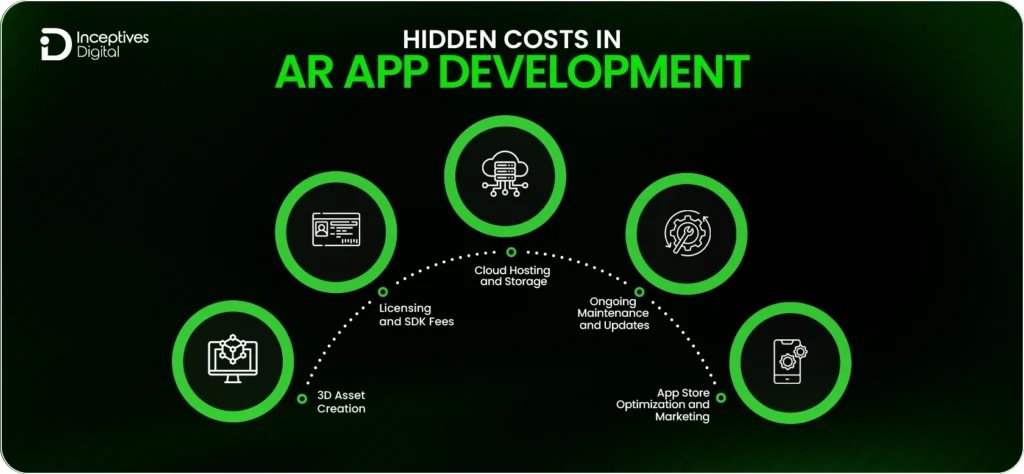
The hidden costs associated with developing AR apps can sometimes exceed the initial cost, with maintenance accounting for 15-20% of the original development cost each year. Developing 3D models, SDKs, and cloud hosting for AR applications can be costly.
Another cost that many business organizations fail to consider is the cost associated with intensive testing on various devices, especially because many devices are already in use. The cost of updates to ensure compatibility with various operating systems after the app’s launch can be high.
3D Asset Creation
The creation of good quality 3D assets is an important part of AR app development, but it can also prove to be a costly affair. Creating good quality 3D models, textures, animations, and environments requires expertise and a skilled workforce. Creating more realistic 3D models can be costly, making 3D assets a major contributor to app development costs.
Licensing and SDK Fees
In developing an AR application, it is common to use third-party software development kits such as ARKit, ARCore, or Unity, which may incur license fees depending on the application’s features. These license fees should be taken into account when planning the application’s budget, as they provide a more accurate cost estimate.
Cloud Hosting and Storage
AR apps usually require cloud hosting and storage, especially for large data files such as 3D models and user-generated content. The cost of cloud hosting may vary depending on the app’s usage, data, and capacity needed on the servers for optimal performance. Cloud hosting is important because it enables real-time updates and support, thereby contributing to overall costs in the long term.
Ongoing Maintenance and Updates
Maintenance is one of the most important, though often overlooked, aspects of the cost of developing an AR app. To run smoothly on the latest operating systems, businesses must update their apps regularly. These recurring expenses can amount to 15-20% of the app’s original development cost, but they are integral to the overall cost.
App Store Optimization and Marketing
After the AR app is developed, significant investment is required in App Store Optimization (ASO) and marketing to attract users to the app. ASO costs include optimization of keywords, descriptions, and images of the app, which ultimately affects the ranking of the app on app stores such as the App Store and Google Play Store. Marketing costs, including advertising campaigns, also add to the total cost of making the app visible in the competitive market.
How Long Does It Take to Build an AR App?
The development time of an augmented reality application may also vary with its complexity. The development time for a simple marker-based application may range from 100 to 250 hours, and the application can be completed in 1 to 2 months.
However, the development time for a complex application, such as a markerless application, may range from 400 to 500 hours and take 3 to 6 months. The development time of an enterprise application may also be longer due to the complex integrations required.
Step-by-Step Process of AR App Development
There are 6 important steps in the development of an AR app, and they are: ideation, in which the app’s purpose and objectives are defined; storyboarding, in which the app’s flow and interactions are planned; 3D creation, in which realistic 3D models are created; SDK, in which ARKit and ARCore are integrated; testing, in which the app’s functionality is tested; and deployment, in which the app is released to the users.
Read below about the step-by-step process of AR app development:
Ideation
In this stage, you determine the purpose and objectives of your application. You would identify your audience, the problem your application solves, and how you are improving user experiences. Setting clear objectives at this stage establishes the entire process.
The cost of the ideation phase can range from $1,000 to $5,000, depending on the complexity of the goals that need to be achieved. This phase involves determining the app’s objectives, target users, and other key details.
Storyboarding
In this stage, designers and developers create a plan for how users will experience the application. Storyboarding illustrates how users would interact with the application, what features would be integrated into it, and how virtual content would be integrated with the physical world.
Storyboarding can cost from $2,000 to $8,000, depending on the complexity of the features that need to be included. In this phase, designers and developers create wireframes of the app to give an idea of how users can interact with it. This involves significant creative work.
3D Asset Creation
In this stage, designers and artists would develop 3D assets for integration into the AR application. 3D assets play a critical role in creating virtual content that would be integrated with the physical world. The 3D assets would be used to generate virtual content experienced by users in the application.
The cost of creating the 3D assets for the AR app is one of the most significant aspects of its development. The cost can range from $5,000 to $50,000 or more, depending on the quality of the assets that need to be developed.
SDK Integration (ARKit/ARCore)
At this stage, the necessary AR development kits (SDKs), such as ARKit for iOS or ARCore for Android, are integrated into the app. The AR software development kits provide the necessary tools for mapping, object detection, and real-time rendering of virtual objects. The integration of such tools is essential for ensuring proper app functionality on the target platform.
The cost of integrating AR development kits, such as ARKit or ARCore, ranges from $3,000 to $15,000, depending on the app’s features. This phase includes technical development in environment mapping, motion tracking, and rendering, depending on the operating systems, such as iOS and Android.
Testing
Testing is another significant step in AR app development, in which the app is tested for proper functionality, performance, and compatibility across devices running different operating systems. The app is tested for proper functionality, including lag, crashes, and object-detection accuracy.
The cost of the testing phase varies from $5,000 to $15,000, depending on the app’s complexity and the number of devices and operating systems on which the app is to be tested and deployed. The app has to be made compatible with different operating systems and devices, which increases the overall cost.
Deployment
Finally, after proper testing of the app, it is ready for deployment, which involves submitting the app for review and approval on app stores such as the Apple App Store for iOS apps or the Google Play Store for Android apps. Once approved, the app is officially launched for public use, while subsequent app support is essential for maintaining compatibility with new iOS versions and other devices.
The cost of deployment is relatively low, ranging from $1,000 to $5,000, depending on whether the app is published to app stores and made available for public use.
How to Reduce AR App Development Cost?
To reduce the cost of developing an AR app, proper planning and choosing the right technology can be effective. Given the complexities of 3D models, real-time tracking, and SDKs in app development, the cost of app development can rise significantly.
However, to keep app development costs in check, businesses can focus on building an MVP, use cross-platform development tools to support multiple platforms, and prioritise essential features over optional ones. Moreover, creating assets using available AR libraries and working with a skilled app development company can help reduce the cost of AR app development.
Choosing the Right AR App Development Company
Choosing the right AR development company requires one to know all about their technical skills, such as in 3D modeling, ARKit/ARCore, and computer vision, while reviewing their portfolio for similar projects. Select those companies that have solid track records, a refined approach to client relationships, strong communication, and a logical post-launch support process to ensure a high-quality experience.
Moreover, it is essential to assess their insights into your particular industry and their potential to personalize their services to meet your requirements. You should look for a development company that provides a consultative experience, helping them understand your vision and providing valuable information to increase the potential of your AR app’s functionality. Finally, it is critical to assess their scalability, since you may require updates or new features in the future.
Final Thoughts
The cost of AR app development varies depending on factors such as app complexity, features, and the technologies used, including ARKit, ARCore, and cross-platform technologies. Businesses need to determine whether they need a simple 2D app or a refined 3D app, and what additional components to include, such as AI, 3D, or cloud, when developing their AR app. Although the cost of developing an AR app varies widely, proper planning, goal-setting, and choosing the right mobile app development company can help businesses effectively manage these costs, which can be valuable in the long run.
CTA SECTION START
cta title: Want to Know the Exact Cost of Your AR App Idea?
cta des: Get a personalized cost estimate for your AR app development project. Reach out to us today for a free consultation.
cta button: Lets Discuss
CTA SECTION END
Augmented Reality App Development Cost FAQs
The factors that affect the cost of AR app development are complexity, platform, 3D modeling, AI, infrastructure, and so on.
The 2D AR apps use static overlays, which means that fewer resources are required for their development. However, in 3D AR apps, dynamic models are used, which makes their development expensive.
Businesses can reduce costs by developing an MVP, using cross-platform tools, focusing on must-have features, and leveraging pre-built AR libraries and development teams.
The time required to develop an AR app ranges from 1 to 2 months for a simple app and 3 to 6 months for a complex one.
The use of AI in AR app development adds interactivity through features such as object recognition and decision-making, but it also increases the complexity and expense of an app.
SIDEBAR LIST START
- How Much Does AR App Development Cost in 2026?
- Key Factors That Affect AR App Development Cost
- AR App Development Cost Breakdown by App Type
- AR App Development Cost by Platform (iOS, Android, Cross-Platform)
- AR App Development Cost by Region (USA vs Offshore Development)
- Hidden Costs in AR App Development
- How Long Does It Take to Build an AR App?
- AR App Development Process (Step-by-Step)
- How to Reduce AR App Development Cost
- Choosing the Right AR App Development Company
- Final Thoughts
- FAQs
SIDEBAR LIST END