What Is Mobile App Performance Optimization?
Mobile application optimization involves improving the application to upgrade its efficiency and performance. Optimizing performance in mobile apps involves minimizing load time and ensuring the application responds properly to user input.
It means ensuring that the app loads instantly, that users experience no lag while using it, and that nothing crashes while they use it. Mobile app performance optimization covers two sides of app operation: frontend and backend. The former refers to optimizing user interfaces and interactions, whereas the latter refers to optimizing API servers and databases.
Improving mobile app development performance is not just about immediate measures; it also involves using proven techniques such as image compression, lazy loading, proper memory management, and API optimization. In addition, organizations adopt a comprehensive strategy to upgrade mobile application performance through caching, monitoring, and scalable architecture, despite growing user demands.
Equally important, optimization guarantees uniform performance regardless of the device used or the environment in which it operates. This means that the performance must be optimal whether the device is a high-performance smartphone or a low-speed connection.
According to Statista, the global mobile app market will exceed $330 billion in 2026, mainly driven by increased smartphone use and digitalization. It means users will expect efficient, smooth app performance on their devices, driven by intense competition in the space and constant development and innovation. Otherwise, performance issues might lead to disengagement, user churn, and losses.
Key Metrics That Define App Speed and Performance
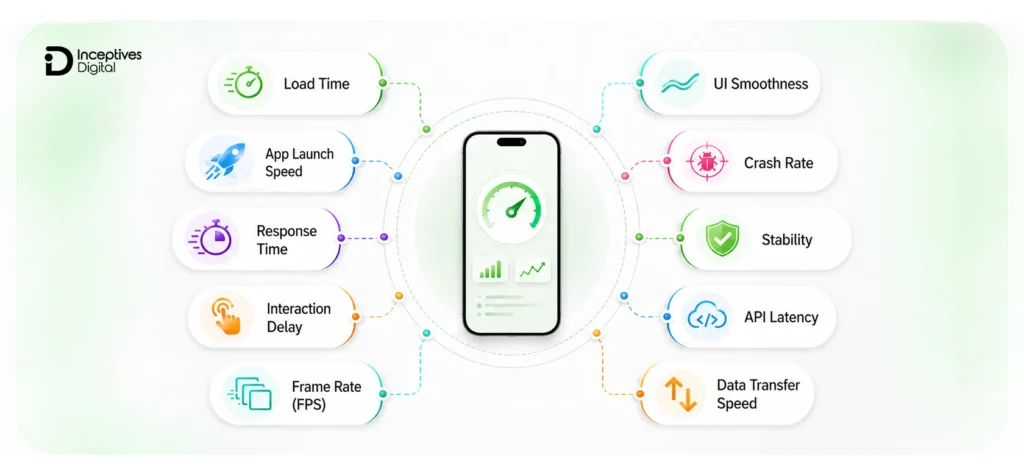
Testing the performance of mobile applications does not require guessing; rather, it requires an approach based on actual measurements. With appropriate measures in place, it will be easy to check whether your application performs well in terms of load time, response time, and consistency across different platforms. This is aimed at ensuring efficiency despite growing usage.
1. Load Time and App Launch Speed
Mobile app loading time is the time it takes for an app to load and become fully functional after tapping its icon. The delay in opening an app is a poor starting point, as it makes users more likely to abandon it. The measures used to improve app loading time include minimizing the app’s size and its startup process.
2. Response Time and Interaction Delay
Response time is the time it takes your application to respond to user input, such as tapping or swiping. This even negatively affects an application’s performance when there’s a slight delay. Response time improvement focuses on making the app respond almost instantly to users without delays.
3. Frame Rate (FPS) and UI Smoothness
Frame rate is described by the number of frames created each second. It influences the speed of object movement in the application. If the frame rate is too low, users will feel lag, which will affect the user interface’s performance. To achieve 60 FPS, applications must optimize rendering pipelines.
4. Crash Rate and Stability
The crash rate is the probability that the software will crash while in use. It may negatively affect users’ trust in the software, thereby increasing installs and negative comments. The only way to reduce the crash rate is to ensure proper coding and software maintenance.
5. API Latency and Data Transfer Speed
Latency in an API is the time between initiating a request and receiving a response from the server. Latency plays a vital role in determining the speed of tasks like user authentication, data retrieval, and transactions in the application; therefore, they become very difficult. There are many ways to upgrade API performance.
Common Issues That Slow Down Mobile Apps
When dealing with mobile applications, the slowdown is not attributed to a single factor but to several factors that may contribute to slowing down at different layers of the application. Knowledge of these problems will help increase the application’s speed.
1. Frontend Bottlenecks
When the front end is overloaded by large asset files, poor coding, or excessive animation use, it is considered a front-end performance problem. Heavy images, inefficient rendering, and poorly designed user interfaces may negatively impact rendering performance.
2. Backend Performance Issues
Problems with backend performance will occur due to high server latency when handling client requests. This can be caused by slow coding, poor API usage, or incorrect server configuration. The functions that might be impacted are sign-in, getting data retrieval from the app, and real-time communication.
3. Database Inefficiencies
Database inefficiency is due to poorly built queries and to the database not being optimized for high-level operations. The lack of indexes, data extraction redundancy, and complex join operations can slow data processing. The content takes too long to load, and the application performs slowly.
4. Network and API Delays
Delays in networks and APIs occur when data transfer from the client to the server takes longer than expected. The causes of delays may include high latency, bigger payloads, or low-quality network connectivity. As a result, application performance will decrease. Activities such as browsing the newsfeed, fetching content, and submitting forms will take a long time.
5. Poor Memory Management
Poor memory management occurs when applications use too many device resources and cannot release unused memory. Such cases can cause applications to perform slowly, freeze, or even fail. Memory leakage caused by leaving processes open or by running too much work in the background will compound the problem.
Mobile App Performance Optimization: Frontend Strategies
Frontend performance directly shapes how fast your app feels to users by affecting their perception of app speed. This means that even if the backend performs well, poor frontend performance will cause lag and delay.
Applying mobile app performance optimization strategies guarantees optimal results.
1. Optimize UI Rendering and Reduce Re-renders
Rendering optimization plays an important role in ensuring smooth application operations. Unnecessary renders, unnecessary state updates, and bad coding practices can cause the application to run slowly. Lifecycle optimization, state optimization, and re-rendering optimization are some techniques that can help software engineers upgrade their apps.
2. Compress Images and Media Assets
Large media files and pictures have been a key reason apps are slow. Compressing media files while maintaining their quality will help minimize application load time and increase rendering speed. Use of modern image formats, implementation of responsive images, and optimization of videos will help in saving spare capacity.
3. Minimize Heavy Libraries
Too much reliance on third-party libraries can make the application large and slow it down. Including more third-party libraries increases load time, memory consumption, and processing time. It is important to replace bulky third-party libraries with compact libraries or native libraries. It is essential to conduct periodic reviews of libraries that may no longer be needed.
4. Lazy Loading and Code Splitting
How do lazy loading and code splitting help improve application efficiency? The two techniques upgrade application efficiency by loading required resources or modules at the right time, thereby loading only what is necessary for the app to perform its functions.
5. Reduce Background Processes and Optimize Tasks
Background operations can drain resources and slow the application’s processing speed if not handled properly. Operations that are not important waste processing time and RAM. Properly scheduling operations by eliminating unnecessary ones will improve efficiency. It guarantees faster operation and battery savings.
Backend Optimization for High-Performance Apps
Performance of the backend infrastructure lies at the heart of any efficient mobile application that is to deliver an excellent user experience. Regardless of how well you design the frontend, a poorly performing backend will be a serious barrier to achieving the necessary performance.
1. API Optimization Techniques
The API’s efficiency is also one of the primary factors affecting an application’s speed. The poor speed of certain functions may slow down processes such as login or content display. There are several ways to speed up an API’s responses by reducing response times. Poorly designed APIs can increase response times even for routine tasks. The best way to improve speed is to optimize the amount of data transferred and the endpoints developers use.
2. Caching Strategies (Redis, CDN)
Caching is one of the best methods for improving the performance of mobile applications by optimizing backend operations and offloading server work. Caching applications like Redis store frequently used data in memory to improve retrieval performance. CDNs deliver static data to users, so there are no repeated requests to servers.
3. Asynchronous Processing
This will increase the software’s efficiency by running long-running tasks asynchronously in the background. The user does not have to wait for tasks such as sending emails to complete before proceeding with other tasks.
4. Scalable Architecture (Microservices vs Monolith)
Selecting appropriate architecture is important because it improves scalability and performance. The monolithic architecture is very simple, but it becomes less effective as applications grow. In contrast, a microservices architecture allows a mobile app tech stack to be partitioned into multiple smaller services, enabling scalability.
5. Load Balancing and Traffic Management
Load balancing is extremely important for keeping servers stable during heavy traffic. User requests from the client are distributed across multiple servers to avoid placing undue pressure on a single system. This helps ensure that the server functions properly without disruptions or lags.
Database Optimization Techniques for Better Speed
Database optimization is a key component when developing applications that are supposed to operate efficiently, since even minor flaws in data storage management can cause severe delays throughout the process. When queries are slow and data is inefficiently stored, the user experience worsens.
Therefore, applying effective techniques for mobile app performance optimization at the database layer ensures fast queries, reduced server load, and scalability as the application scales up. Besides, an optimized database helps process data more efficiently during periods of high workload.
For more, read about other factors that can affect app development cost.
Indexing for Faster Queries
Indexing improves database efficiency by enabling data to be accessed quickly without scanning the entire table. With well-designed indexes, databases become more efficient at finding records, particularly in huge datasets. However, excessive indexing may lead to inefficiencies in writing processes. Indexing should be balanced to achieve maximum efficiency.
Query Optimization Best Practices
Query optimization deals with writing efficient queries. An optimal query should have fewer joins, unnecessary attributes should be eliminated, and query nesting should be kept to a minimum. Sometimes an inefficient query can cause poor performance across the entire database system.
Database Caching
Cache helps minimize the frequency with which you have to query your database for the same data, since it stores results in memory. Redis or another cache can help speed up reading.
Handling Large Data Efficiently
Handling large amounts of data effectively is crucial to maintaining database efficiency. Methods such as pagination, data partitioning, and storing obsolete information can facilitate minimizing query load. Otherwise, large chunks of data may increase query delays. Effective data management will ensure quick access and improve efficiency over time.
Database Normalization and Denormalization Balance
An appropriate mix of normalization and denormalization is needed for database efficiency. With normalization, we avoid duplicate data storage, while denormalization improves query performance by reducing the number of joins. Too much normalization affects query efficiency.
Mobile App Performance Optimization for Better UX
The speed of a mobile application is not only dependent on its actual speed but also on how quickly users perceive their tasks being performed. There may be very fast mobile applications that appear slow because they have not been optimized for user experience.
1. Perceived Performance vs Actual Speed
Performance perceptions focus on how users perceive speed rather than on numbers and statistics alone. While an application may be very fast, if the user cannot see any visible response, it will seem very slow. The trick for developers lies in combining real performance enhancements with perception.
2. Skeleton Screens and Loading States
Using skeleton screens improves the user experience by showing something while the information loads. The process becomes less boring for the user as they can see a preview of what they will ultimately receive.
3. Optimistic UI Updates
An optimistically updated UI enables applications to respond instantly to user actions, regardless of whether the server acknowledges the results. An example of such an action is a post, where the interface updates without the server needing to confirm the action.
4. Smart Content Preloading
Smart content preloading is loading information based on a user’s activity. For instance, applications may preload the next screen or the most frequently used information to reduce wait time. Predicting users actions enables applications to provide information almost immediately.
5. Micro-Interactions and Instant Feedback
Micro-interactions are instantaneous responses that occur when users interact with their applications through actions such as tapping buttons or performing certain activities. It indicates to the user that all is well, regardless of the time required to execute certain actions. Good feedback will help your app run efficiently and quickly.
Tools and Best Practices for Performance Monitoring
Application performance monitoring is important to ensure smooth, reliable operation. If an application’s performance is not monitored, problems cannot be identified before they affect end users.
Performance Monitoring Tools
Choosing the right metrics can be very important when analyzing how an application performs. The main metrics to monitor are loading times, response times, number of crashes, API latencies, and memory consumption. Real-time mobile app performance monitoring tools of the mentioned metrics enable identifying performance issues before they become noticeable to end users. In addition, it helps understand how users interact with the mobile app testing strategies and optimize its performance.
Real-Time Metrics to Track
Proper metric measurement is essential when evaluating application performance. Important metrics to measure may include load time, response time, crash rate, API latency, and memory usage. Measuring these metrics in real time enables early identification of performance issues before they affect end users.
Continuous Optimization Practices
Optimizing the application’s performance is a recurring task rather than a one-time thing. Regularly performing code reviews, performance testing, and mobile app performance monitoring is essential for maintaining performance efficiency. Continuous integration and delivery pipelines, real-world load testing, and updating outdated software are among the best approaches to achieving performance efficiency.
How to Choose the Right Mobile App Development Company?
Choosing the right mobile app development company is an important step in developing an efficient and effective mobile app. With the right partner, not only will your app be developed effectively, but mistakes will be avoided, performance will be optimized, and success guaranteed.
- Examine previous work to gain insights into their level of experience, the quality of their design, and their ability to develop apps similar to yours.
- Verify their competence in frontend, backend, and APIs.
- A reputable company adheres to development methodologies such as Agile to ensure transparency, flexibility, and timely delivery.
- Inquire about their approach to performance optimization from day one.
- Positive customer feedback provides insight into their reliability, communication skills, and success rate.
- Mobile app maintenance and performance optimization are essential for the sustained success of a mobile application.
- Select a team that communicates well, understands your goals, and involves you throughout the project.
- Avoid going for the lowest price.
To Sum This Up
The importance of mobile app performance optimization cannot be underestimated when developing high-speed apps that operate smoothly and are convenient for end users. Improvements can be made at all levels, including the front-end, back-end, and database management system.
Applying the best mobile app performance monitoring software will help you reduce loading times, upgrade responsiveness, and deliver high performance across all devices and under any network conditions.
If you want to achieve sustainable success, you should focus not only on temporary solutions. You need well-thought-out mobile app development cost optimization, continuous mobile app performance monitoring, performance result tracking, and highly qualified specialists. Cooperation with a professional mobile app development company is the key to success.
CTA SECTION START
cta title: Improve Mobile App Performance & Speed
cta des: Boost your mobile app performance with expert optimization techniques to reduce load time, eliminate lag, and deliver a seamless user experience across all devices.
cta button: Optimize Your App Now
CTA SECTION END
Frequently Asked Question about Mobile App Performance Optimization
Mobile app performance optimization is the practice of improving app performance by optimizing the frontend UI, backend systems, APIs, and databases.
An app’s performance affects its usability, user retention, and engagement. Inefficient applications often have high uninstall rates and poor user experiences.
The most effective ways to optimize an application’s performance include image compression, lazy loading, caching, optimizing APIs, database indexing, and memory management.
There are several methods of measuring the performance of an application. These include load time, response time, crash rate, frames per second, API latency, and memory utilization.
Top mobile app optimization companies include Inceptives Digital, Gummicube, Moburst, AppTweak, and Yodel Mobile, specializing in ASO, performance tuning, and mobile growth marketing.
SIDEBAR LIST START
- What Is Mobile App Performance Optimization?
- Key Metrics That Define App Speed and Performance
- Common Issues That Slow Down Mobile Apps
- Mobile App Performance Optimization: Frontend Strategies
- Backend Optimization for High-Performance Apps
- Database Optimization Techniques for Better Speed
- Mobile App Performance Optimization for Better UX
- Tools and Best Practices for Performance Monitoring
- How to Choose the Right Mobile App Development Company?
- Conclusion
- FAQs
SIDEBAR LIST END